
Easy Small Bedroom Ideas That Make Any Room Feel Bigger
By HomeStyledLiving | October 5, 2026
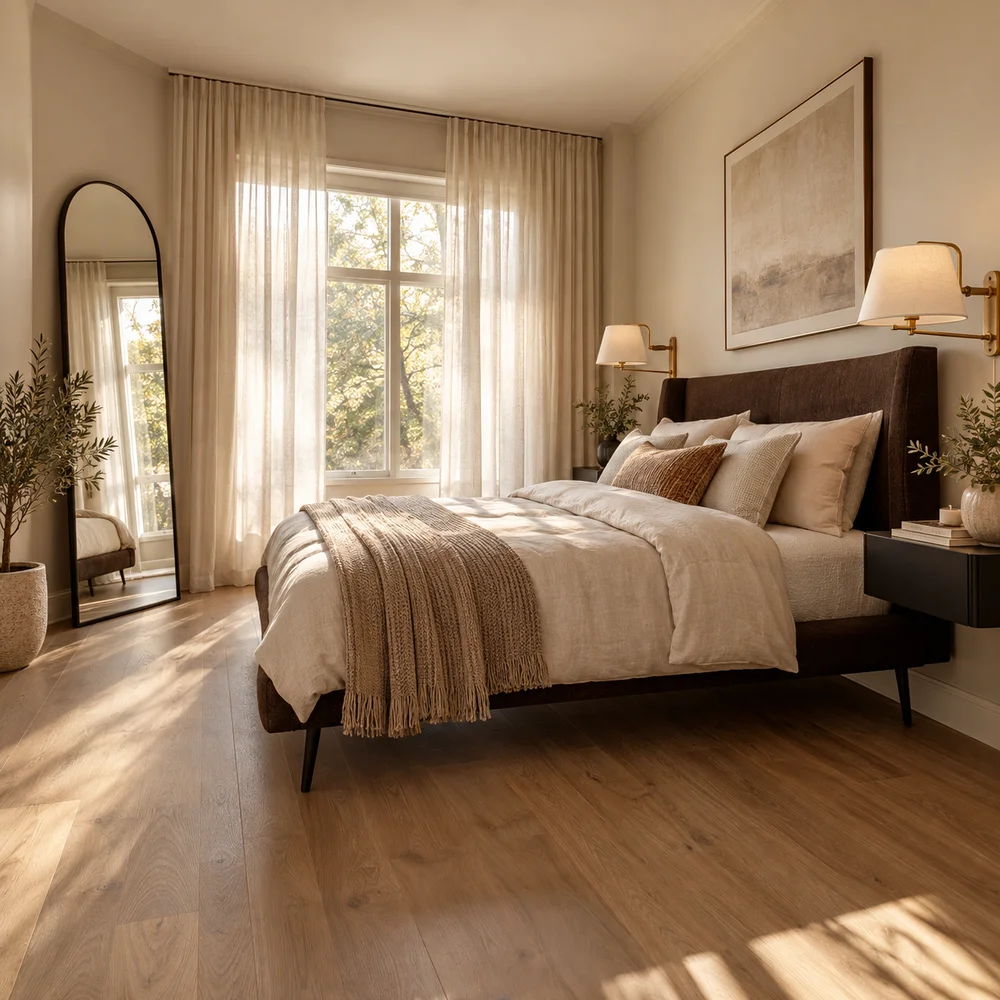
Step into a small bedroom at the end of a long day and you can feel the walls before you see them. The dresser is right there at your elbow, the curtains stop short of the ceiling, the floor disappears under a bed skirt and a basket and yesterday’s sweater, and the whole room seems to end about an arm’s length from where you’re standing. It isn’t only a question of square footage. It’s the sensation of a space that keeps saying no. These small bedroom ideas focus on simple changes that make a room feel more open without sacrificing comfort or personality.
The encouraging part is that a lot of that sensation is perception, and perception is surprisingly easy to change. Your eye measures a room by what it runs into: hard edges where one color stops and another begins, heavy shapes planted on the floor, clutter that forces it to stop and read, windows that are covered instead of open. Every one of those interruptions makes the room read smaller than it really is. Remove enough of them and the same four walls start to feel calm, open, and generous.
That is the thinking behind every idea in this guide. These small bedroom ideas are not about knocking down walls or buying an entirely new room of furniture. They are about three simple moves: removing edges so surfaces flow into one another, extending lines upward and outward so the eye travels further, and giving the floor back so the room has somewhere to breathe. Most of them can be done in a weekend, and several require nothing more than a drill, a level, and a clear afternoon.
The twelve ideas below move from the biggest surfaces — walls, windows, the bed — down to the small daily habits that decide whether a bedroom stays open or quietly fills up again. Each one explains why it works, so you can adapt it to your own room rather than copying a single photograph, and each is paired with one specific piece that shows the idea in practice. Taken together, they add up to a small bedroom layout that feels lighter and more restful without pretending to be something it isn’t.
1. Paint Walls, Trim, and Ceiling in One Soft Shade
 Save it
The fastest way to make a small bedroom feel bigger is to take away the lines that tell your eye where the room ends. In most bedrooms those lines are everywhere: white trim outlining every door and window, a bright white ceiling sitting on top of colored walls like a lid, a contrasting baseboard drawing a border around the floor. Each of those edges is a measuring stick. Your eye finds the corners instantly, calculates the size of the box, and the box feels small.
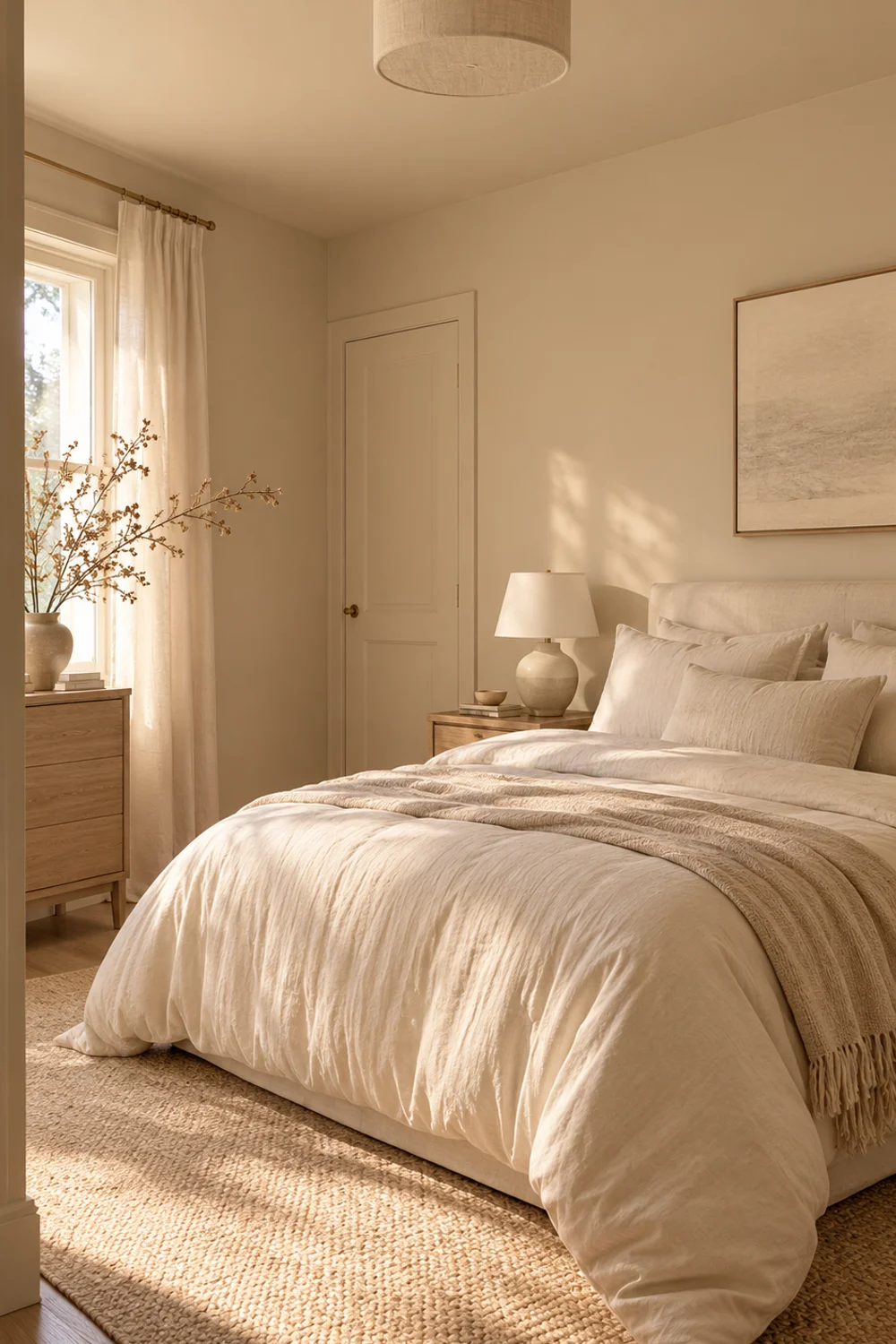
Painting the walls, trim, and ceiling in one soft, pale shade removes most of those measuring sticks at once. Corners soften, the ceiling stops reading as a separate plane, and the room seems to wrap around you rather than frame you. Designers often call this color drenching, but in a small bedroom the goal is quieter than the dramatic, saturated versions you see online. Choose a warm, light neutral — a soft oatmeal, a pale mushroom, a creamy greige — with enough warmth that it doesn’t turn gray and chilly on overcast days.
A few details make the difference. Use a matte or eggshell finish on the walls and ceiling so light spreads evenly instead of bouncing in hot spots, and step up to satin only on the trim for durability, keeping the same color. Test your shade on at least two walls and look at it in the morning and again after dark under your bedside lighting, because a color that glows at noon can look muddy at night. If painting the ceiling feels like a step too far, even matching the trim to the walls removes a surprising amount of visual noise.
Then carry the same tone onto the largest piece of furniture in the room. The bed covers more surface than anything except the walls, and a busy or high-contrast bedspread will reintroduce exactly the edges you just painted out. Bedding in a matching light neutral lets the bed settle into the room instead of sitting in it like a block. A queen comforter set in Light Oatmeal is a straightforward way to do this, because it arrives as a complete set — comforter, sheets, shams, and pillowcases — all in one soft tone.
Having everything in one color also keeps the bed looking finished with almost no effort. There is no pattern to coordinate and no stack of contrasting pillows to arrange, just a calm, tonal surface that continues the walls and lets the room feel wider than it measures.
2. Hang Sheer Curtains From the Ceiling, Not the Window Frame
 Save it
Most curtains in small bedrooms are hung exactly where the window tells you to hang them: a rod screwed a few inches above the frame, panels stopping somewhere around the sill or just brushing the floor. It seems logical, but it quietly shrinks the room. The rod draws a hard horizontal line across the wall at an awkward midpoint, the strip of wall above it chops the vertical height, and the window reads as a small opening rather than a generous source of light.
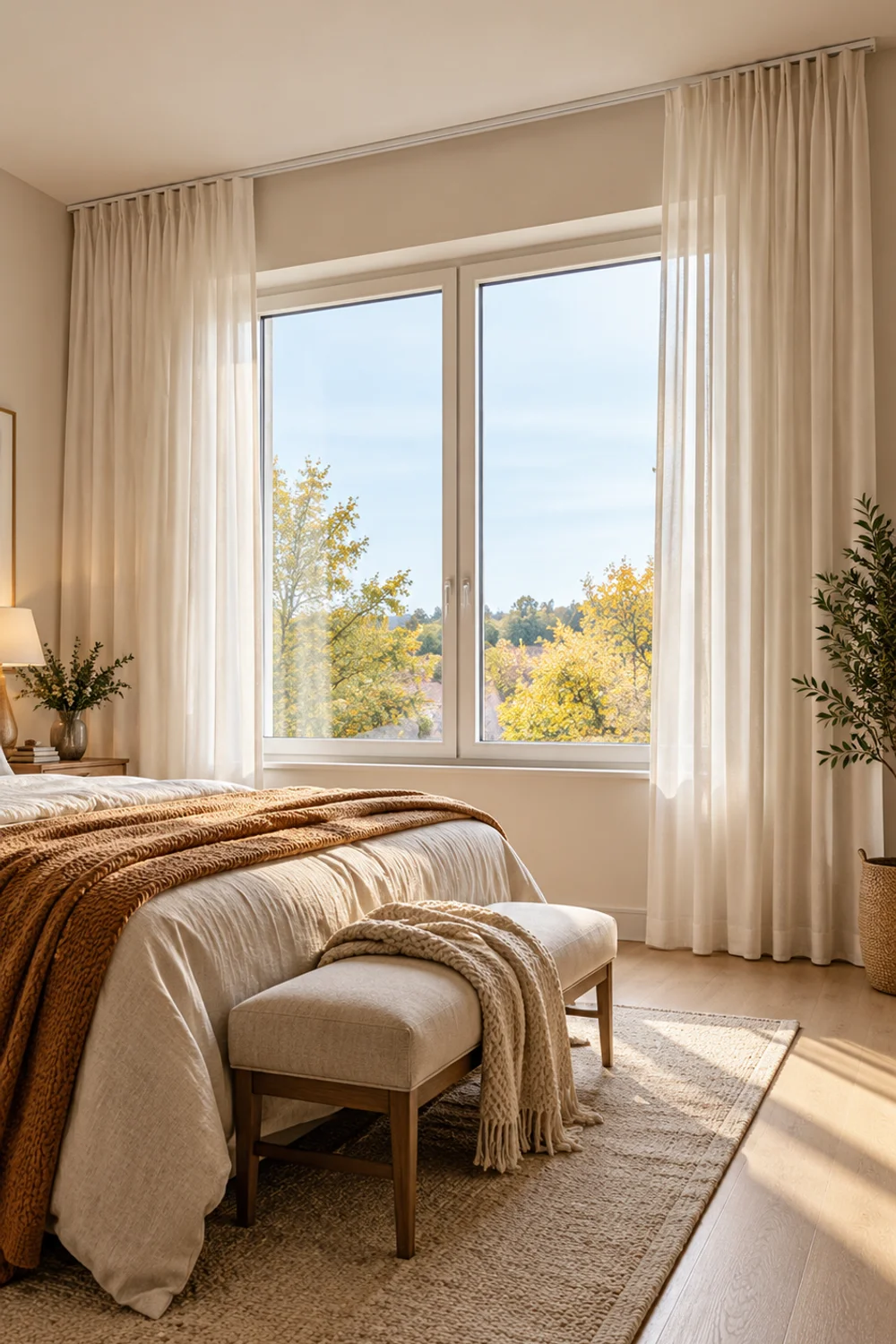
Moving the curtain line to the ceiling changes the proportions of the entire wall. When fabric falls in one uninterrupted drop from ceiling to floor, your eye follows it the full height of the room, and the ceiling seems higher as a result. It’s the same principle that makes vertical stripes lengthen a silhouette: one long, unbroken line reads as more height than two shorter ones stacked on top of each other.
Placement sideways matters just as much. Extend the track well past the window frame on both sides — roughly eight to twelve inches, or more if the wall allows — so the open curtains stack against the wall rather than over the glass. That way the full window stays exposed during the day, the room gets every bit of available daylight, and the window itself looks wider than it is. In a very small room, running the track almost wall to wall creates a soft, continuous backdrop that makes the whole wall feel like a feature rather than a problem.
A ceiling track is the cleanest way to achieve this. Unlike a rod with brackets and finials, it sits flush against the ceiling, so there is no visible hardware breaking the line and no gap where light spills over the top. This ceiling curtain track comes in a 16.4-foot length of aluminum track that can be mounted to the ceiling or the wall, with mounting hardware included, which gives you enough run to cover a wide window or an entire wall.
Installation does involve screws into the ceiling, so if you rent, check your lease first; the small holes are easy to fill when you move out. Measure the height from ceiling to floor before you buy curtains, too. For this idea to work, the fabric should just kiss the floor. Panels that hover a few inches above it reintroduce the very line you were trying to remove.
3. Lean a Tall Mirror Where It Can Catch the Window
 Save it
Mirrors are the most familiar trick for making a small room feel larger, and also the most frequently misused. A mirror doesn’t add space by itself. What it does is borrow light and depth from whatever it faces, and if it faces a blank wall, a cluttered corner, or the foot of the bed, it simply doubles whatever is already there. Placement is everything.
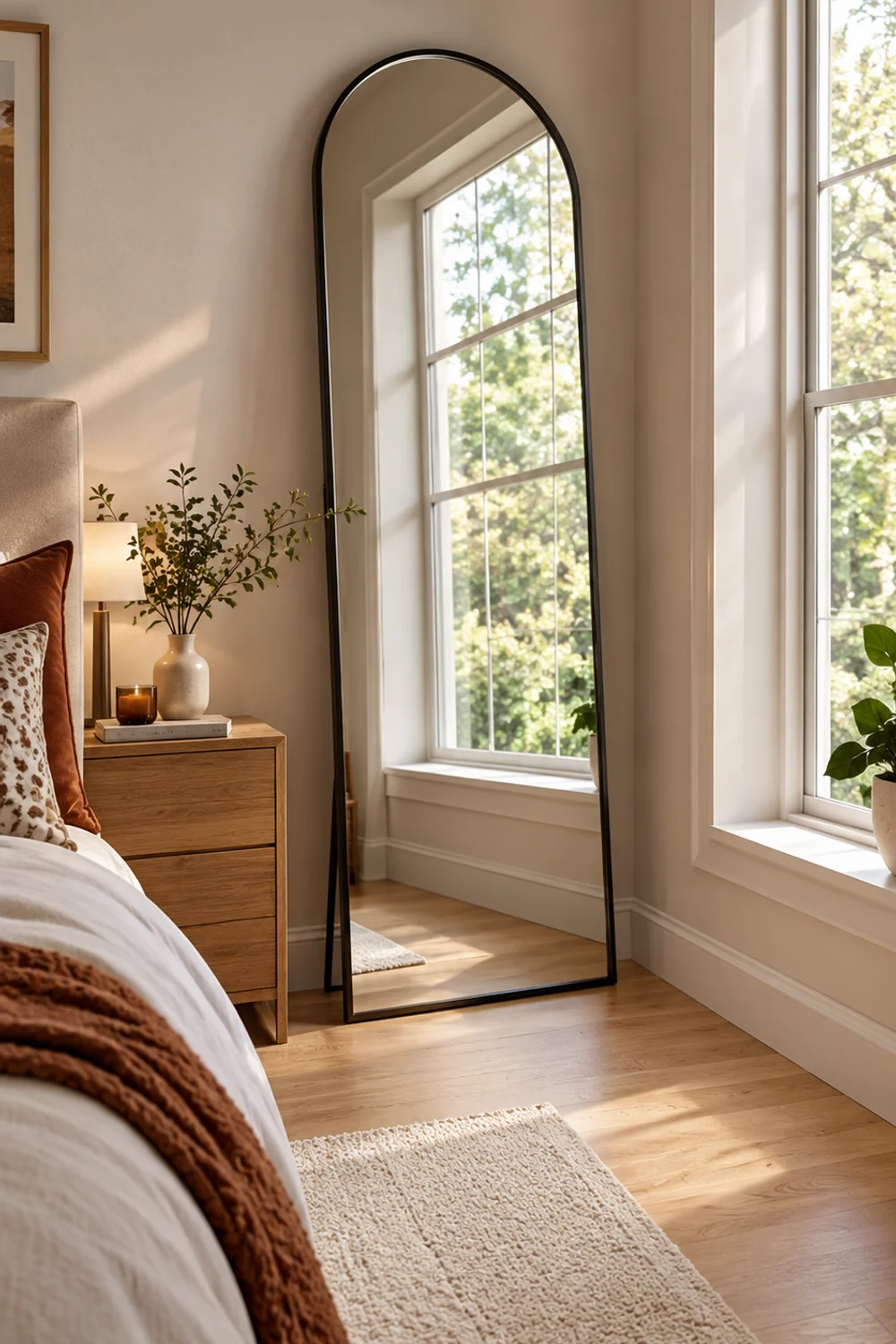
The most effective position is beside a window or on an adjacent wall angled toward it, where the mirror picks up daylight and the view outside and throws both back into the room. The result feels like a second window: the light level rises, the eye reads depth where there is really a wall, and the room seems to extend beyond its footprint. Directly opposite a window can work too, but in a bedroom it can also bounce harsh morning glare onto the bed, so an adjacent wall is often the more comfortable choice.
Size and orientation matter as much as position. A tall, full-length mirror echoes the vertical line you created with ceiling-hung curtains, pulling the eye upward rather than across. One large mirror also works far better than several small ones. A single expanse of glass reads as depth; a cluster of little mirrors reads as decoration and adds visual busyness, which is the opposite of what a small bedroom needs.
This Full Length Arched Mirror at 71 by 26 inches has exactly the proportions this idea calls for. Its height carries the eye toward the ceiling, and the arched top softens the rectangle of the wall, giving the reflection a gentle, window-like shape. The slim black aluminum frame is a subtle graphic outline rather than a heavy border, and the listing notes shatter-proof tempered glass, which is reassuring for something large enough to lean.
Because it can stand, lean, or hang, you can choose based on your room. Leaning it against the wall creates a relaxed, editorial look and requires no nails, but anything this size should still be secured with an anti-tip strap or wall anchor, especially if children or pets share the space. Keep the floor directly in front of it clear so the reflection shows open floor rather than a laundry basket; what the mirror reflects is just as important as where it hangs.
4. Raise the Bed on Slim Legs So the Floor Keeps Going
 Save it
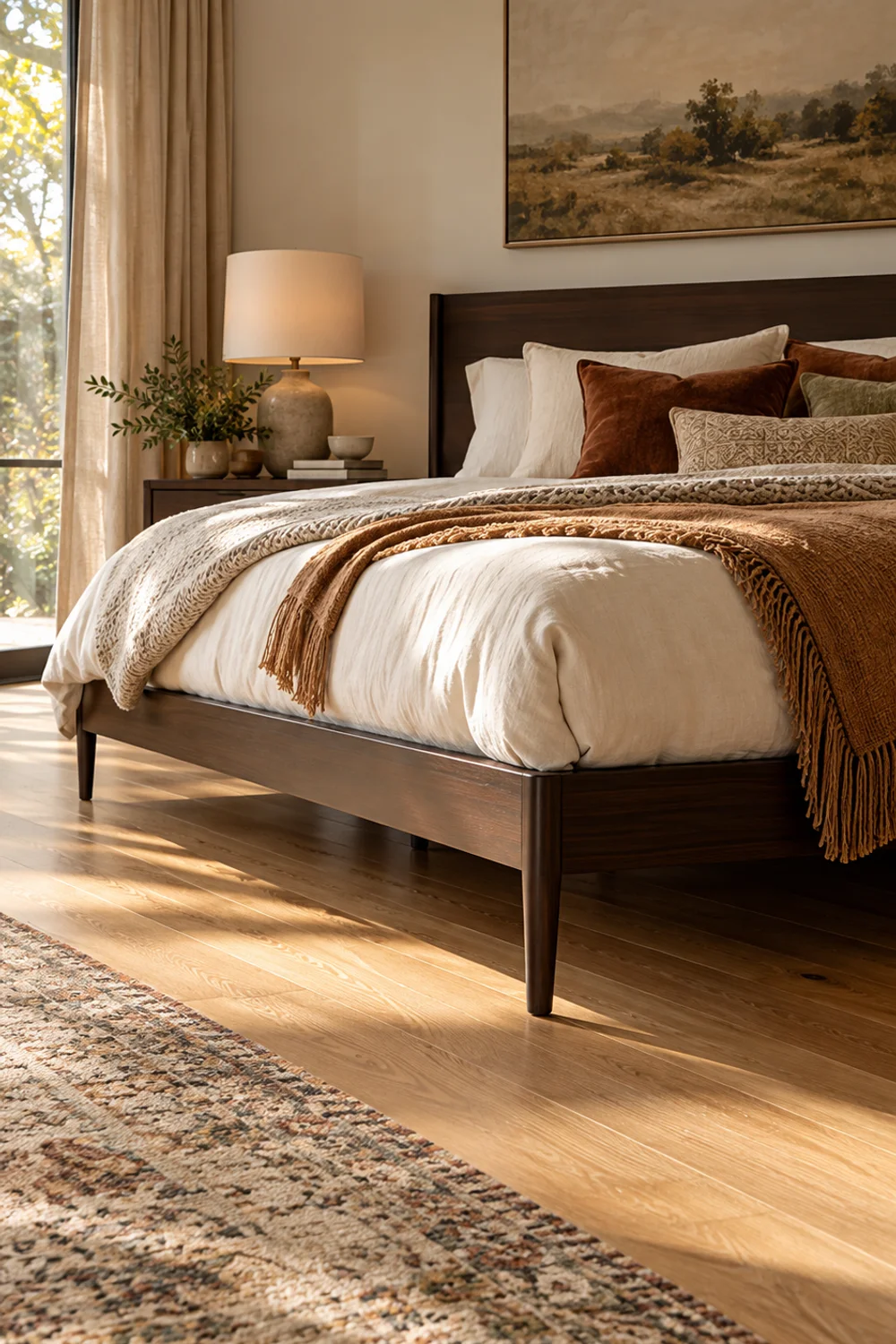
In most small bedrooms the bed takes up more floor than every other piece of furniture combined, which means it has an outsized influence on how big the room feels. A bed that sits directly on the floor — a solid base, a storage platform boxed in to the ground, or a frame hidden under a long bed skirt — reads as one heavy, immovable block. The floor stops at its edge, and the room seems to end there.
Lifting the bed onto legs lets the floor continue underneath it. Even a modest band of visible floor tells your eye that the room keeps going past the bed, and the space below it becomes part of the room rather than a dark cavity. Light travels further, shadows are softer, and the bed looks as though it rests in the room rather than being wedged into it. It is the same reason leggy furniture always feels lighter than furniture that sits flat on the ground.
The frame itself should be visually simple. Clean lines, a slatted base, and no bulky footboard keep the foot of the bed open, which matters in a tight room where you walk past it every day. This queen bamboo platform bed in Espresso follows that mid-century logic: a streamlined frame on legs with wood slat support, so it needs no box spring and keeps the overall profile trim.
Its tall headboard is worth thinking about rather than avoiding. In a small bedroom, a tall headboard behaves like a piece of architecture on the wall — it pulls the eye upward and gives the bed a clear focal point, so the room doesn’t need artwork, shelves, and decorations to feel finished. The espresso finish also works as a single dark anchor against the soft, light walls from the first idea. One grounded, confident piece reads as intentional; several dark pieces scattered around the room would make it feel crowded.
The one rule that makes this idea work is keeping the space under the bed clear. It’s tempting to fill every inch with bins, but a row of boxes under the bed rebuilds the solid block you were trying to lift. If you need under-bed storage, limit it to one or two low, matching containers pushed to the center, so the floor stays visible around the edges where the eye actually lands.
5. Float the Nightstands Off the Floor
 Save it
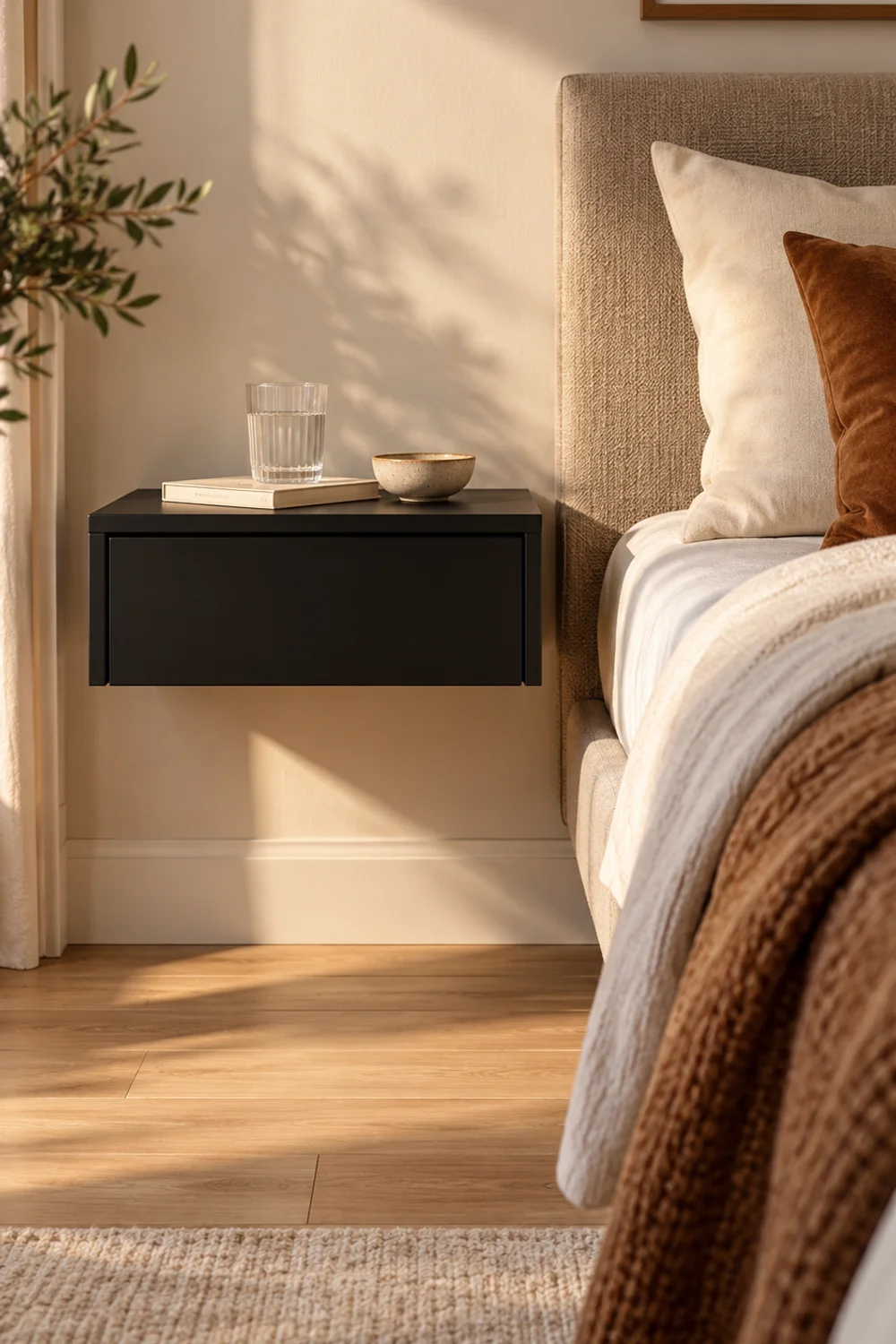
Nightstands are small, but in a small bedroom they occupy some of the most valuable real estate in the room: the narrow strip between the bed and the wall, the very first stretch of floor you see beside the bed. Traditional nightstands fill that strip completely, with four legs or a solid base planted on the floor and a boxy silhouette that crowds the sides of the bed.
A floating nightstand mounts directly to the wall, leaving the floor below it completely open. The visual difference is larger than you might expect. The floor runs uninterrupted from wall to bed, the corner of the room stays visible, and the bedside feels airy rather than packed. It also makes cleaning easier, since there are no legs to work around, and it frees the floor for a pair of slippers or a small basket if you need it — though leaving it empty looks best.
When choosing one, think about what you actually keep by the bed. A single drawer is often more useful than open shelves, because it hides the chargers, hand cream, and reading glasses that would otherwise sit on top and create clutter. The Modern Black Floating Nightstand with Drawer is a good example: a compact, minimalist shelf with one drawer, sized for small spaces and easy to mount.
The black finish might seem counterintuitive in a room you’re trying to make feel lighter, but a small dark shape against a pale wall reads as a crisp graphic accent rather than a heavy mass. Because it floats, the floor beneath it stays light, and the contrast gives the soft, tonal room a little definition so it doesn’t feel washed out. Pair it with one other dark element — the bed frame or the mirror — so the black feels repeated and deliberate.
Mounting height is what makes a floating nightstand comfortable to use. Aim for the top surface to sit roughly level with, or an inch or two below, the top of your mattress, so reaching for a glass of water at night feels natural. Use proper wall anchors or screw into a stud, since this surface will be used daily. And resist the urge to cover the top: a lamp is unnecessary if you follow the next idea, which leaves room for just a book, a glass, and your phone.
6. Move the Lighting Onto the Walls
 Save it
Table lamps are one of the quiet reasons small bedrooms feel crowded. A lamp takes up most of a nightstand’s surface, its shade sits at eye level where it blocks the view across the room, and its cord trails down the side of the furniture to an outlet. Multiply that by two and the bedside area is full before you’ve placed a single personal object.
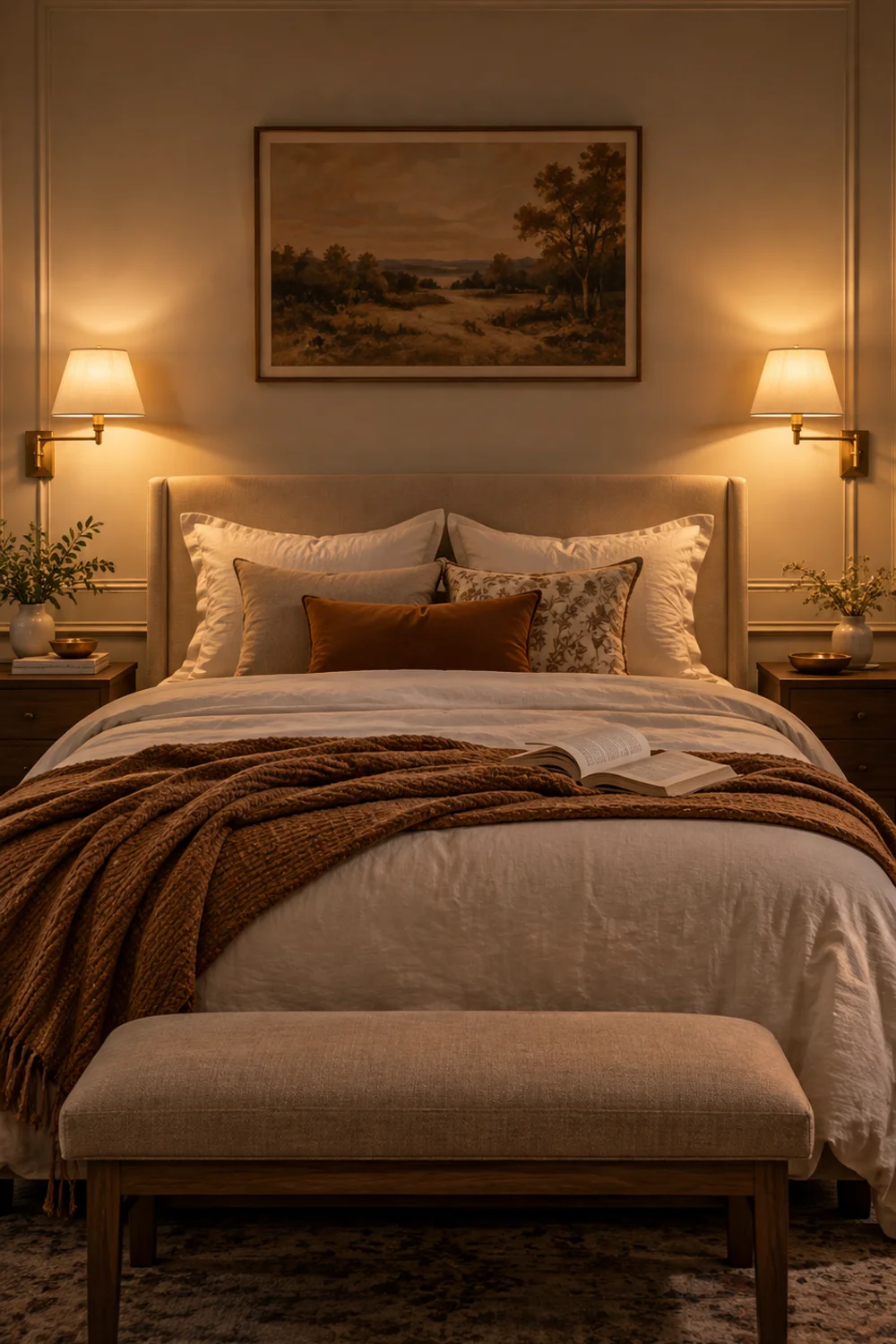
Moving the light onto the wall solves all three problems at once. Wall sconces free the entire nightstand surface, take the lamp shade out of your line of sight, and lift the light to a height where it washes down the wall rather than pooling on a tabletop. In a small room, light that spreads across a vertical surface makes that wall recede slightly, so the space feels wider and softer, especially in the evening when overhead lighting can feel harsh.
Plug-in sconces make this easy even if there’s no wiring behind the bed. This plug-in swing arm wall sconces come as a set of two with creamy white linen shades and a gold finish, and they can be used plug-in or hardwired. Having a matching pair on either side of the bed gives the room a calm, balanced symmetry, which helps a small space feel ordered rather than improvised.
The swing arm is more than a style detail. It lets you pull the light toward you for reading and push it back flat against the wall when you’re done, so the fixture takes up almost no space when it isn’t in use. The linen shades diffuse the bulb into a soft, warm glow rather than a bright spot, which is exactly the kind of light that makes a bedroom feel restful at night. Choose warm bulbs, around 2700K, to keep that glow consistent with the soft palette of the room.
Placement takes a little measuring. For reading in bed, mount the sconces so the bottom of the shade sits a little above your shoulder height when you’re sitting up against the headboard, and roughly in line with the outer edge of the mattress so the light falls on your book rather than behind your head. Mount both at exactly the same height; in a small room, even a slight mismatch is noticeable.
7. Choose One Narrow Dresser Instead of a Long Low One
 Save it
The long, low dresser is a staple of bedroom furniture sets, and it is one of the worst choices for a small room. It stretches across most of a wall, sticks out into the walking path, and creates a broad horizontal band that visually shortens the room. Its wide top also becomes a landing zone for everything that doesn’t have a home, which adds clutter to an already crowded surface.
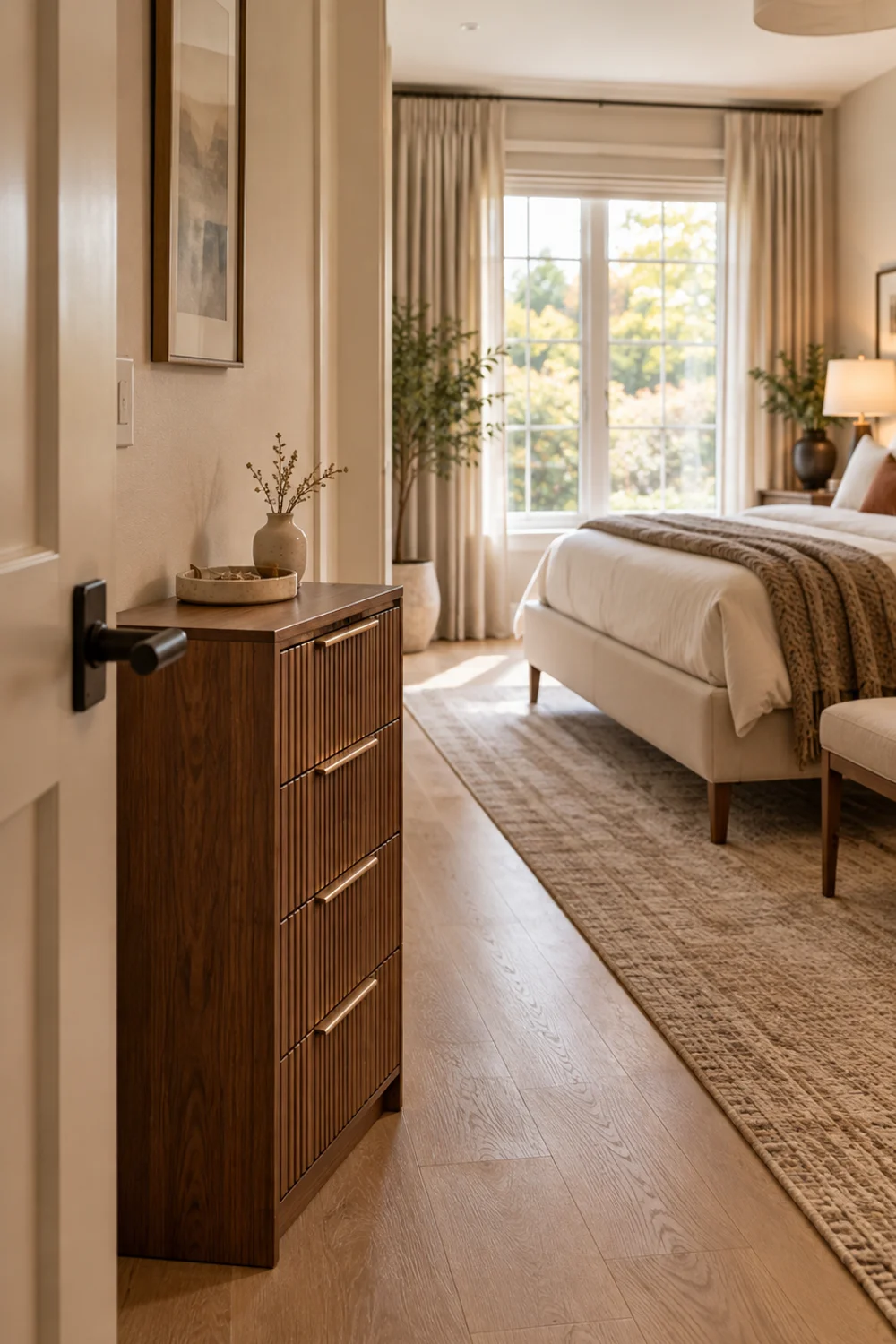
A narrow dresser does the same essential job with a fraction of the footprint. Its compact width leaves more of the wall visible and more floor open around it, and the smaller surface on top naturally limits how much can accumulate there. In a small bedroom, choosing less furniture surface is often the most effective way to keep clutter under control, because clutter always expands to fill the space available.
Where you place it matters as much as its size. Put the dresser on the same wall as the door, or just beside it, so that when you step into the room your eye lands first on open space — the window, the bed, the mirror — rather than on a piece of furniture right in front of you. This simple change in the room’s layout makes the first impression noticeably more open, which shapes how large the whole room feels.
The Walnut Fluted 4-Drawer Dresser, at 23.6 inches wide, 14.9 inches deep, and 30.7 inches high, is scaled for exactly this kind of spot. It is compact enough to tuck beside a door or into a narrow wall section, and its shallow depth keeps it from pushing into the walkway. The fluted drawer fronts give it texture and a sense of craftsmanship, so a small piece still feels substantial and considered rather than temporary.
The vertical fluting has a subtle visual benefit too. Those repeating lines draw the eye up and down rather than side to side, echoing the vertical emphasis of ceiling-high curtains and a tall mirror. The walnut tone adds warmth alongside the espresso bed without matching it exactly, which keeps the room from feeling like a furniture set.
Four drawers won’t hold as much as a six-drawer dresser, so before buying, edit your clothes honestly and move off-season pieces elsewhere. Any furniture with drawers should also be anchored to the wall with an anti-tip kit, particularly in homes with children.
8. Let Clear Acrylic Furniture Take the Extra Jobs
 Save it
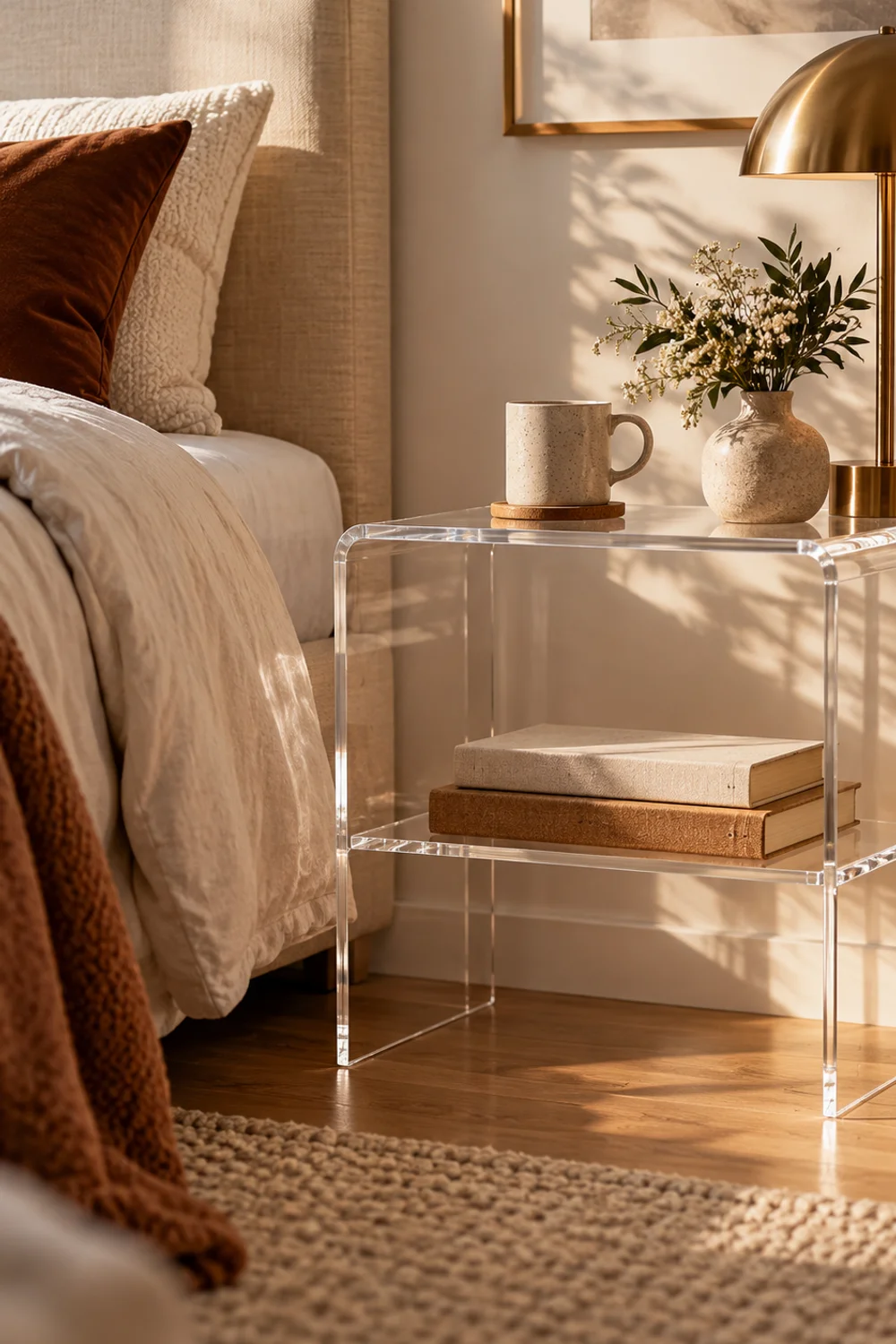
Every bedroom collects small furniture needs: a place to set down a mug beside a reading chair, a second bedside surface on the side without a wall, a spot to rest a bag or a folded blanket. Each solution usually means adding another solid object to the floor, and in a small room those extra pieces add up quickly. Individually they’re minor; together they fill the floor and make the room feel cluttered.
Clear acrylic furniture gives you the surface without the visual weight. Because you can see straight through it, the floor, the rug, and the wall behind remain visible, and the piece reads as barely there. Your eye registers the function — a place to put things — without registering a new block of mass. It’s one of the few ways to add furniture to a small bedroom without the room feeling fuller.
The trick is restraint. One acrylic piece looks intentional and refined; several start to look like a showroom and lose the effect entirely. Use it for the job that would otherwise require the bulkiest solution — a nightstand on the side of the bed where a floating shelf won’t work, or a side table beside a chair near the window. This acrylic bedside nightstand is a good example, with a clear surface on top and an additional shelf below for a few books or a small basket.
That lower shelf is worth using thoughtfully. Because the table is transparent, whatever sits on it is fully on display, so keep it to a couple of neatly stacked books or one attractive object. Anything jumbled becomes more visible, not less, on clear furniture.
Acrylic also reflects light slightly along its edges, which adds a soft glow near a window or under a wall sconce. It pairs especially well with warm wood and natural fabrics, which keep it from feeling cold or clinical. To keep it looking its best, clean it with a soft microfiber cloth and a mild soap solution rather than paper towels or ammonia-based glass cleaners, which can leave fine scratches and cloudiness over time.
9. Fold a Desk Into the Wall
 Save it
For many people, the bedroom has to be more than a place to sleep. It’s also the only quiet spot for answering emails, paying bills, or working from home a few days a week. But a permanent desk in a small bedroom is a constant intrusion: it takes a corner of floor, it carries a pile of papers and a laptop at all hours, and it keeps the room in work mode long after the working day has ended.
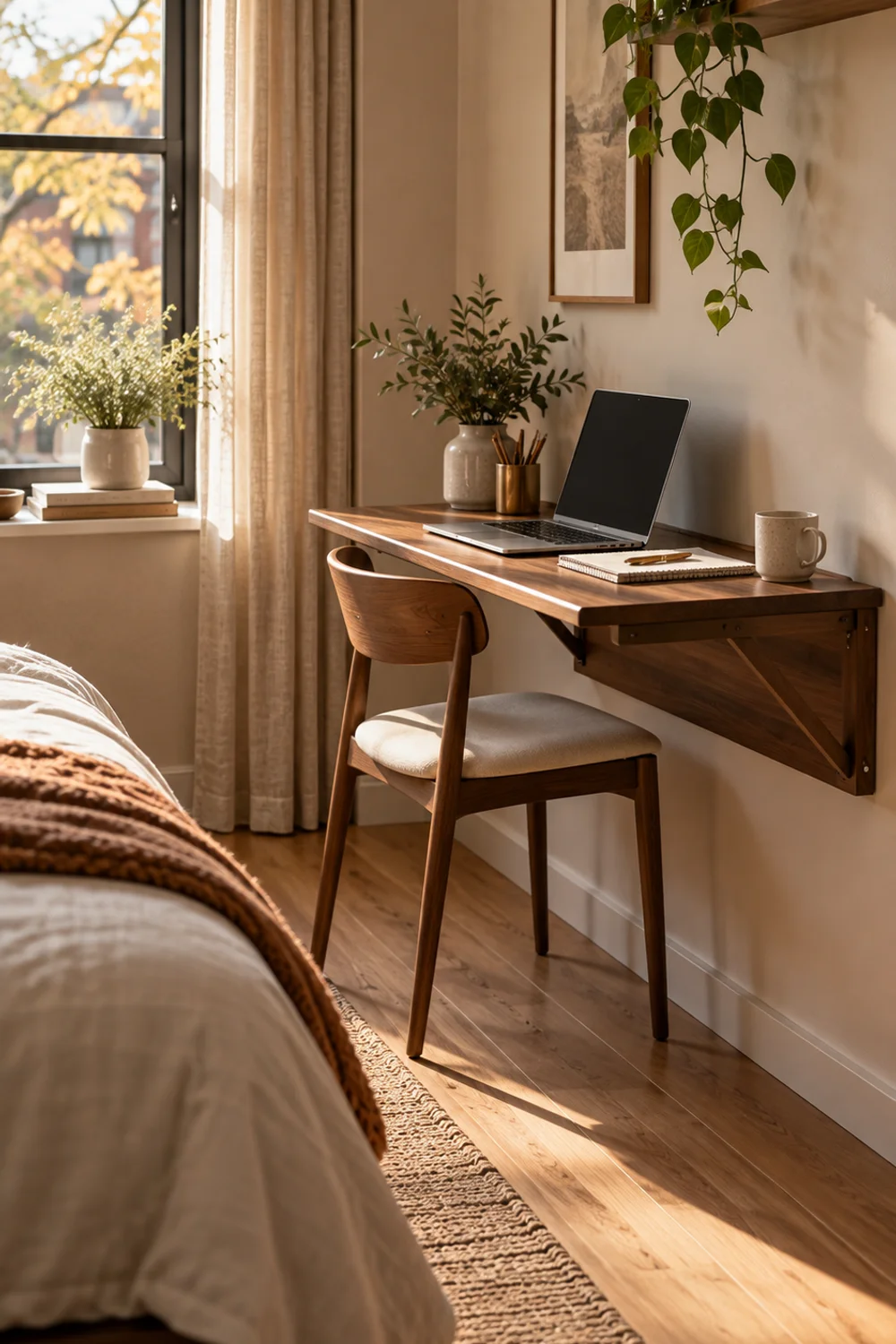
A wall-mounted folding desk solves both the space problem and the mental one. When you need it, the leaf drops down to create a real work surface; when you’re done, it folds flat against the wall and the room returns to being a bedroom. That daily transformation matters. A desk that disappears in the evening removes a visual reminder of unfinished tasks from the space where you’re trying to rest, and it gives back the floor at the same time.
The Wall Mounted 31-inch Folding Drop Leaf Desk in walnut is a good fit for this kind of room. At 31 inches wide, it offers a practical surface for a laptop and a notebook without dominating a wall, and when folded it becomes a slim panel rather than a piece of furniture. The walnut finish ties in with the dresser, so the room’s wood tones feel coordinated rather than random.
Location is important. The best spot is often near the window, where natural light is best for working, or on a stretch of wall that would otherwise be unused. Mount it at standard desk height, around 28 to 30 inches from the floor, and pair it with a compact chair or stool that can slide fully underneath or be moved to another spot when the desk is closed. A folding chair hung on a hook is the most space-saving option of all.
Discipline makes this idea work. Keep only the essentials near the desk — a laptop, a charger, one notebook — and put them away each evening when you fold it closed. If the desk surface becomes a permanent storage spot, it stops folding, and you’re back to having a fixed desk in a small room. Mounting requires screws into the studs or proper anchors, since it needs to support your arms and equipment.
10. Hang One Statement Mirror Instead of a Gallery Wall
 Save it
Gallery walls are beautiful in large rooms, but in a small bedroom they work against you. Every frame introduces four new edges, every image asks the eye to stop and look, and a wall full of small pieces becomes one of the busiest surfaces in the room. Instead of making the space feel curated, a gallery wall can make it feel crowded — which is precisely the feeling you’re trying to remove.
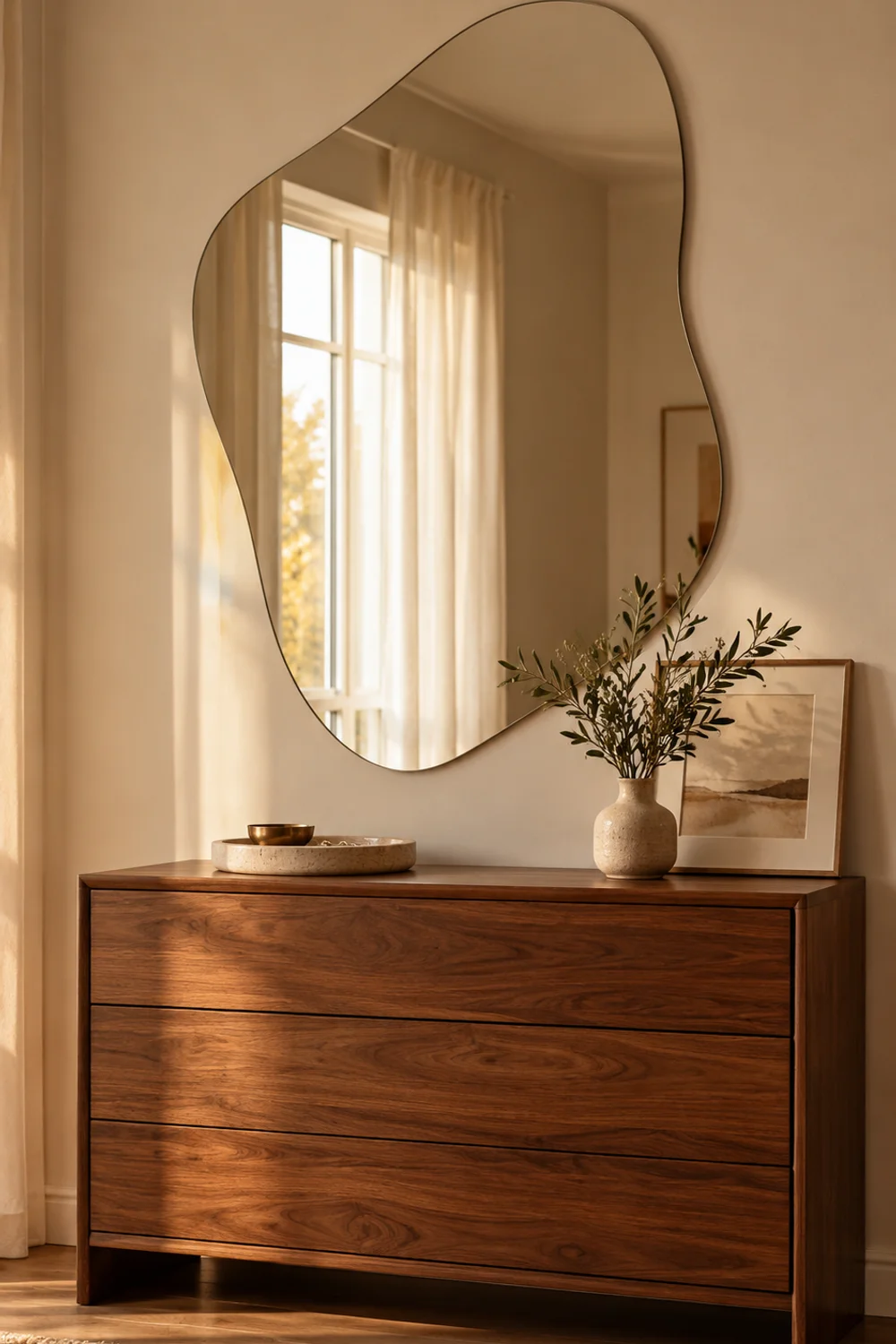
Replacing many small pieces with one statement piece gives the wall a single, calm focal point. Your eye rests on it rather than jumping from frame to frame, and the empty wall around it becomes part of the composition. In a small bedroom, that surrounding breathing room is what makes the piece feel important and the room feel intentional.
A decorative mirror is a particularly clever choice for this role, because it does two jobs. It works as art, giving the wall a strong visual anchor, and it adds a second, smaller source of reflected light and depth to the room. This differs from the tall mirror by the window, which is there to borrow daylight; a statement mirror is there to replace clutter with a single sculptural shape. The 32 by 18 inch Irregular Asymmetrical Wall Mirror suits this purpose well, with an organic, free-form outline and HD tempered glass that reads as modern and artful rather than purely functional.
Its asymmetrical shape is what makes it feel like art. A rectangular mirror above a dresser tends to look like a practical fixture, while an irregular outline has movement and personality, softening a room that’s otherwise full of straight lines from furniture, windows, and doors. Frameless glass also means no heavy border, so the mirror feels light even as the main focal point.
The best spot is usually above the narrow dresser. Hang it so the bottom edge sits roughly six to ten inches above the dresser top, and keep the surface beneath it minimal — a small tray or a single object — so the arrangement stays calm. Think about what the mirror reflects from its position: ideally the window, the soft curtains, or open wall, rather than the bed or a busy corner. And if you have artwork you love, there’s no need to give it up entirely; lean one favorite piece on the dresser beside the mirror rather than covering a whole wall with frames.
11. Give the "Chair Pile" a Wall-Mounted Home
 Save it
Almost every bedroom has one: the chair, the corner, or the end of the bed where clothes pile up. It’s the jacket you’ll wear again tomorrow, the jeans that aren’t quite ready for the wash, the bag you’ll grab on your way out. None of it belongs in the closet yet, so it lands wherever there’s space. In a small bedroom, that pile is often the single biggest source of visual clutter, and it tends to grow until it takes over a chair or covers half the bed.
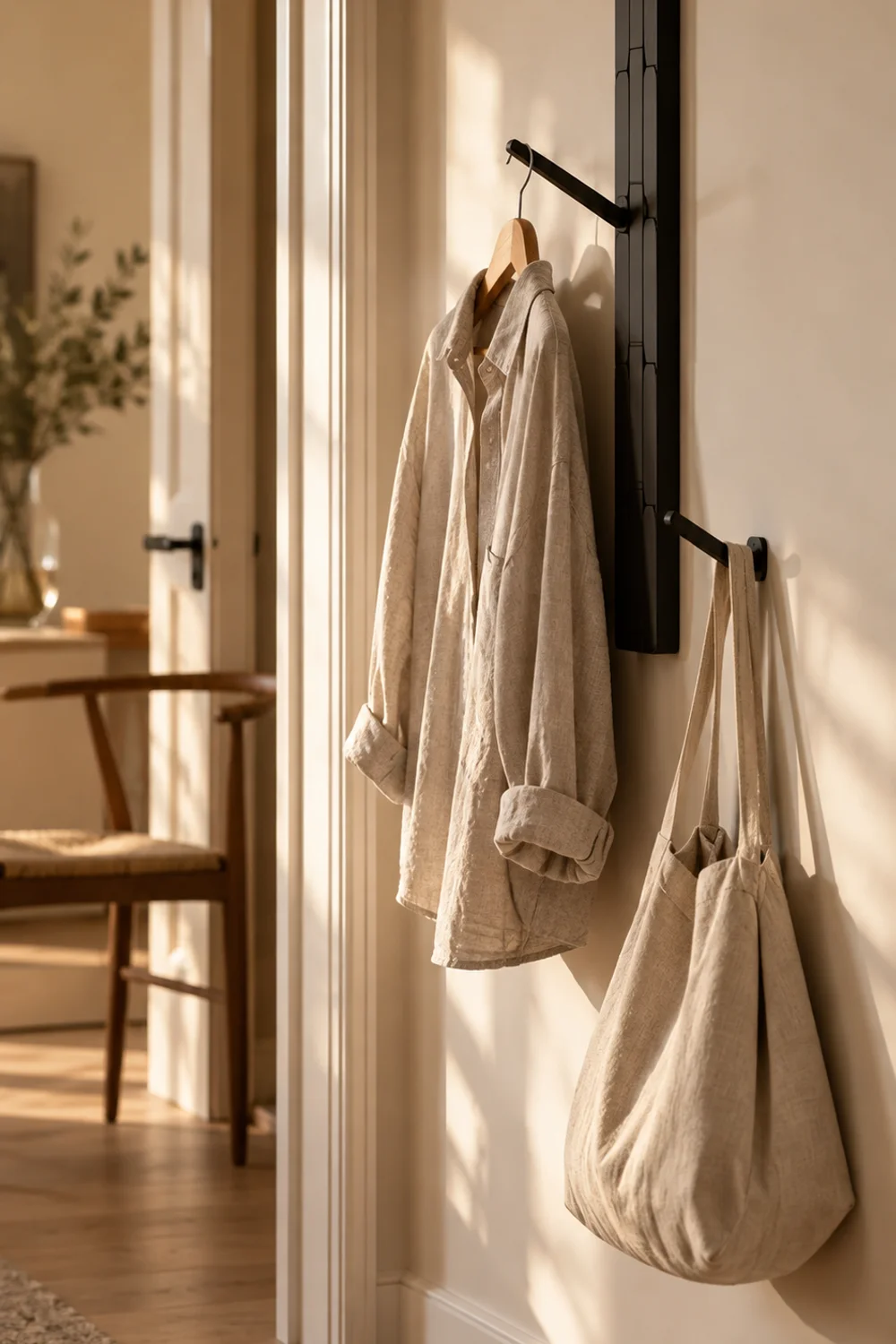
The solution isn’t more willpower. It’s giving those in-between clothes a designated home that’s easier to use than the chair. Wall hooks placed where you naturally undress give tomorrow’s outfit a place to hang, keep the floor and furniture clear, and let your clothes air out rather than wrinkle in a heap. Because they’re mounted on the wall, they take up no floor space at all.
The challenge with most hooks is that they stick out from the wall even when they’re empty, which in a small room adds visual noise and something to bump into. A wall mount coat rack solves this cleverly: its five pegs retract into the board, so you can open only as many as you need and fold the rest flat. When they’re all closed, it reads as a slim, sculptural line on the wall rather than a row of hardware.
The black finish connects with the floating nightstand and the mirror frame, repeating that graphic accent around the room so it feels planned rather than scattered. Mount it beside the bedroom door, on the wall behind the door’s swing, or on a narrow stretch of wall near the closet — wherever you currently drop clothes. The hook works only if it’s more convenient than the chair.
Set a simple rule to keep it effective: the pegs are for items you’ll wear again within a day or two, not long-term storage. When everything is out of use, fold the pegs back in. This small habit is one of the most effective small bedroom decor decisions you can make, because it protects all the other work you’ve done. A room with open floor, soft light, and calm walls still feels small if every surface is covered with clothes.
12. Let Linen Sheers Filter the Light Instead of Blocking It
 Save it
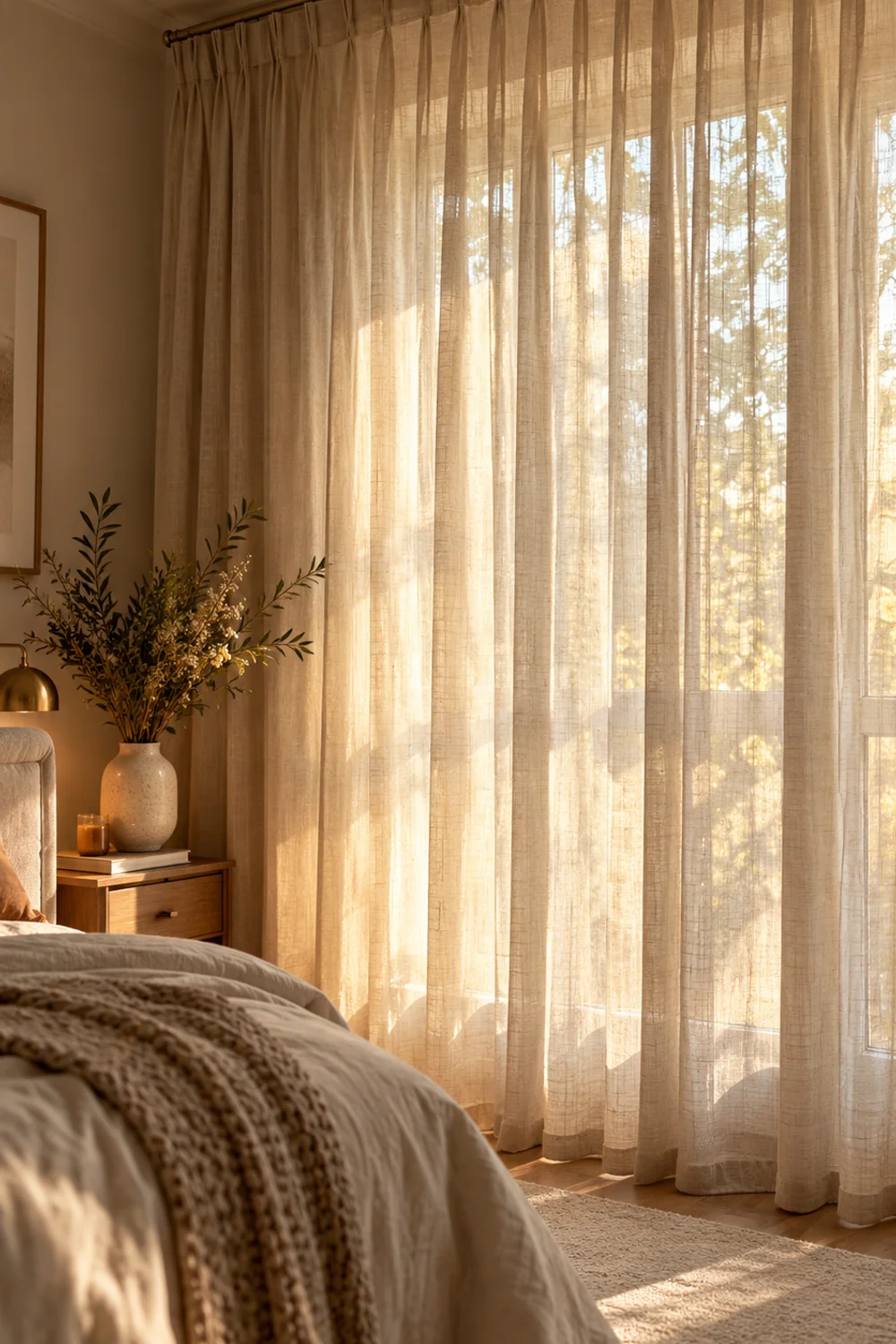
Hanging curtains from the ceiling changes the proportions of the wall; the fabric you choose determines how the room feels in daylight. Heavy, opaque curtains block light even when they’re partly open, and their dense folds become a thick, dark mass at the edges of the window. In a small bedroom, that mass visually closes in the room, and drawn curtains turn the window into a solid wall.
Sheer linen curtains do the opposite. Instead of blocking daylight, they filter it, turning strong sun into a soft, diffused glow that fills the whole room evenly. The window remains a source of light even with the curtains closed, and the fabric itself seems to glow, adding a luminous layer rather than a heavy one. You still get privacy during the day and softened glare, but the room keeps its brightness and sense of openness.
Texture is part of the effect. Linen, with its natural slubs and slightly irregular weave, gives sheers a soft, relaxed look that feels warm and lived-in rather than stiff or synthetic. A Pleated Linen Curtains in Natural are a good example: light-filtering, 90 inches long, sold as a set of two panels with hooks included. The pinch pleats create even, tailored folds that stack neatly at the side of the window and fall in consistent vertical lines.
Those tailored pleats matter in a small room. Loose, gathered curtains can look bulky and untidy, while evenly spaced pleats keep the fabric orderly and reinforce the vertical lines that make the ceiling feel higher. The hook design also works well with a ceiling track, so the panels glide easily and hang cleanly from the top. Before ordering, measure your ceiling-to-floor height carefully; if your drop is longer than the panel length, you may need to adjust the track height or choose a longer size so the fabric still reaches the floor.
The natural color is intentional as well. It blends with the soft neutral walls rather than standing out against them, so the curtains become part of the room’s background instead of a separate element. If you need darkness for sleep, layer a simple blackout roller shade inside the window frame behind the sheers. During the day, it disappears completely, and the linen remains the soft, glowing surface that defines the room.
Common Mistakes
1. Hanging dark, heavy curtains at window height
Heavy drapes on a rod just above the frame make a small bedroom feel smaller in two ways at once. The rod creates a hard horizontal line across the middle of the wall, and the dense fabric closes in the window even when it’s open. Moving the curtain line to the ceiling and choosing light, filtering fabric reverses both effects.
2. Scattering many small mirrors and decorations around the room
Small objects multiply visual noise. A cluster of little mirrors, several framed prints, and a collection of accessories on every surface give the eye dozens of places to stop, making the room feel busy and cramped. A few larger, deliberate pieces — one tall mirror, one statement mirror — create a calmer, more spacious feeling than many small ones.
3. Pushing every piece of furniture against the walls without thinking about sightlines
Lining the walls with furniture seems like the best way to open the middle of a room, but what matters more is what you see first. If the first thing visible from the doorway is a dresser or a desk, the room feels blocked. Place taller or bulkier pieces on the door wall and keep the view toward the window as open as possible.
4. Filling the space under the bed with storage
Under-bed storage seems like free space, but a solid row of bins rebuilds the heavy block that a raised bed is meant to remove. The floor disappears again, and the room loses its sense of depth. If you need extra storage, use one or two low containers in the center and keep the edges visible.
5. Choosing furniture that’s too large for the room
Oversized dressers, bulky upholstered footboards, and deep nightstands can overwhelm a small bedroom even when the room technically fits them. Measure walkways before buying, aim for at least two feet of clearance around the bed where possible, and choose narrower, lighter pieces that leave floor and wall visible.
Frequently Asked Questions
What color makes a small bedroom look bigger?
Soft, light neutrals — warm whites, oatmeal, pale greige, or mushroom — generally make a small bedroom feel larger because they reflect light and reduce contrast. Painting the walls, trim, and ceiling in the same shade softens the corners so the room feels less boxed in.
Where should I put a mirror in a small bedroom?
Place a large mirror beside a window or on a wall angled toward it, where it can reflect daylight and the view outside. Avoid placing it where it reflects clutter or the foot of the bed, and choose one large mirror rather than several small ones.
Should curtains touch the floor in a small bedroom?
Yes. Curtains that hang from the ceiling and just touch the floor create one continuous vertical line, making the ceiling look higher. Curtains that stop above the floor or at the sill interrupt that line and can make the room feel shorter.
Can dark colors work in a small bedroom?
They can, but they work best as accents rather than the main color. A dark bed frame, a black nightstand, or a slim black mirror frame can add definition to a light room. Covering several large surfaces in dark colors, however, usually makes a small bedroom feel more enclosed.
What is the best bed for a small bedroom?
A bed raised on legs, with a simple frame and no bulky footboard, usually works best, because it lets the floor remain visible beneath it. Keep the space under the bed as clear as possible to preserve that sense of openness.
Final Thoughts
A small bedroom will never become a large one, and it doesn’t need to. What it needs is fewer interruptions: fewer hard edges, fewer heavy shapes planted on the floor, fewer piles competing for your attention. When the walls flow into the ceiling, the curtains rise from the ceiling to the floor, the bed and nightstands lift away from the ground, and the light moves up onto the walls, the room stops feeling like a box and starts feeling like a retreat.
If you’re not sure where to begin, start with the two changes that affect the most surface: the paint and the curtains. They set the tone for everything that follows. Then work gradually through the furniture and the daily habits, giving each new piece a clear job and a reason to be there. The result won’t just look bigger in photographs. It will feel calmer to walk into, easier to keep tidy, and far more restful at the end of the day.
This post contains affiliate links. I may earn a small commission at no extra cost to you. As an Amazon Associate I earn from qualifying purchases.

GET YOUR FREE CHECKLIST
A More Organized Home
Starts Here
Join the community and my free Home Organization Checklist, plus weekly tops and inspiration.
Thank you!
You have successfully joined our subscriber list.