

Small Bedroom Organization Ideas That Instantly Free Up Space
By HomeStyledLiving | October 9, 2026
By the end of most days, a small bedroom tells you exactly where its storage has failed. The chair in the corner has quietly become a second closet. There is a stack of books on the nightstand that no longer leaves room for a glass of water, a laundry pile that never quite makes it to the basket, and a tangle of throw pillows on the floor because there was nowhere else to put them when you pulled back the covers. None of it feels like a big problem on its own. Together, it makes the room feel half its size.
The instinct is to blame the square footage, but in most small bedrooms the real issue is simpler: too many things have no address. When an object doesn’t have one specific, easy place to live, it lands on the nearest flat surface, and in a small room the nearest flat surface is always the one you need most. Floor, chair, dresser top, bed. Once every category has a home that is genuinely easier to use than the pile, the pile stops forming.
That is the thinking behind every idea in this guide. Rather than adding more furniture, each section gives one type of belonging a single, contained home, and uses space the room already has but rarely puts to work: the gap under the bed, the inside of a drawer, the height of a closet rod, the back of the door, a bare stretch of wall. Most of these changes take an afternoon, and several take less than ten minutes.
The thirteen ideas below move through the room zone by zone, from the space under the bed to the dresser drawers, the closet, the door, the floor and the wall, and finish with the off-season layer that quietly eats the most room of all. Each one explains why it works so you can adapt it to your own space, and each is paired with one specific product that shows the idea in practice.
1. Slide Foldable Storage Bins Under the Bed for Spare Linens
 Save it
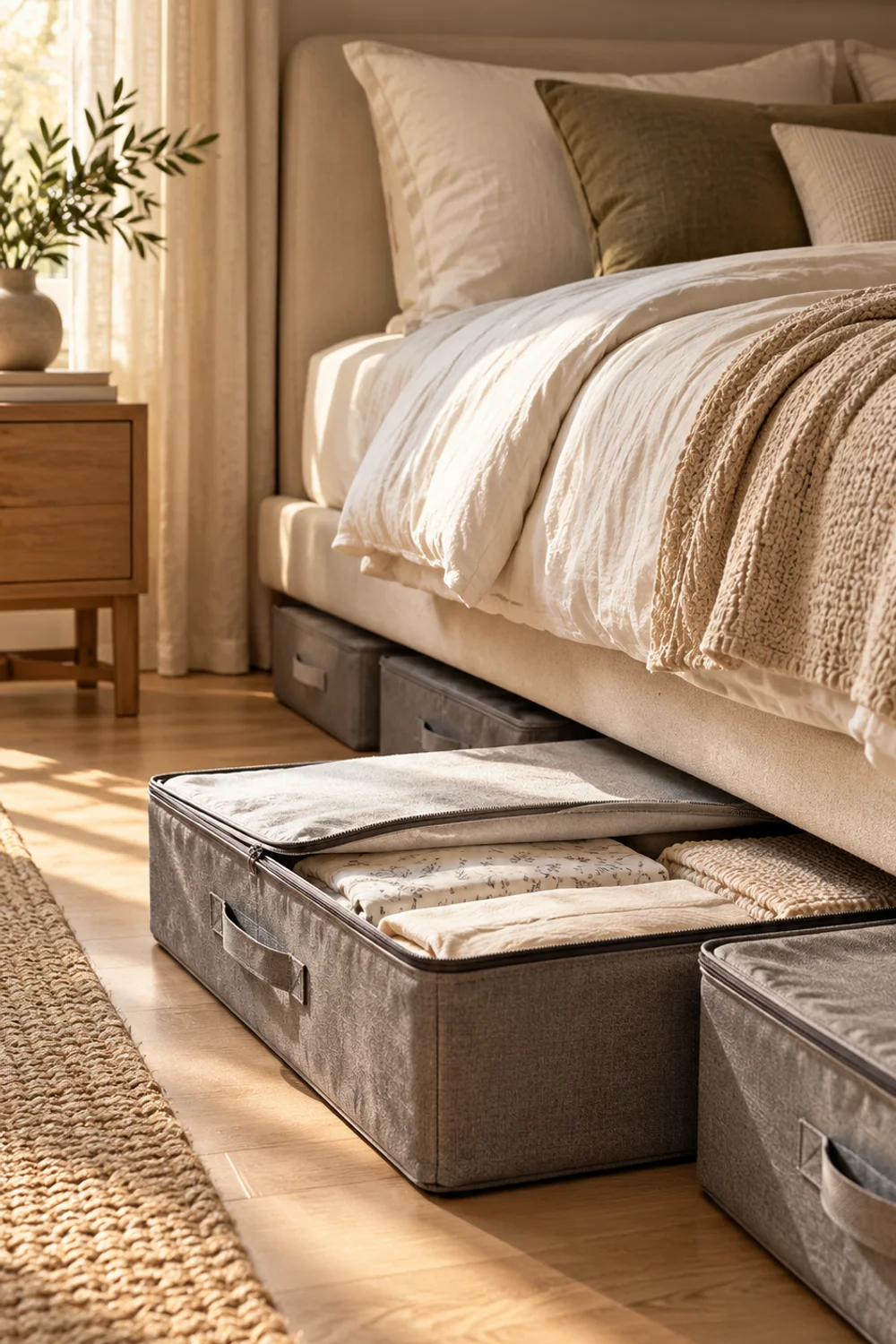
The space under your bed is the largest empty volume in most small bedrooms, and it sits right next to the things that belong in it. Spare sheet sets, an extra blanket, a second set of pillowcases: these are items you only reach for when you’re changing the bed, and the bed is exactly where you’ll be standing. Storing them underneath means they no longer take up a closet shelf or a dresser drawer that could be doing a daily job.
How you store them matters more than where. Loose linens slid under a bed collect dust, slip out of their folds, and turn into a heap you have to pull out entirely to find one pillowcase. Closed, same-size bins solve all three problems at once. Each one holds a single category, stays clean, and slides out whole, so you grab the bin, take what you need, and push it back in under a minute.
The 95L under-bed storage containers come as a set of four foldable grey bins, designed specifically for linens, blankets, comforters and pillows. Four matching containers let you give each category its own bin, for example one for sheet sets, one for spare pillowcases and shams, one for a lightweight blanket and one for guest bedding, instead of mixing everything into one oversized box.
Before you buy any under-bed storage, measure the clearance between the floor and the bed frame, and leave a little room so the bins slide in without scraping. Label the short end of each bin, since that’s the only side you’ll see.
There is one honest trade-off to consider. If your bed sits on slim, open legs and part of its charm is the floor you can see beneath it, filling that space will make the room feel heavier. That lighter approach is the one behind Easy Small Bedroom Ideas That Make Any Room Feel Bigger, where the goal is for the room to look larger rather than hold more. If what your room needs is storage, keep the bins tucked fully under the frame, away from the edges, so the bed still reads as one clean shape.
2. Divide Deep Dresser Drawers Into Lanes With Adjustable Dividers
 Save it
A deep dresser drawer is one of the least efficient storage spaces in a bedroom, simply because of how we fill it. Clothes go in flat, one on top of another, and within a week the drawer has become a single layered pile. Only the top layer is visible, so that’s what gets worn, and every time you pull something from the bottom, the whole stack collapses into the empty space it left behind.
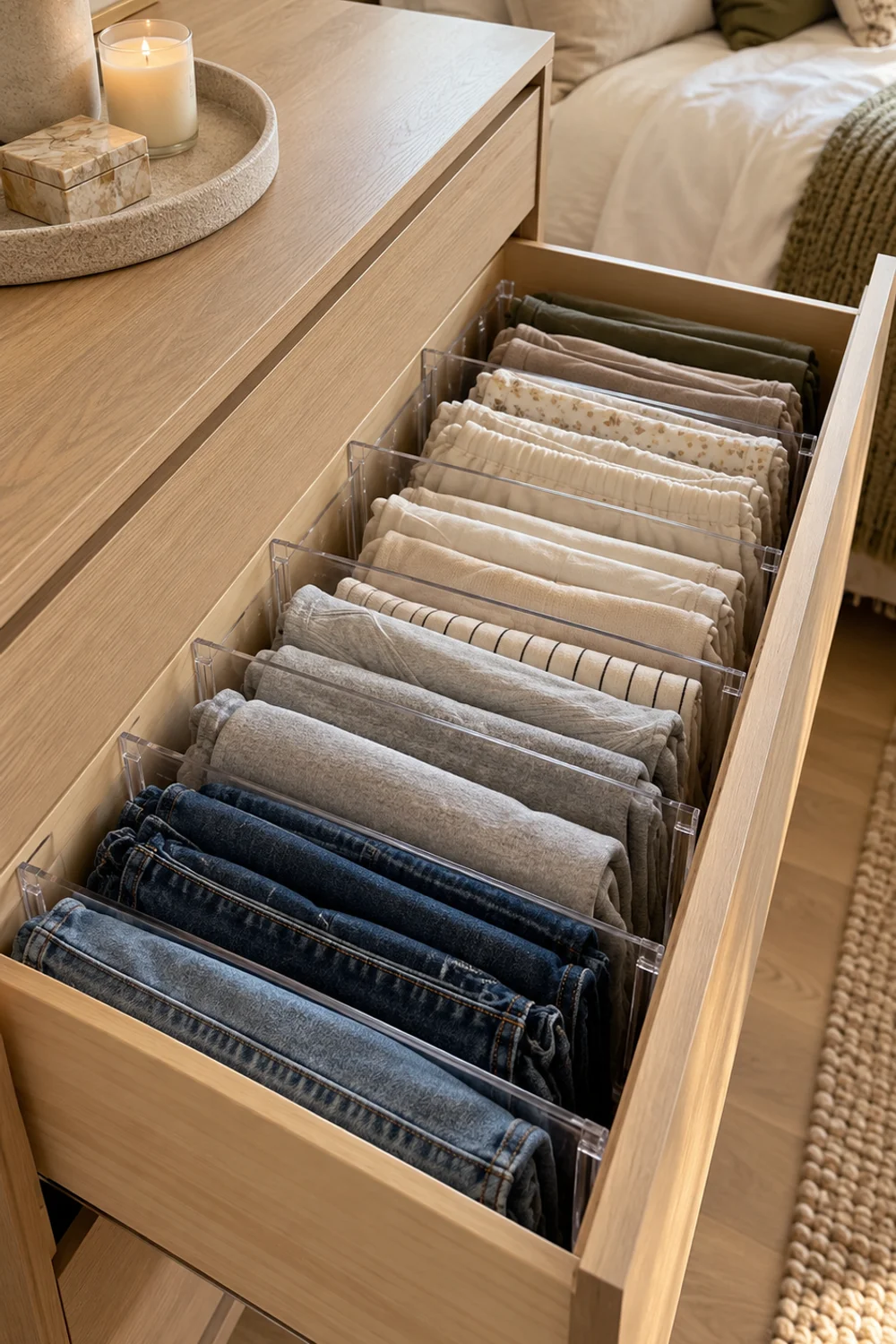
Dividers change the geometry of the drawer. Instead of one large open box, you get a series of narrow lanes, each holding one category standing on its edge. Jeans in one lane, pajamas in another, sweatshirts in a third. Because each lane is only as wide as the folded garment, nothing can slide sideways, and because everything stands upright, you see the whole contents of the drawer the moment you open it. You’ll also usually find you can fit more into the same drawer, because upright folded clothes don’t leave the pockets of air a loose stack does.
This adjustable drawer dividers are a clear plastic set of twelve, four inches high, that expand to fit drawers between roughly ten and sixteen and a half inches wide. Being expandable means they hold themselves in place across the drawer instead of needing to be screwed in, and being clear means they visually disappear, so the drawer looks tidy rather than partitioned.
Set the lanes around what you actually own, not around an ideal. Take everything out of the drawer, group it by category, fold each group to the same width, and only then place the dividers. One wide lane for bulky pieces and two or three narrower lanes for thinner ones usually works better than evenly spaced dividers.
Reserve these lanes for larger folded pieces, since the deepest drawers suit them best. Smaller items like T-shirts, leggings and underwear need a finer system, which you’ll find in the final idea of this guide.
3. Line the Closet Shelf With Fabric Bins Instead of Loose Stacks
 Save it
The shelf above a closet rod is often the most wasted storage in a small bedroom. It is usually deep, it sits just above eye level, and it is almost always filled with stacks: folded sweaters, towels, spare bags, a pile of scarves. Stacks on a high shelf fail in a predictable way. You can’t see what’s at the bottom, you can’t pull anything out without the rest toppling, and after a few weeks the shelf becomes a place things are put rather than a place things are found.
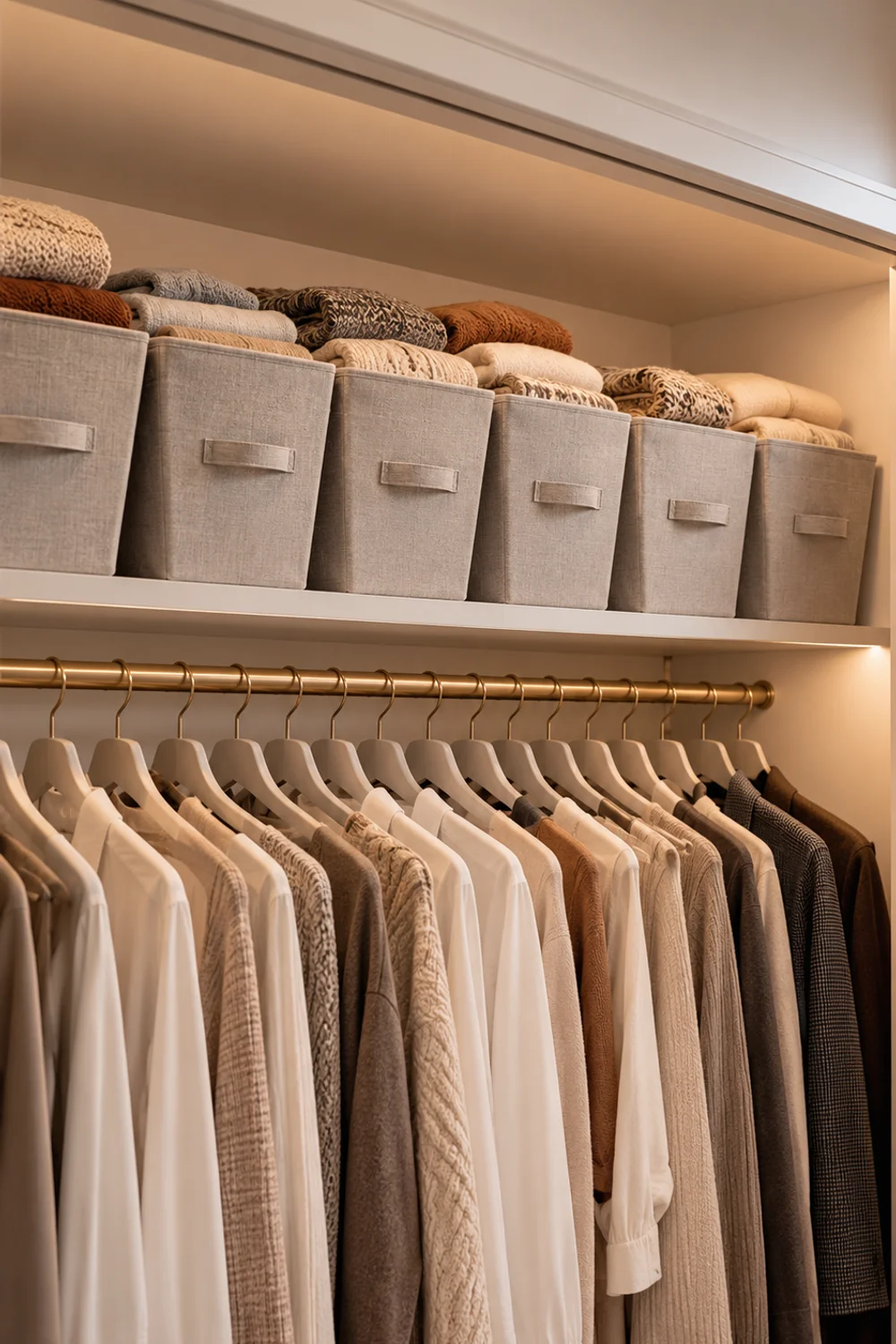
Bins turn a shelf into something closer to a row of drawers. Instead of reaching into a stack, you pull a whole container down, take what you need, and slide it back. One bin per category keeps things from migrating, and a bin that is easy to lift means the back of the shelf, which is often ignored entirely, becomes usable too.
Shape matters on a high shelf. The fabric closet shelf bins come in a set of six in light gray, with a trapezoid profile that is narrower at the base and wider at the opening, plus a handle on the front. That wider top makes it easier to see into a bin that sits above your head, and the handle gives you something to grip when you’re pulling it down from above. The bins are collapsible, so any you don’t need right away fold flat until they do.
Line them up side by side across the full width of the shelf rather than stacking them, so each one stays accessible without moving another. Label the front of each bin clearly, even if you think you’ll remember, because the whole point is being able to find something at a glance.
Choose the categories by frequency. Items you reach for weekly, such as gym clothes, scarves or folded knits, belong in the bins closest to the door. Things you use a few times a year can go at the far end, where they won’t get in the way.
4. Hang Pants in Layers on a Multi-Tier Pants Hanger
 Save it
Trousers are one of the most awkward categories in a small closet. Folded, they take up a surprising amount of shelf or drawer space and crease along every fold. Hung individually, each pair claims its own hanger width on the rod, and in a narrow closet eight pairs of pants can take up as much rail as a whole season of tops.
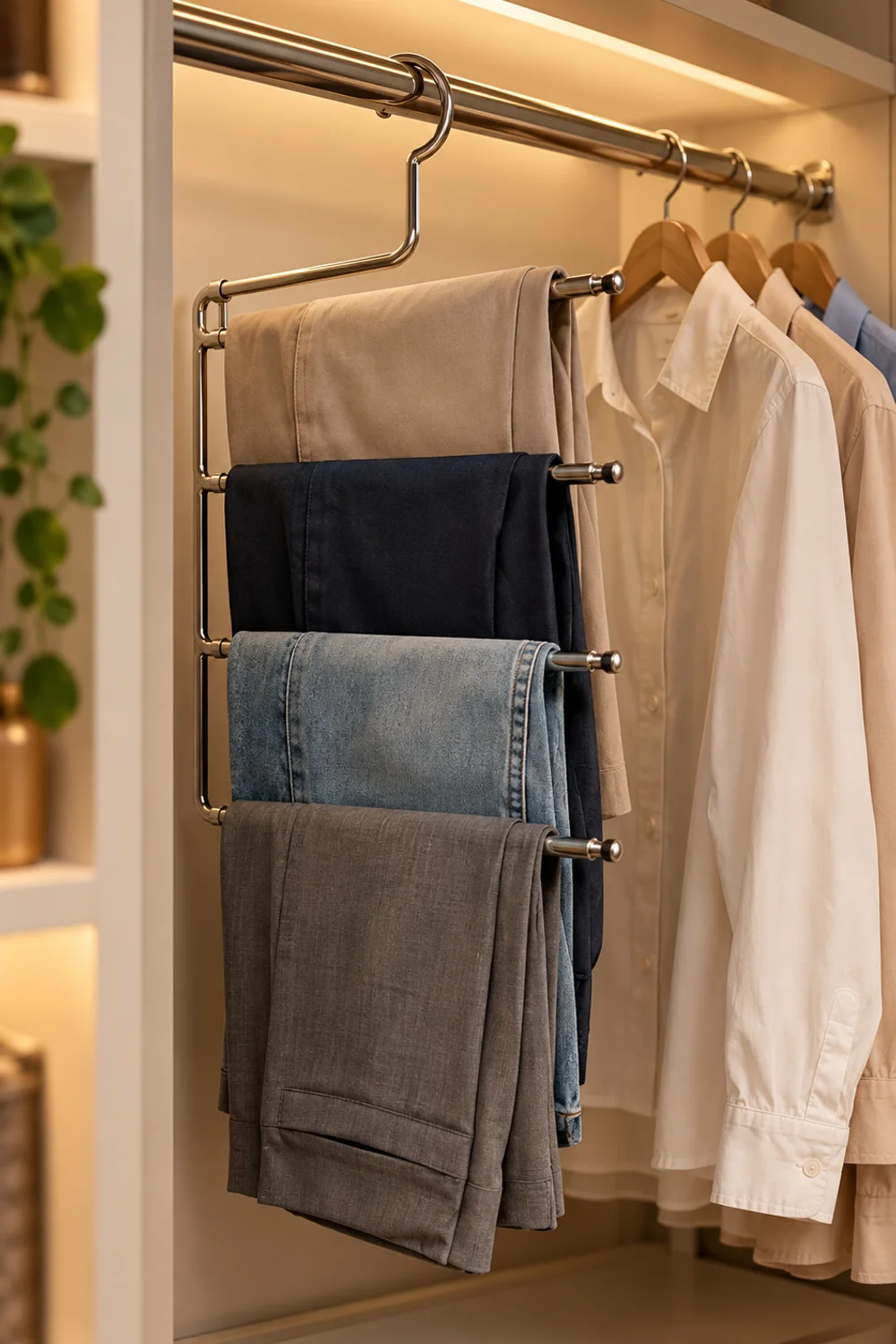
A multi-tier pants hanger solves this by stacking vertically instead of spreading horizontally. Several bars hang one above the other from a single hook, each holding one pair folded over it, so an entire category of pants occupies the width of just one hanger. Your trousers stay together, they stay visible, and they stay smoother than they would in a drawer.
This Pants Hangers come as a set of two multi-layer racks and include ten metal clips, so the same hanger can hold trousers folded over the bars or be used for scarves and lighter pieces. With two in the set, it’s easy to divide by type: one for work trousers and one for jeans and casual pants, or one for each person if the closet is shared.
Hang them at the end of the rod, not in the middle, since a layered hanger is heavier and fuller than a standard one and works best where it has a little clearance on one side. That also keeps it out of the way of the pieces you pull out every day.
Be selective about what goes on it. Pants that you wear often and that don’t need to be pressed each time are ideal. Very heavy denim can be split across both hangers so neither one is overloaded, and delicate fabrics that mark easily may be better on their own hanger.
A tiered hanger also makes one small habit easier. When you can see all your trousers at once, it becomes obvious which pairs haven’t been worn in months, and those are the easiest candidates to donate when you want the closet to breathe a little more.
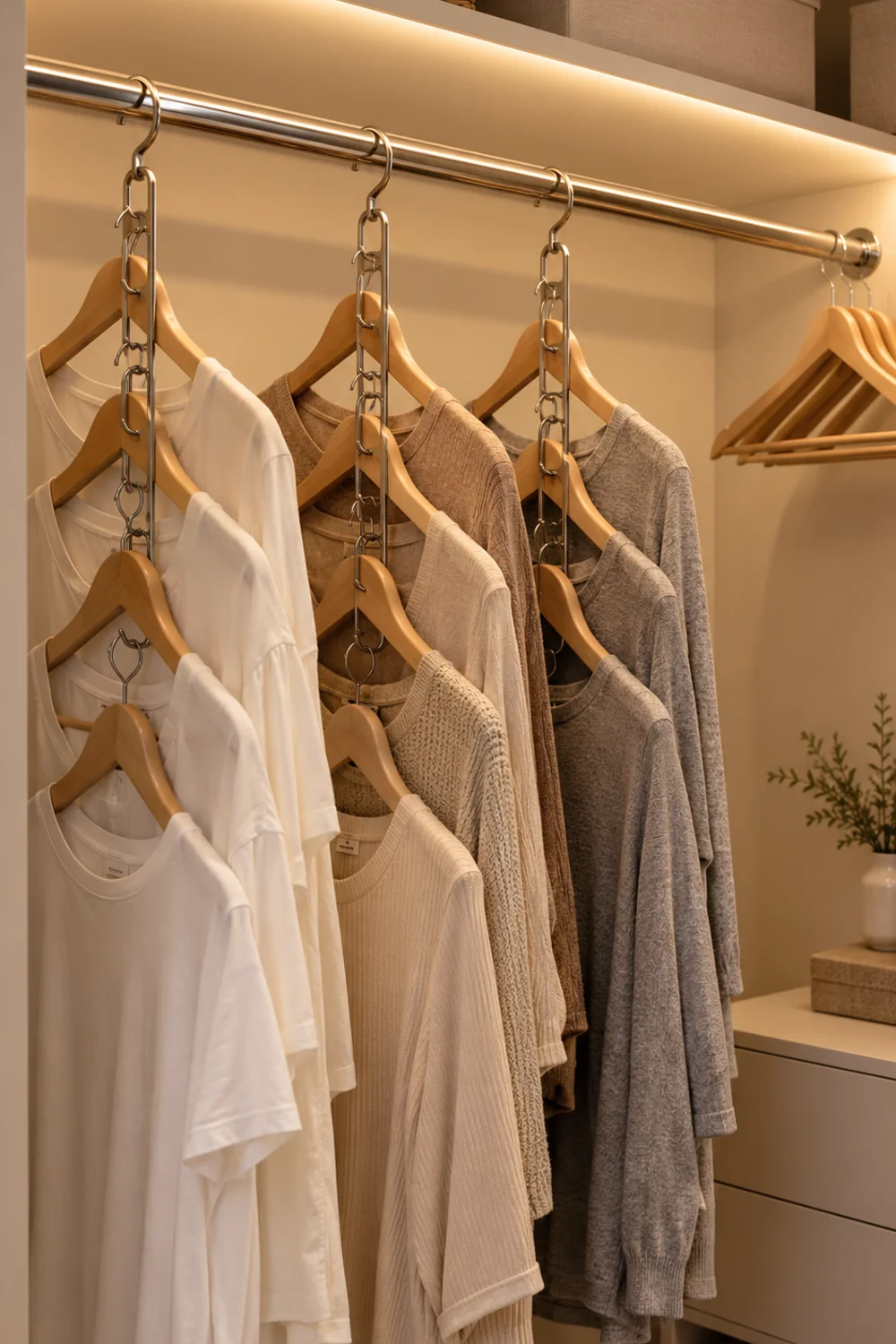
5. Cascade Tops Vertically With Space-Saving Hangers
 Save it
When people say their closet is full, they usually mean the rod is full. Every hanger claims its own width, and in a small bedroom closet that width runs out quickly, long before the closet itself is out of space. Below the hems of shirts and blouses there is often a large empty band of air that nothing ever uses.
Space-saving hangers work by turning that empty height into storage. Each one has a series of openings that other hangers hook into, so instead of five tops sitting side by side on the rod, they hang one below another from a single point. What used to take a hand-span of rail now takes the width of one hanger, and the space below the shorter clothes finally gets used.
The space-saving hangers come in a pack of twelve metal hangers, and the listing rates them at up to thirty pounds each. Metal keeps them slim, so they don’t add bulk of their own, and twelve is enough to organize a whole category rather than one or two outfits.
This system works best with a clear logic behind each cascade. Group by category, such as all your plain T-shirts, all your blouses or all your knit tops, or by color within a category, so that when you look at one column you know exactly what’s in it. Mixing everything together defeats the purpose, because you end up lifting the entire column to find one piece.
Keep the heaviest items near the top of each cascade, where the hanger is strongest and the pieces are easiest to reach. Reserve cascades for shorter tops. Long dresses and coats need their full length, and a cascade of long garments will simply pool on the closet floor.
One more benefit is often overlooked. Once you’ve cleared a section of rail, leave some of it empty. A closet with a little breathing room is much easier to keep organized, because there’s always somewhere to hang something back straight away instead of draping it over the chair.
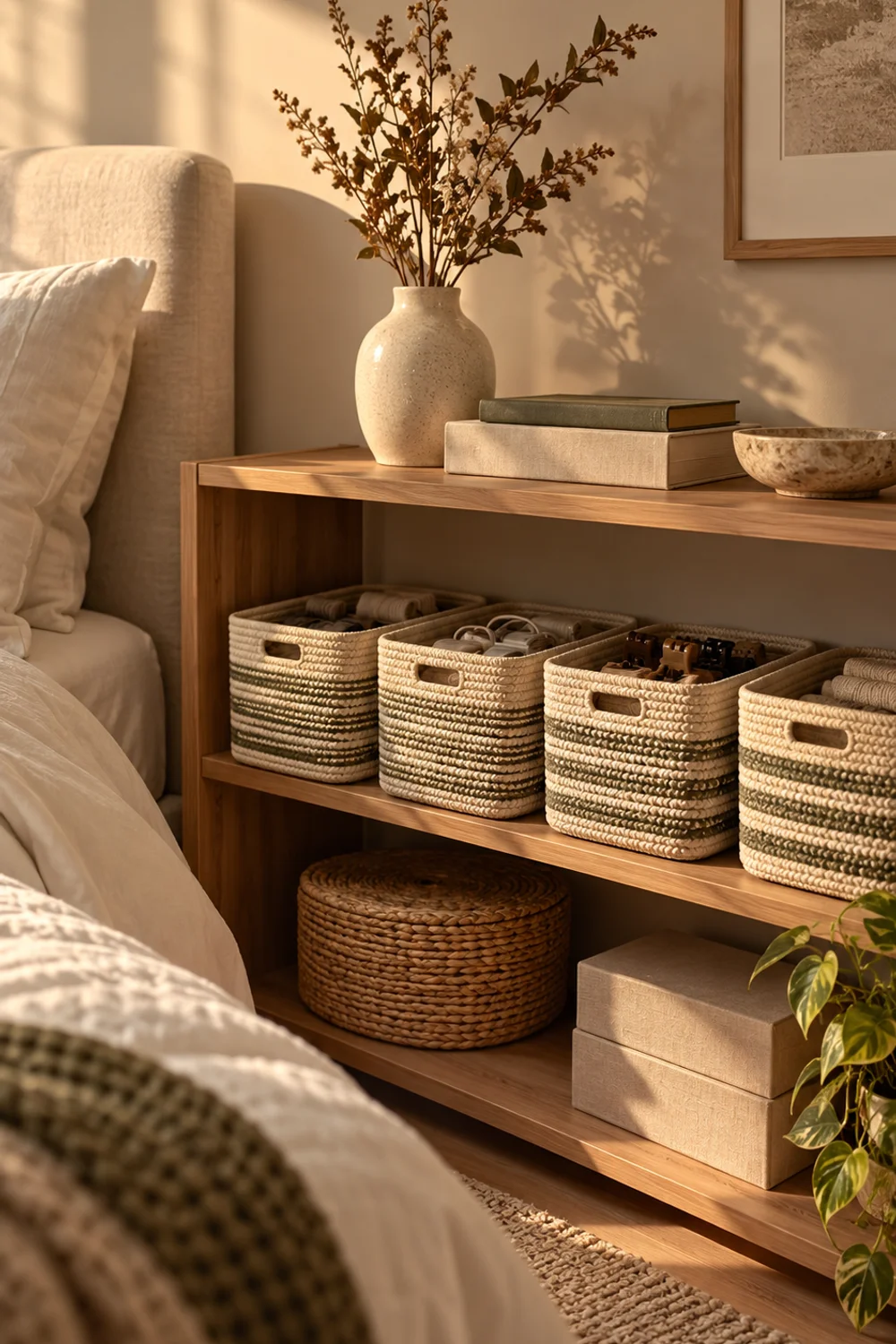
6. Corral Small Loose Items in Woven Baskets on Open Shelves
 Save it
Small things make a small bedroom look cluttered out of all proportion to their size. A charging cable, a hair clip, a pair of rolled socks, a sunglasses case, a candle, lip balm. None of them take up much space, but spread across a shelf or a nightstand, they give the eye dozens of separate things to register, and the room starts to feel busy even when it’s technically tidy.
Baskets work because they turn many small things into one larger, calm shape. A row of matching baskets on an open shelf reads as a single, deliberate element, and the clutter inside it disappears from view. The organizational side is just as important: each basket becomes a home for one category, so you always know where the chargers go and where the hair accessories go, and so does everyone else in the house.
This woven storage baskets come in a set of five, each about 13.8 by 9.8 by 7.9 inches, woven from cotton rope in khaki and white. That size fits a standard bookcase shelf, the open shelf of a nightstand or the floor of a closet, and five identical baskets give you enough to create a consistent row rather than a mismatched collection. Cotton rope also has a soft, textural look that suits a bedroom far better than hard plastic bins.
Give each basket a single job and resist the urge to create one “miscellaneous” basket, because that is exactly where clutter goes to multiply. Useful bedroom categories include tech and chargers, hair and beauty accessories, socks and tights, small leisure items like a book light or a sleep mask, and things that need to leave the room, such as items to return or give away.
If a basket starts overflowing, treat it as a signal rather than a failure. It’s the easiest moment to edit, because you only have to go through one category, not the whole room.
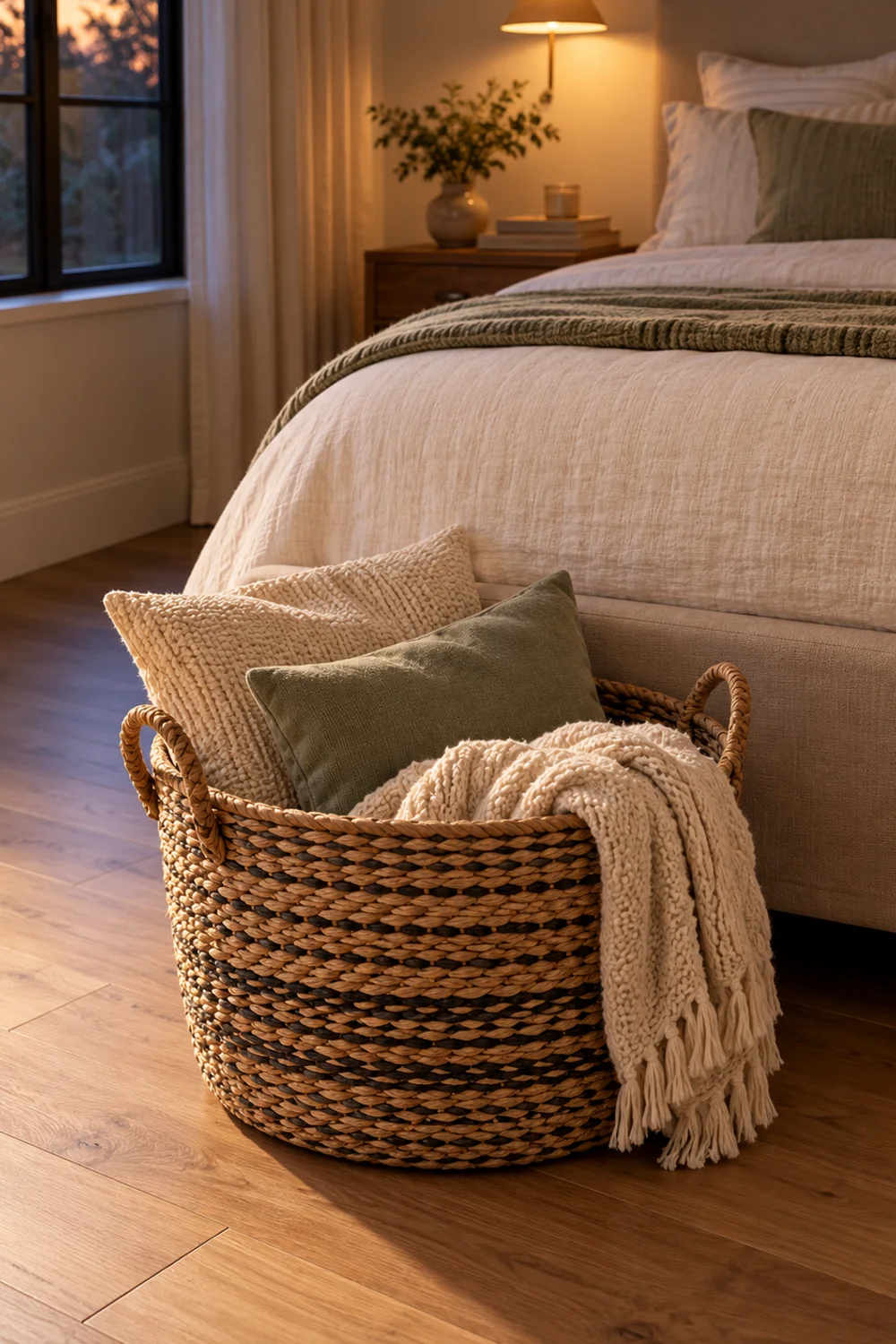
7. Give Throws and Extra Pillows a Blanket Basket at the Foot of the Bed
 Save it
Few moments in a small bedroom create clutter as reliably as bedtime. Decorative pillows, a folded throw, sometimes an extra blanket: every night they come off the bed, and in a room without a dedicated place for them, they end up on the floor, the chair or the end of the bed where they’ll be kicked off again. In the morning they go back on, and the cycle repeats.
The fix is to decide where those pieces live at night, and to make that place easier than the floor. A large open basket placed at the foot of the bed or in the nearest corner does exactly this. Pillows and throws drop straight in without folding, and the basket itself looks deliberate and warm, so it can stay in view without adding to the sense of mess.
Large blanket basket measures about 20 by 13 inches and is woven from cotton rope and jute in a natural and black pattern, with handles on each side and no lid. The open top is what matters here: at the end of the day you want to drop things in, not lift a lid and arrange them. The handles make it easy to slide the basket out of the way when you vacuum or move it closer to the bed at night.
Use the basket as a limit as well as a home. If your decorative pillows and throws don’t comfortably fit in it, that’s a sign the bed is carrying more than it needs. Keeping only what fits makes making the bed faster in the morning and clearing it faster at night.
During the day, the basket can hold the same throw you use for reading in bed, so it stays within reach instead of draping over furniture. In colder months it can also hold an extra blanket for anyone who runs cold.
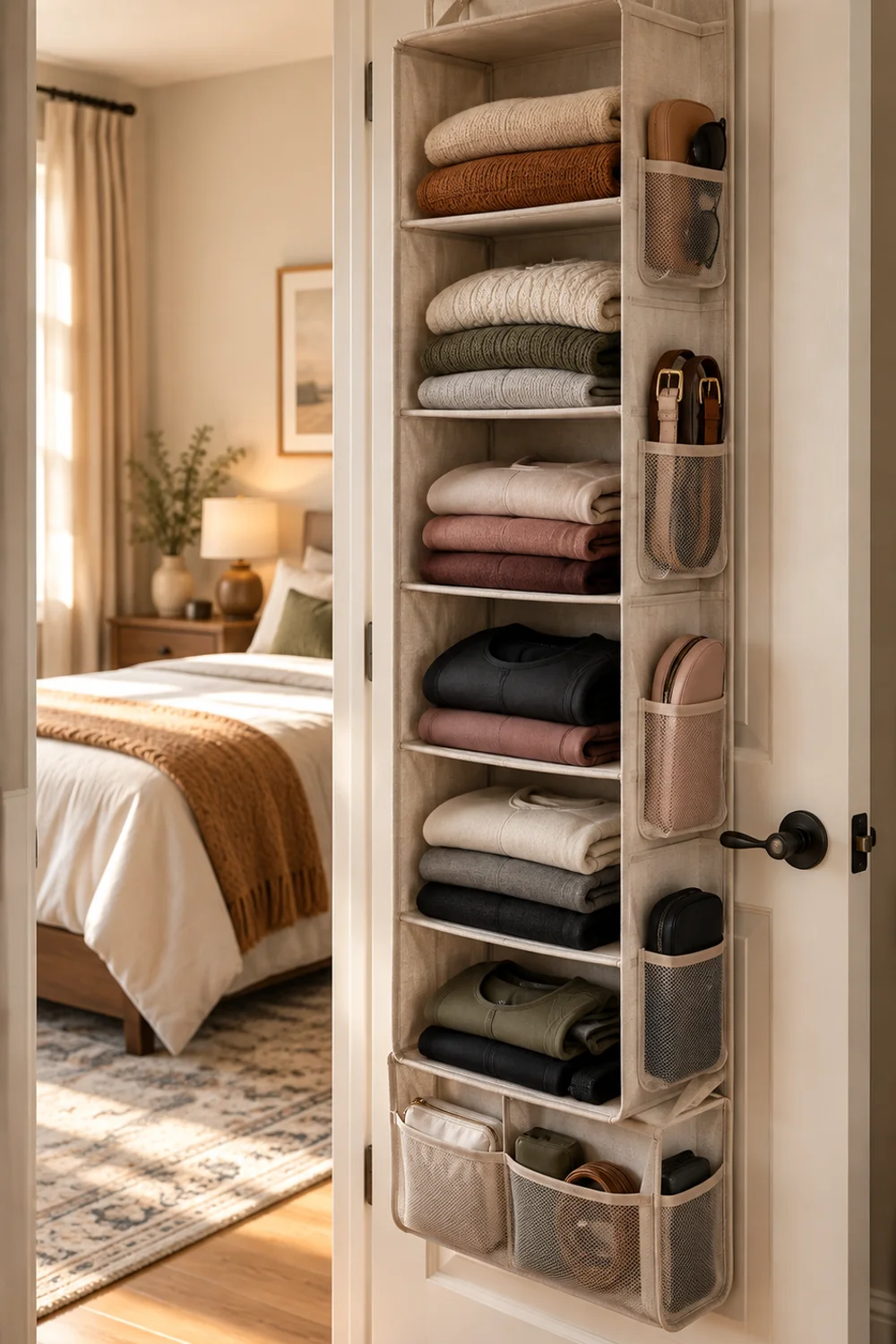
8. Turn the Back of the Door Into Shelves With an Over-the-Door Organizer
 Save it
In a small bedroom, floor space is precious and wall space is often taken by the bed, the window and the closet. The back of the door is one of the few surfaces left that is full height, unused and costs nothing in floor area. It is also somewhere you pass several times a day, which makes it an excellent home for items you use often.
An over-the-door organizer turns that flat surface into a narrow shelving unit. Because it hangs from the top of the door, it needs no drilling and no floor, and because it sits flat against the door, it disappears when the door is open against the wall. The shelves hold folded or bulkier items, while pockets suit the small things that would otherwise end up scattered across the dresser.
This over-the-door organizer in beige combines six shelves with thirteen mesh pockets, and the listing rates it for up to fifty-five pounds. The mix of shelves and pockets means one organizer can take on several categories at once: folded scarves or workout clothes on the shelves, and smaller accessories, travel toiletries, belts or sunglasses in the pockets, where the mesh lets you see what’s inside.
Check two things before you hang it. First, make sure the door closes properly with the hooks in place, since some doors fit tightly against the frame. Second, consider which door works best. A closet door is ideal for clothing and accessories, while the bedroom door itself is better for things you grab on your way out, like a bag, a scarf or your keys.
Load the organizer from the bottom up, placing heavier items on the lower shelves so the door swings smoothly and the organizer stays steady. Reserve the upper pockets for lightweight things you use less often.
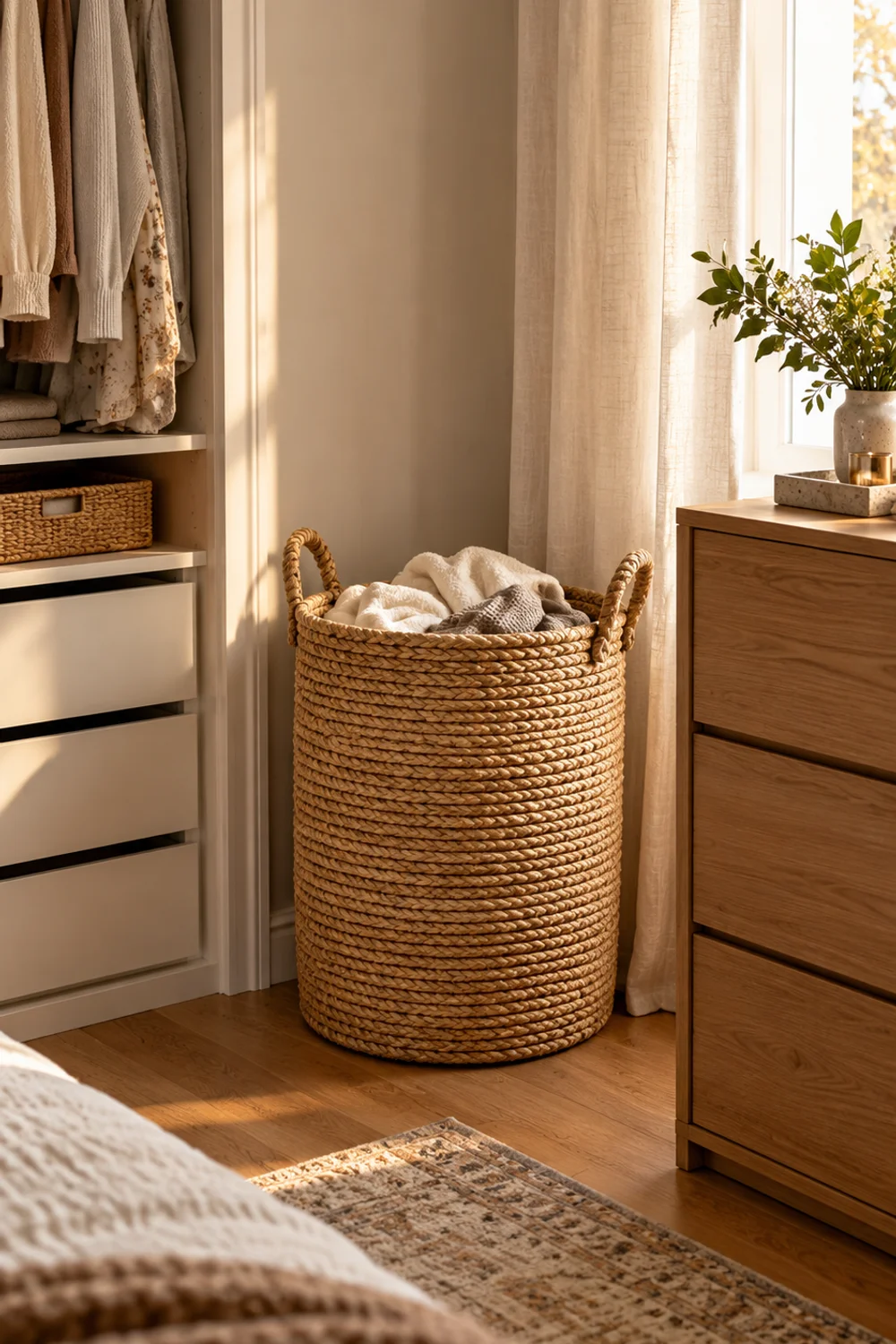
9. Stop the Floor Pile With a Woven Laundry Hamper Where You Undress
 Save it
Laundry clutter has less to do with how much laundry you have and more to do with where the hamper is. Clothes come off in one particular spot, usually beside the bed, near the closet or next to the door. If the hamper sits somewhere else, like the bathroom, the hallway or the back of the closet, the path of least resistance is the floor or the nearest chair, and that is where clothes accumulate.
The solution is to put the hamper exactly where clothes come off, even if that isn’t where you imagined it would go. That is one reason a good-looking hamper matters so much in a small bedroom: if it’s attractive, you don’t feel the need to hide it, and a hamper that stays in plain view, right where it’s needed, is one that actually gets used.
A laundry hamper is a 58-liter woven jute rope basket with sturdy handles, and it’s collapsible for when you need to put it away. Its natural woven texture looks more like a decorative basket than a utility item, so it can sit next to a dresser or in a visible corner without making the room feel like a laundry room. The handles are practical too, letting you carry it to the washing machine and tip the contents straight in.
A 58-liter hamper is large enough to hold several days of clothes for one person, which is enough to make laundry day a regular rhythm rather than an emergency. If you share the room, consider two hampers, one per person, so no one has to sort through someone else’s clothes.
Pair the hamper with a simple rule: clothes are either clean and put away, or worn and in the hamper. Anything worn once that you plan to wear again, like jeans or a sweater, gets hung back up or folded immediately rather than joining an in-between pile. The hamper handles the rest.
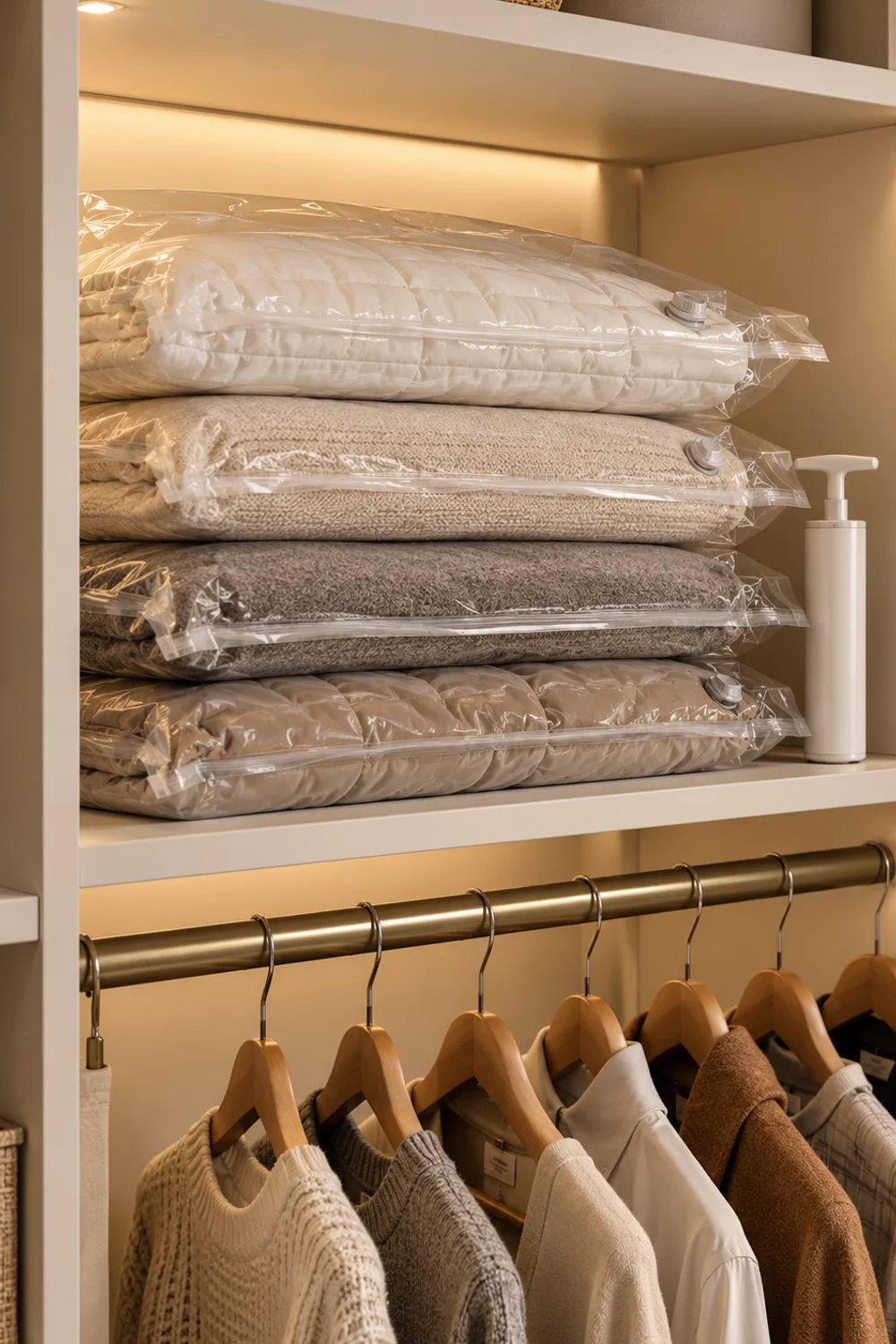
10. Vacuum-Seal Bulky Off-Season Bedding and Coats
 Save it
The most space-hungry things in a small bedroom are often the ones you aren’t using at all. A winter duvet in July, a heavy coat in August, a spare comforter for guests who visit twice a year. These items are bulky precisely because they’re full of air, and that air takes up closet shelves, under-bed space and entire drawers for most of the year.
Vacuum storage bags remove that air. Once the bag is sealed and the air is pumped out, a puffy comforter or a padded coat shrinks down to a flat, firm package that can slide under a bed, stand upright at the back of a closet or stack neatly on a high shelf. The bag also keeps the contents protected from dust until you need them again.
This vacuum storage bag set comes with twenty bags in a range of sizes and a hand pump, so you don’t need a vacuum cleaner to use it. The mix of sizes is useful in a bedroom: larger bags for duvets and comforters, medium bags for coats or a stack of blankets, and smaller ones for off-season sweaters or travel.
Vacuum storage works best for items you won’t need for months, not weeks, since unpacking and repacking takes more effort than simply opening a bin. Make sure everything is completely clean and dry before sealing it, and when you take items out, give them time to air and regain their shape before using them. Down and heavily padded items in particular should be shaken out and left to loft.
It’s worth being selective as well. Not everything benefits from compression. Structured pieces and delicate knits can be stored in soft bags instead, which you’ll find in idea twelve.
Label every bag with its contents and season. Once compressed, a duvet and a stack of blankets look almost identical, and a clear label saves you from opening the wrong one.
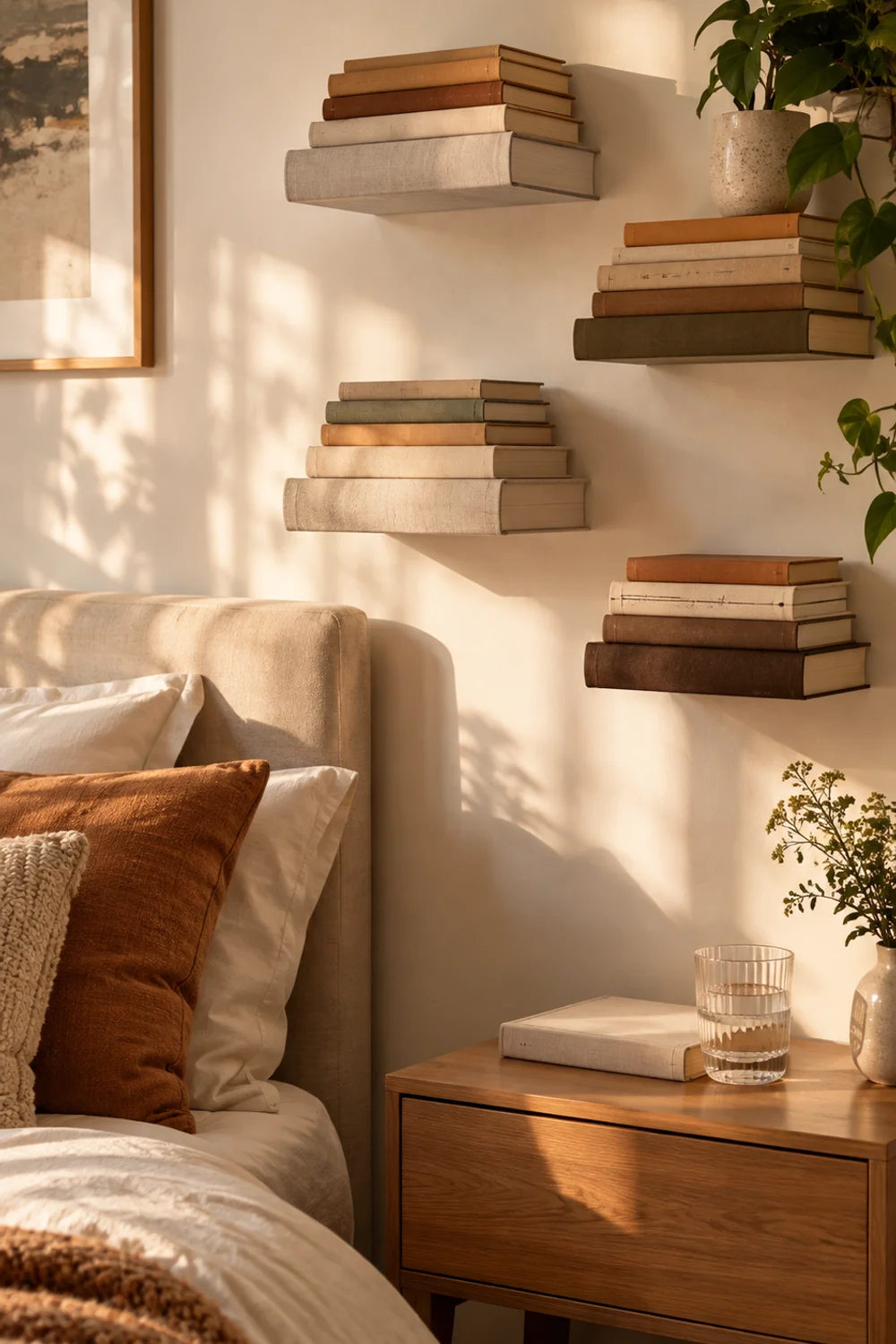
11. Stack Books on Invisible Floating Shelves to Clear the Nightstand
 Save it
Books are one of the slowest and most persistent sources of bedroom clutter. One book becomes a stack on the nightstand, the stack spreads to the floor beside the bed, and eventually there’s a second stack on the dresser. Because books feel meaningful rather than messy, they’re easy to overlook, but in a small room they take up exactly the surfaces you need for daily life.
Invisible floating shelves give books an address on the wall instead. Each shelf is a hidden metal bracket that slides inside the bottom book of a stack, so the books seem to float against the wall with no visible support. It moves an entire collection off the nightstand and into vertical space, and it looks more like a design feature than storage.
Invisible floating bookshelves come in a pack of four, made from heavy-duty metal in white. White brackets blend into a light wall, and a set of four is enough to create a small, staggered arrangement rather than one lonely stack. They mount to the wall with screws, so if you rent, expect a few small holes that are easy to patch when you move.
Arrange the shelves in a loose, staggered pattern at different heights rather than in a straight line, which makes the stacks look natural and gives the wall a sense of movement. Place the heaviest, largest book at the bottom of each stack, both for stability and for proportion, and keep each stack to a height that looks balanced rather than precarious.
Leave only the book you’re currently reading on the nightstand. Everything else lives on the wall, where it becomes something you enjoy seeing rather than something you have to move around. The wall beside or above a desk, a reading chair or the bed itself can all work, as long as the shelves are easy to reach.
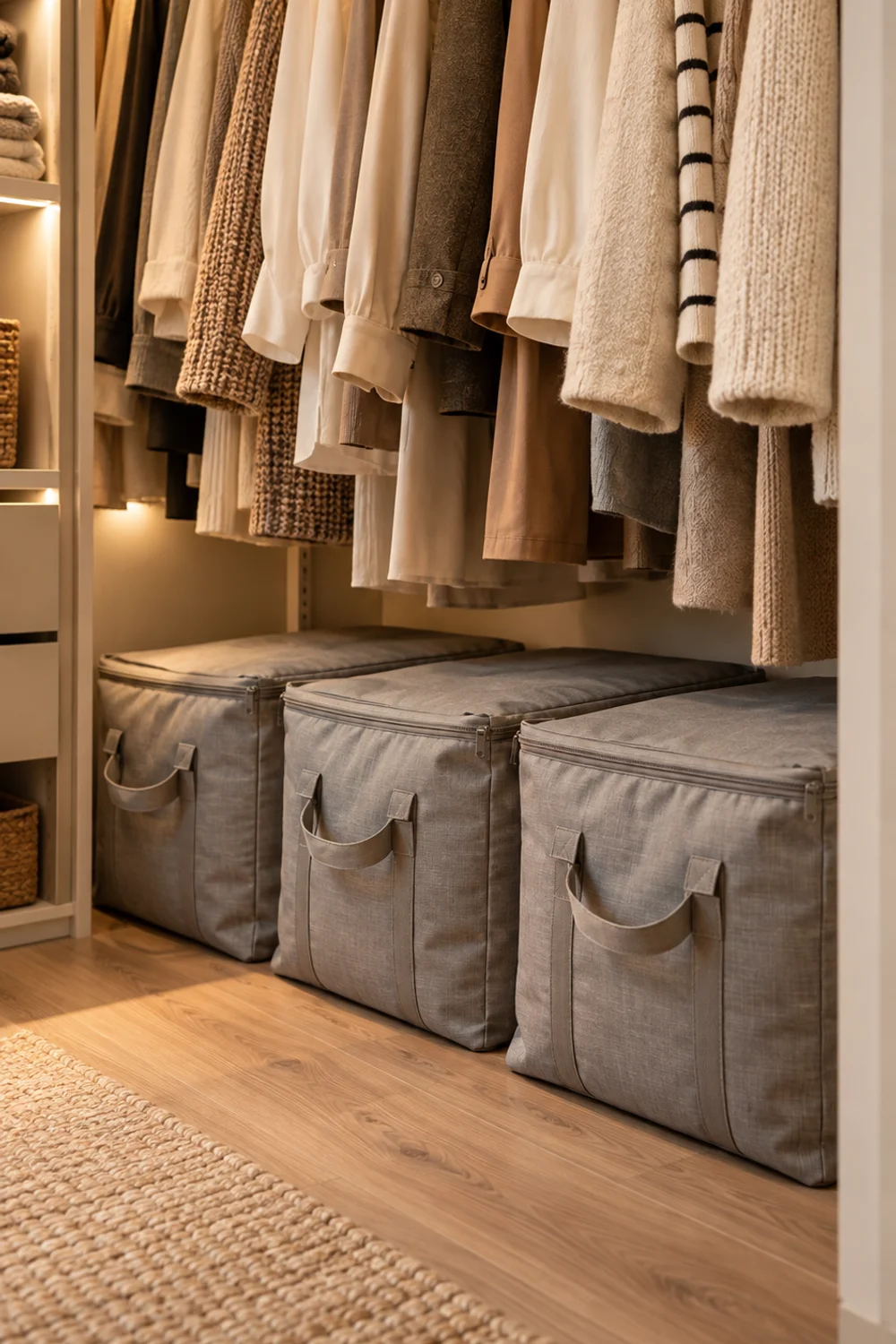
12. Store Off-Season Clothes in Soft Storage Bags on the Closet Floor
 Save it
Every closet carries two wardrobes at once: the clothes you wear now and the clothes you’ll wear in six months. In a small bedroom, keeping both within reach is what makes the closet feel impossible. Heavy sweaters crowd out summer tops, or linen shirts take space from winter layers, and the clothes you actually need are harder to find because of the ones you don’t.
The simplest way to free up space is to split the two. At the start of each season, move everything you won’t wear for the next few months into storage, and keep only the current season on the rod and in the drawers. The closet immediately feels larger, getting dressed becomes faster, and swapping seasons twice a year is a natural moment to decide what’s still worth keeping.
Not everything should be vacuum-sealed. Knitwear, structured jackets and anything you might want to pull out on an unexpectedly warm or cold day are better in soft storage that doesn’t compress them. The 90-liter storage bags come in a set of six in gray, foldable, with reinforced handles, and are designed for clothing, blankets and bedding. They are large enough to hold a whole category, such as all your summer dresses or all your knitwear, and the handles make them easy to pull out from a closet floor or lift down from a top shelf.
Line the bags up on the closet floor below shorter hanging clothes, where there’s usually unused space, or on the top shelf if the floor is already in use. Keep one category per bag and label the front with both the contents and the season, for example “summer tops” or “winter knits,” so the next seasonal swap takes minutes rather than an afternoon.
When one season ends, reverse the process. What was in storage comes out, what you’ve been wearing goes in, and anything you didn’t reach for all season is a good candidate to let go.
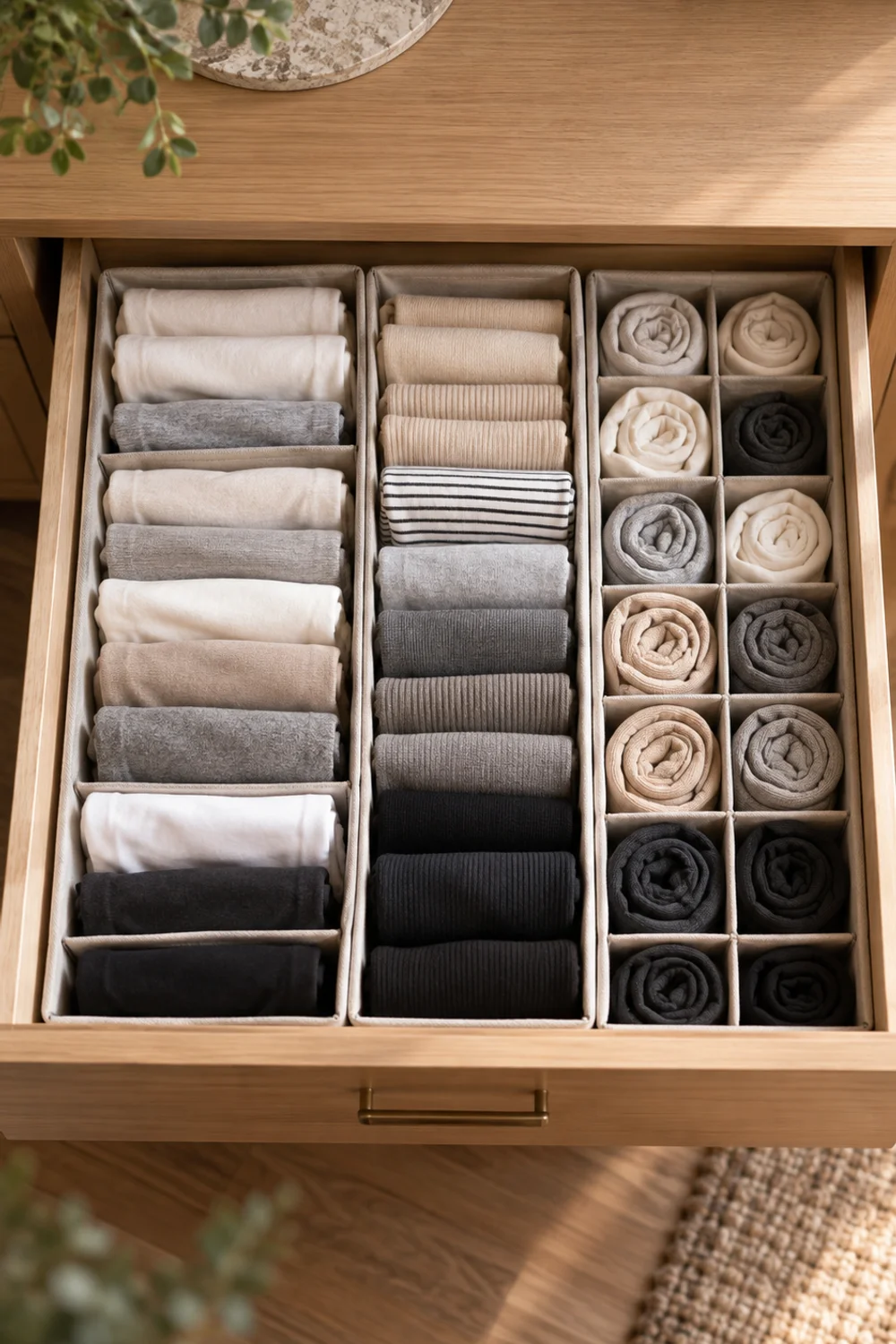
13. File-Fold T-Shirts and Leggings Into Grid Drawer Organizers
 Save it
The smallest items in a wardrobe are usually the hardest to keep in order. T-shirts, leggings, underwear and thin knits slide around, lose their folds and end up in a jumble that you dig through every morning. Even in a drawer with lane dividers, these pieces are simply too small and soft to stay neatly in place.
File-folding solves this by treating clothes like documents in a filing cabinet. Each piece is folded into a small, firm rectangle that can stand on its edge, then placed upright in the drawer. When everything stands up, you see every item at a glance when you open the drawer. Taking one out doesn’t disturb the rest, and nothing gets buried at the bottom.
Grid organizers make file-folding practical over the long term. T-shirt drawer organizers come in a pack of four, each with ten compartments, made from washable fabric. Each cell holds one folded item, so the drawer stays orderly by design and it becomes obvious when something is out of place. The fabric is soft on clothes and can be washed if it gets dusty.
To file-fold a T-shirt, lay it flat, fold each side toward the center so the shirt becomes a long rectangle, then fold it in half from top to bottom, and in half or in thirds again until it stands up by itself. Leggings work the same way: fold them in half lengthwise, then roll or fold them into a compact shape that fits one cell.
Use one organizer per category, such as one for T-shirts, one for leggings and one for underwear or socks, and place them side by side in the same drawer or in separate shallow drawers. Combined with the lane dividers in your deeper drawers, this gives every piece of clothing a place, from the largest sweatshirt to the smallest pair of socks.
Common Mistakes
1. Buying storage before deciding what goes where
Containers only help when they have a job. Buying baskets, bins and organizers first and deciding what to put in them later usually adds more things to a room that already feels full. Start with the categories that keep ending up on the floor or the chair, choose a place for each, and only then choose the container that fits that place.
2. Overloading one zone until it stops working
A packed closet rod, a bin you can barely close or a drawer that has to be forced shut are all signs that one area is doing too much. Overfilled storage becomes hard to use, and when storage is hard to use, things end up back on surfaces. Leave a little space in each zone so putting things away stays easy.
3. Compressing everything, including things you’ll need soon
Vacuum-sealed bags are excellent for bulky items you won’t touch for months, but using them for clothes you may need next week makes them a nuisance. Keep compression for true off-season items and use soft storage for everything that still needs to be accessible.
4. Mixing categories inside one container
A basket or bin that holds “a bit of everything” quickly turns into a drawer of clutter with a lid on it. One category per container makes things easy to find and easy to put back, and it also makes it obvious when a category has grown too large.
5. Letting one piece of furniture become the default drop zone
The bedroom chair, the end of the bed or the top of the dresser often turns into a permanent holding area for clothes and objects. Give those in-between items a real home, such as a hook, a hamper or a basket, and the surface stays free for its intended use.
Frequently Asked Questions
How do I organize a small bedroom with a tiny closet?
Use the height of the closet as well as its width. Space-saving and multi-tier hangers free up rail space, bins turn the top shelf into accessible storage, and an over-the-door organizer adds shelves without taking any floor space. Moving off-season clothes into storage bags also leaves more room for what you wear every day.
What should I store under the bed?
The space under the bed is best for items you use occasionally and that belong near the bed, such as spare sheets, pillowcases, blankets and guest bedding. Use closed, same-size containers so everything stays clean and each bin can be pulled out on its own.
Are vacuum storage bags safe for all clothes and bedding?
They work well for bulky, sturdy items like comforters, duvets, blankets and padded coats that you won’t need for several months. Make sure everything is clean and completely dry before sealing, and let items air and regain their shape after unpacking. Structured pieces and delicate knits are usually better stored in soft, uncompressed bags.
How do I stop clothes from piling up on a chair?
Give every type of clothing a clear destination. Worn clothes go straight into a hamper placed where you undress, and clothes you’ll wear again are hung back up or folded right away. When the hamper and the closet are easier to use than the chair, the pile stops forming.
How do I keep a small bedroom organized long-term?
Give every category a single home, keep one category per container, and leave some breathing room in each storage zone. A quick seasonal swap of clothes and a regular check of baskets and drawers will stop clutter from building up again.
Final Thoughts
A small bedroom doesn’t need more furniture to feel spacious. It needs fewer things without a home. When spare linens live under the bed, clothes stand upright in their drawers, the closet uses its full height, the door carries its share of storage and books move from the nightstand to the wall, the surfaces you use every day are finally free, and the room feels calmer the moment you walk in.
If you’re not sure where to begin, start with the two zones that free up the most space the fastest: the space under the bed and the closet rod. Then work your way through the rest of the room one category at a time. Each small change gives something a place to belong, and together they turn a bedroom that is always slightly cluttered into one that stays organized almost on its own.
This post contains affiliate links. I may earn a small commission at no extra cost to you. As an Amazon Associate I earn from qualifying purchases.
GET YOUR FREE CHECKLIST
A More Organized Home
Starts Here
Join the community and my free Home Organization Checklist, plus weekly tops and inspiration.
Thank you!
You have successfully joined our subscriber list.