
How to Create a Closet in a Bedroom Without One
By HomeStyledLiving | November 02, 2026
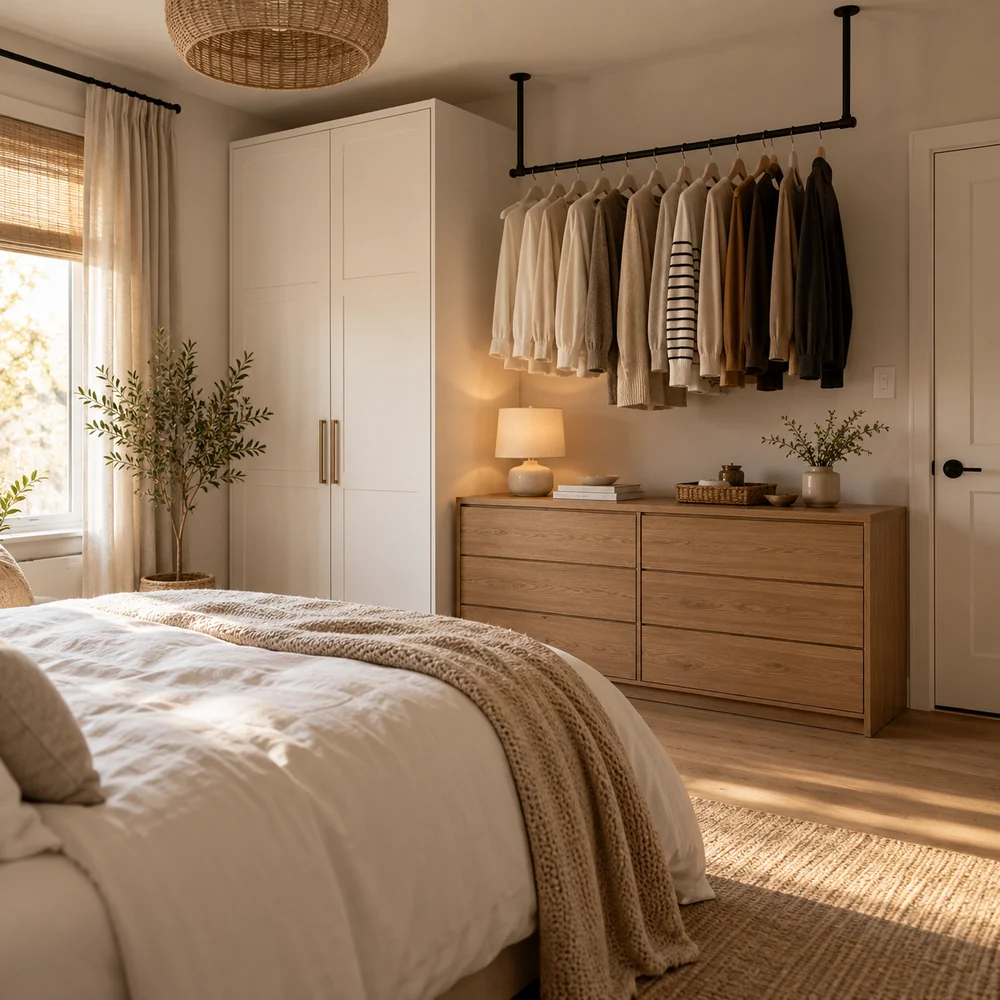
You notice it first in the mornings. The chair has become a second wardrobe, the end of the bed holds yesterday’s jacket, and every few days a pile of clothes migrates from one flat surface to the next because nothing in the room is built to hold them. A bedroom with no closet does not feel messy because you are untidy. It feels messy because the one piece of architecture that was meant to absorb all that fabric is missing.
The good news is that a closet is less a room than a set of jobs. It gives clothes a place to hang so they stay smooth, a place to fold so the heavy things do not stretch, and a way to keep the whole arrangement from taking over the room. Each of those jobs can be built from separate pieces, and often more beautifully than a builder’s reach-in box would have done it.
This guide moves through eight ways to do exactly that, from a wall of hanging rails to a curtain that closes the whole arrangement away at night. They are different in cost, in footprint and in how much they ask of your walls, and some of them are alternatives rather than a sequence. Read it as a menu: choose the structure that suits your room, then add the pieces that make it behave like a real closet.
A few honest limits apply throughout. Several of these pieces mount to a wall or ceiling and need screws, so they suit an owner more than a tenant, and the portable options are the better answer if your lease matters. Where a listing gives a size or a weight rating, this guide repeats it as the listing states it. Where it does not, the sensible move is to check the manufacturer’s instructions before you load anything.
1. Build a Closet Wall With a Wall-Mounted Industrial Pipe System
 Save it
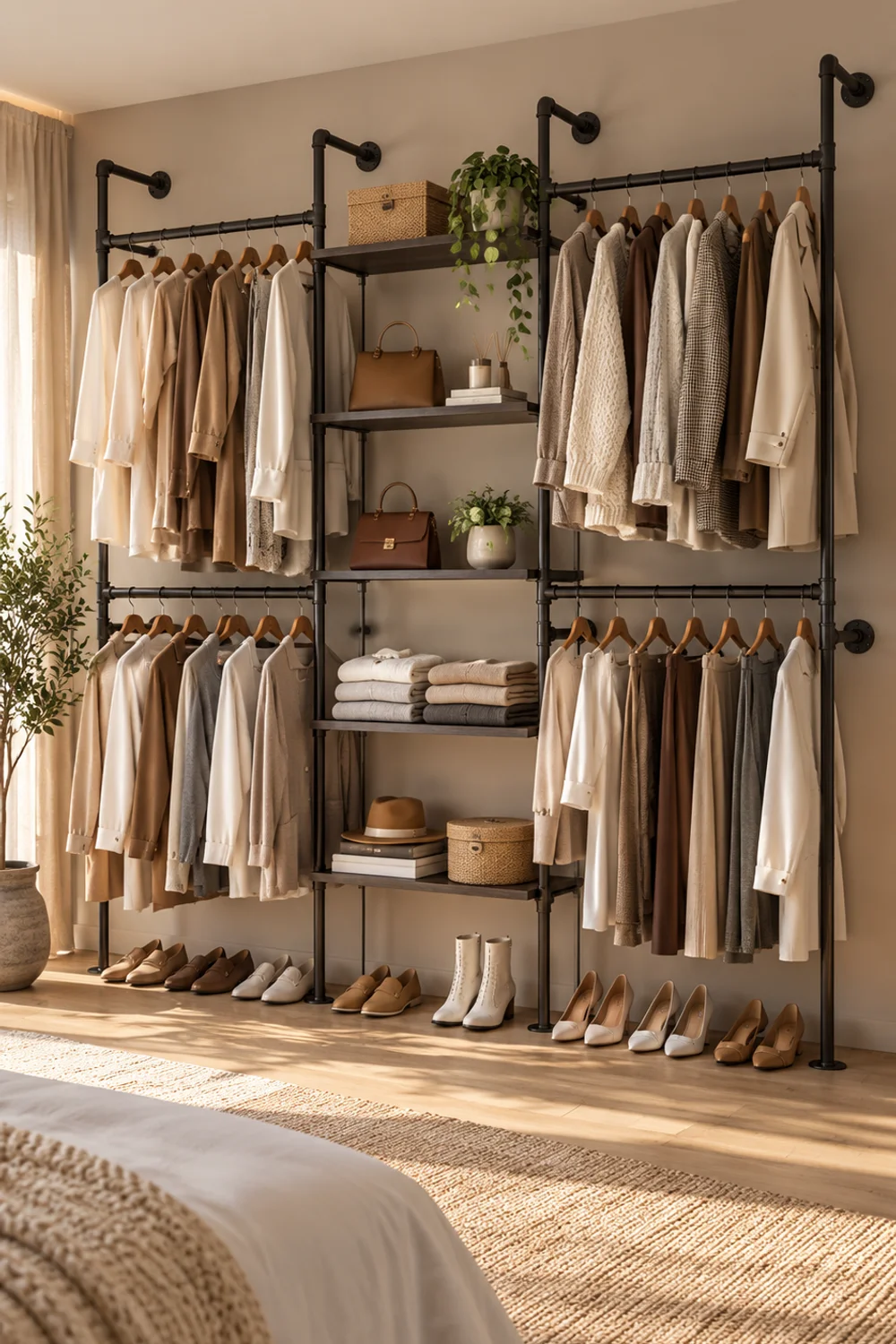
If you have a long, plain wall and a sense of drama, an open rail system turns that wall into the room’s most deliberate feature. Instead of hiding clothes, you present them: rods at two heights, a column of shelves for bags and folded knits, shoes lined up along the floor. Done well it reads like a boutique, and the discipline of seeing everything you own keeps the collection edited.
An industrial pipe system is built for this. It is a wall-mounted frame in black iron pipe, listed at 6.42 feet, with four detachable hanging rods and five shelves, and the listing describes both an L-shaped arrangement for a corner and a straight line along a wall. The pipe joints thread together, so the frame is assembled by hand rather than welded or bolted into a fixed shape.
Because it is wall-mounted, this is the section that most clearly needs a drill. The frame is secured to the wall rather than standing on its own, which is what gives an open system its stability, and it means you should find the studs or choose anchors suited to your wall type before you commit. Do not treat the listing’s claims about strength as a substitute for that step.
Plan the arrangement before you hang a single shirt. Put the long rod where dresses and coats will use it and the double rods where shirts and folded trousers will, and keep the shelves for what you reach for daily. An open system punishes overfilling more than a cabinet does, because every overstuffed rail is visible. Leave a hand’s width between items, keep one colour family on the rails, and the wall will look curated instead of crowded.
Choose this approach for a bedroom with one clear wall and a willingness to edit. It is the most architectural option in this guide and the closest to a real walk-in feeling, provided you accept that everything you hang is on show.
2. Choose an Armoire That Looks Like Furniture, Not a Fix
 Save it
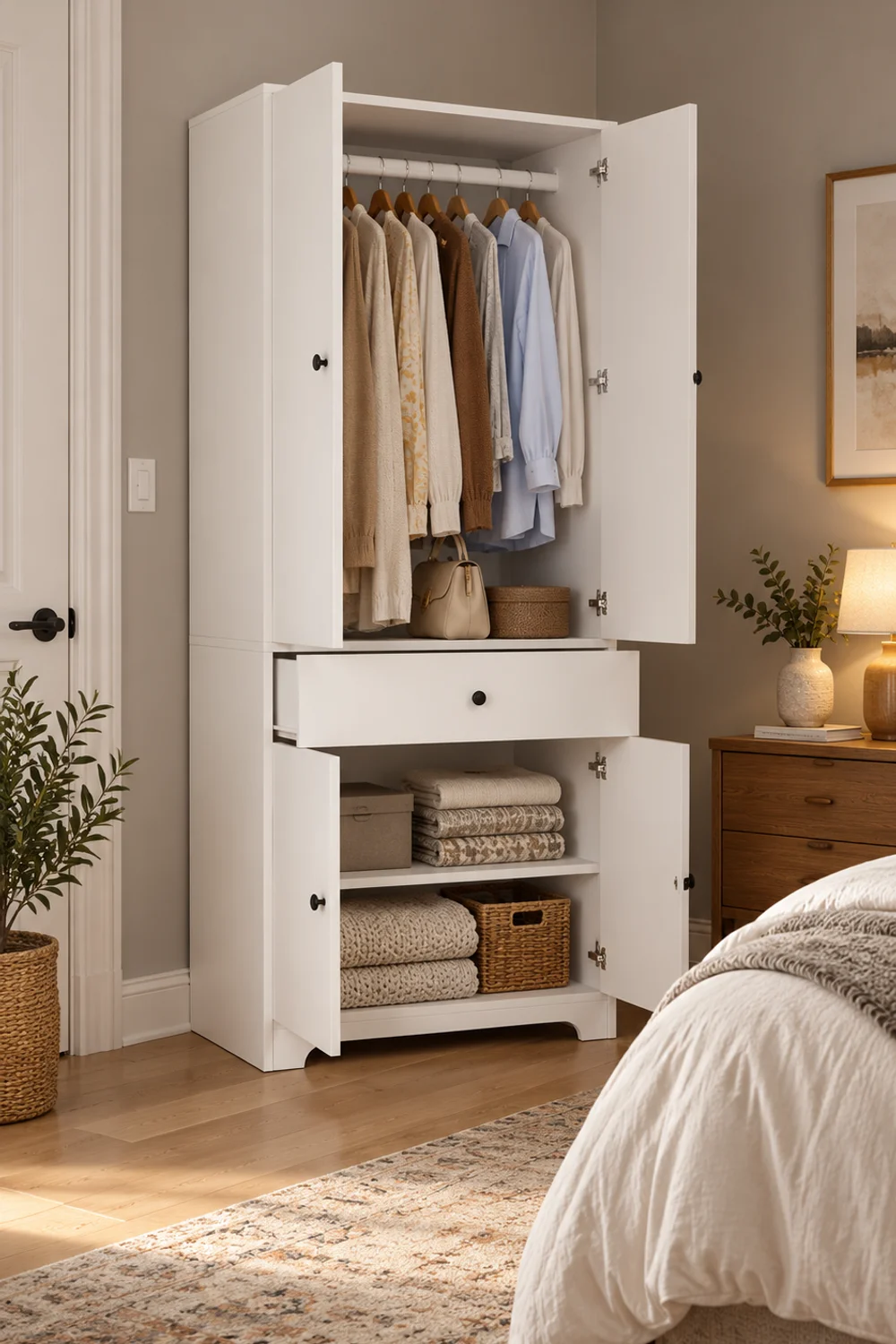
Not everyone wants to see their clothes. For a bedroom where calm matters more than display, a closed armoire does what an open system cannot: it makes the storage disappear behind two doors and lets the room go back to looking like a bedroom. It also solves dust and light, because closed doors keep both away from fabric.
The 71-inch white armoire in this guide is a good example of the type. Two upper doors open onto an aluminum hanging rod, a drawer sits beneath them, and two lower doors close over an adjustable shelf, so hanging, folded and bulky storage all live in one footprint. The shelves are removable according to the listing, which is useful for a long coat or a dress that needs full length.
Where it goes matters as much as what it is. A tall piece reads best against the wall you see least from the bed, not the wall you face when you wake up, and it needs enough clear floor in front for both doors to swing open. Measure that arc, not just the width of the cabinet, and keep the door side clear of the bed and the bedroom door.
Safety is part of the plan with any tall wardrobe. The listing states that an anti-tip anchoring kit is included, so use it, fasten the piece to the wall as the instructions say, and keep heavier items on the lower shelf. A wardrobe that is anchored and loaded sensibly is far less likely to become a hazard in a room where children or pets wander.
Choose this when you want the quietest result. White is gentle against most wall colours, the drawer saves a separate chest for small things, and the closed doors mean you never have to decide how tidy the inside looks.
3. Add a Tall, Narrow Dresser for Everything That Does Not Hang
 Save it
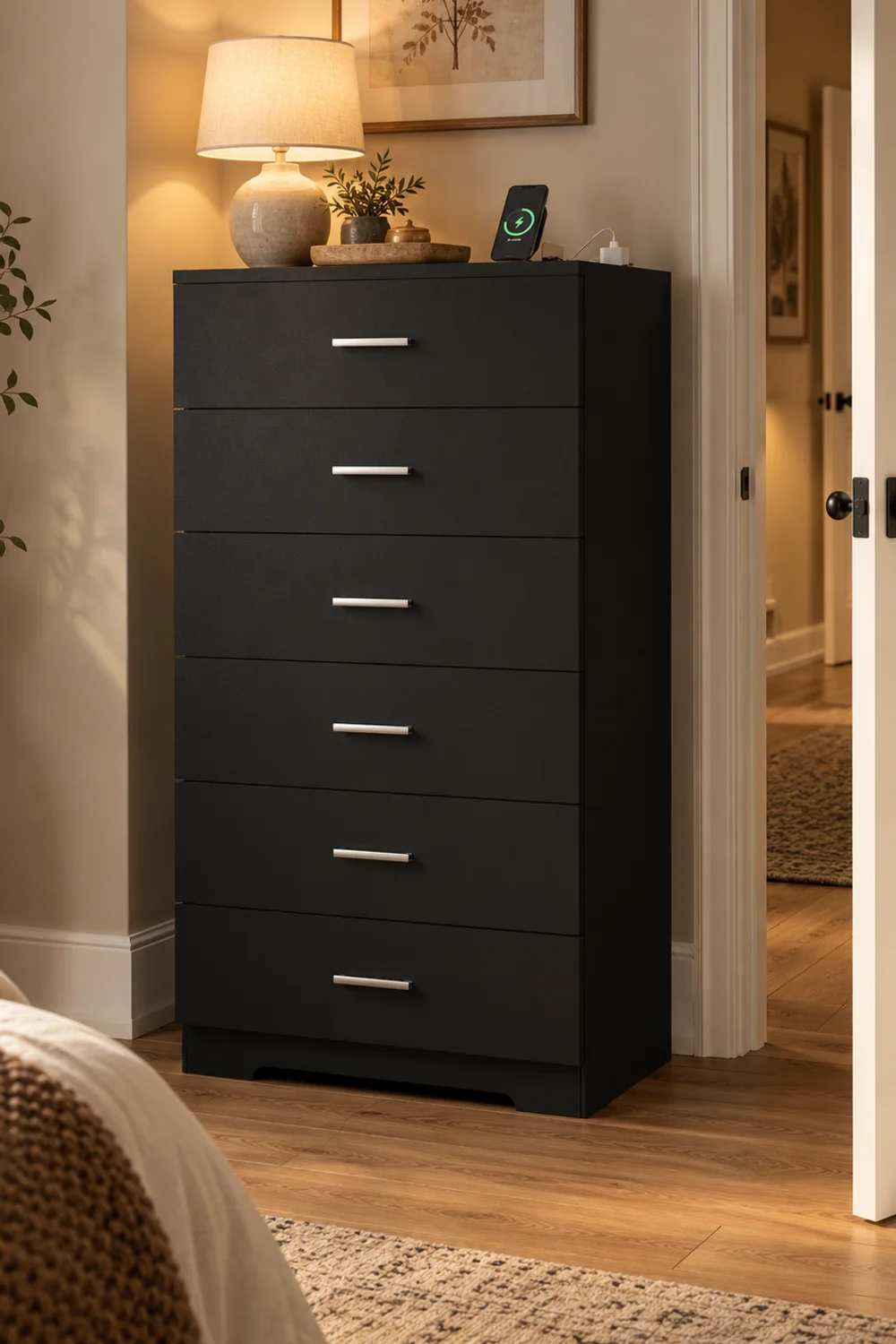
A closet is not only hanging space, and this is the piece most workarounds forget. Folded knits, underwear, workout clothes and socks need drawers, and a narrow tall dresser gives you that capacity using height instead of floor. Standing on a small footprint, it is the sort of piece that slips into a corner, beside a doorway or at the end of a wardrobe wall.
This dresser is listed at about 23.7 inches wide, 15.1 inches deep and 47.5 inches tall, with six drawers and matte black fronts with slim silver handles. It also has a charging station built into the top, with one Type-C port, two USB ports and two AC outlets according to the listing, which turns the top into a place to dock a phone and leave the nightstand clear.
Narrow furniture works best against a wall that is already doing a job. The door wall is a good candidate, because a slim piece there keeps the doorway sightline open instead of walling it in, a placement idea explored in Easy Small Bedroom Ideas That Make Any Room Feel Bigger for rooms where every edge counts. Placing it beside the wardrobe or rail system also lets the drawers and the hanging space read as one composed unit.
Treat the built-in power with the care you would give any extension lead. Plug it into a wall socket, do not chain it to other adapters, and follow the listing’s guidance on what it can charge. If you would rather keep electronics out of the clothes zone, the same dresser works perfectly as a plain chest of drawers.
Choose this when you already have, or are about to buy, a hanging solution. Six drawers in a slim black column also give the room a visual anchor, which helps a collection of mixed pieces look intentional.
4. Use a Wide Dresser as the Base of Your Closet Wall
 Save it
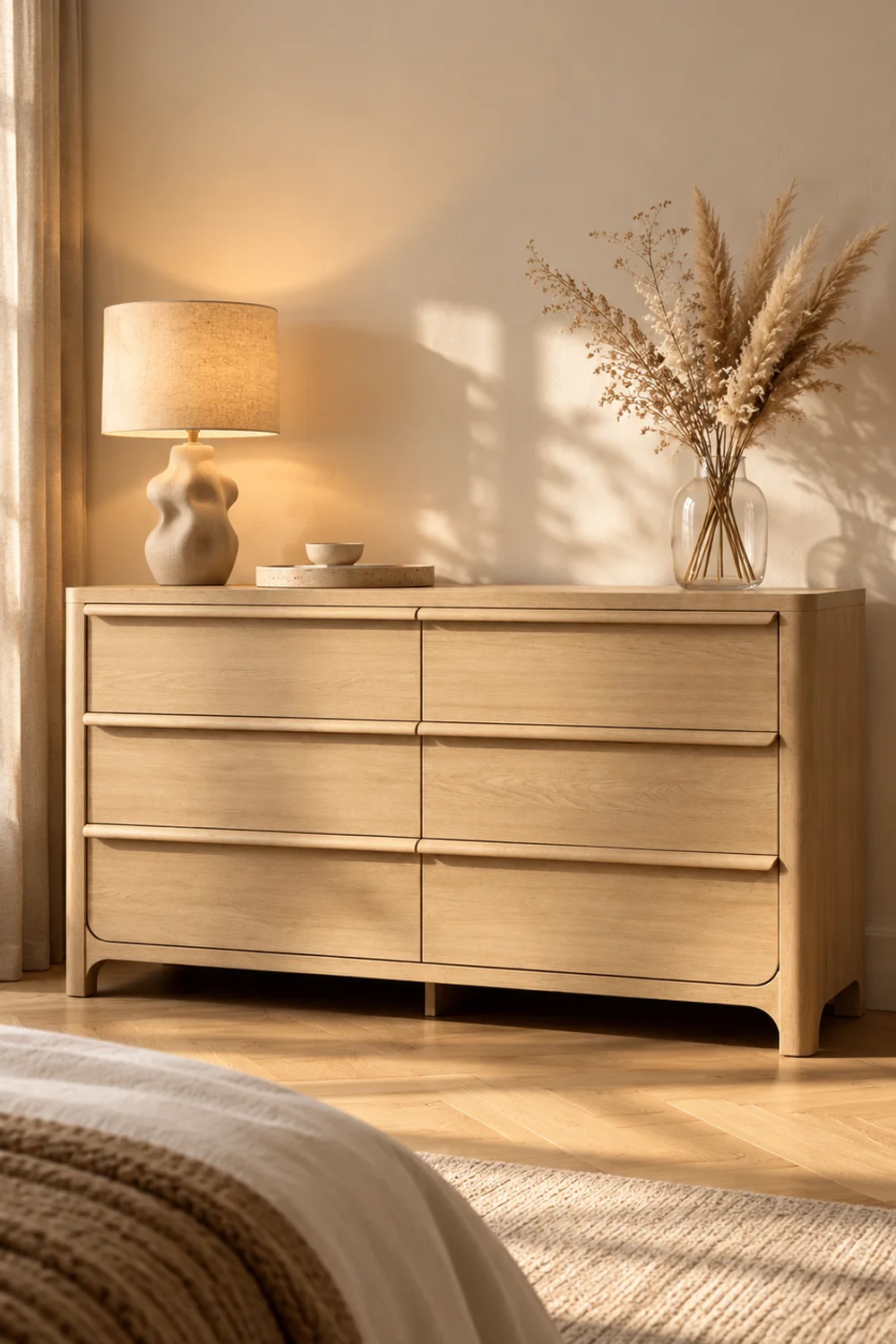
Where a narrow dresser tucks away, a wide one can be the foundation of the entire arrangement. A low, long chest along one wall holds an enormous amount of folded clothing, gives you a surface for a lamp and a tray, and leaves the wall above it free for hanging space, which is what the next section does with a rod.
The 57-inch dresser here is a six-drawer chest in a natural wood-grain finish. The drawers sit in two columns and three rows, the corners are rounded on the top, the sides and the fronts, and the recessed handles are arched. It stands on short legs with an open base, which lets floor show underneath and keeps a wide piece from looking heavy. The listing is new and has no customer ratings yet, so read the specifications and the return terms with a little extra attention.
Use the width deliberately. Give each column a purpose, one for everyday clothes and one for the seasonal or occasional, so you never have to open six drawers to find a pair of socks. Keep the top mostly clear, with one lamp or a small tray, because the visual rest on top is what lets the wall above it carry hanging clothes without feeling heavy.
Natural wood does something useful in a closet-less room. It warms the cool metal and black that open rails and wire shelves bring, and it tells the eye that this is a bedroom piece first and storage second. The lighter finish also keeps a long run of drawers from dominating a small room.
Choose this when you have a free wall of about four to five feet and want to build a closet wall upward from it, with the drawers working at hip height and the hanging space waiting above.
5. Set Up a Freestanding Closet System When You Need Full Capacity
 Save it
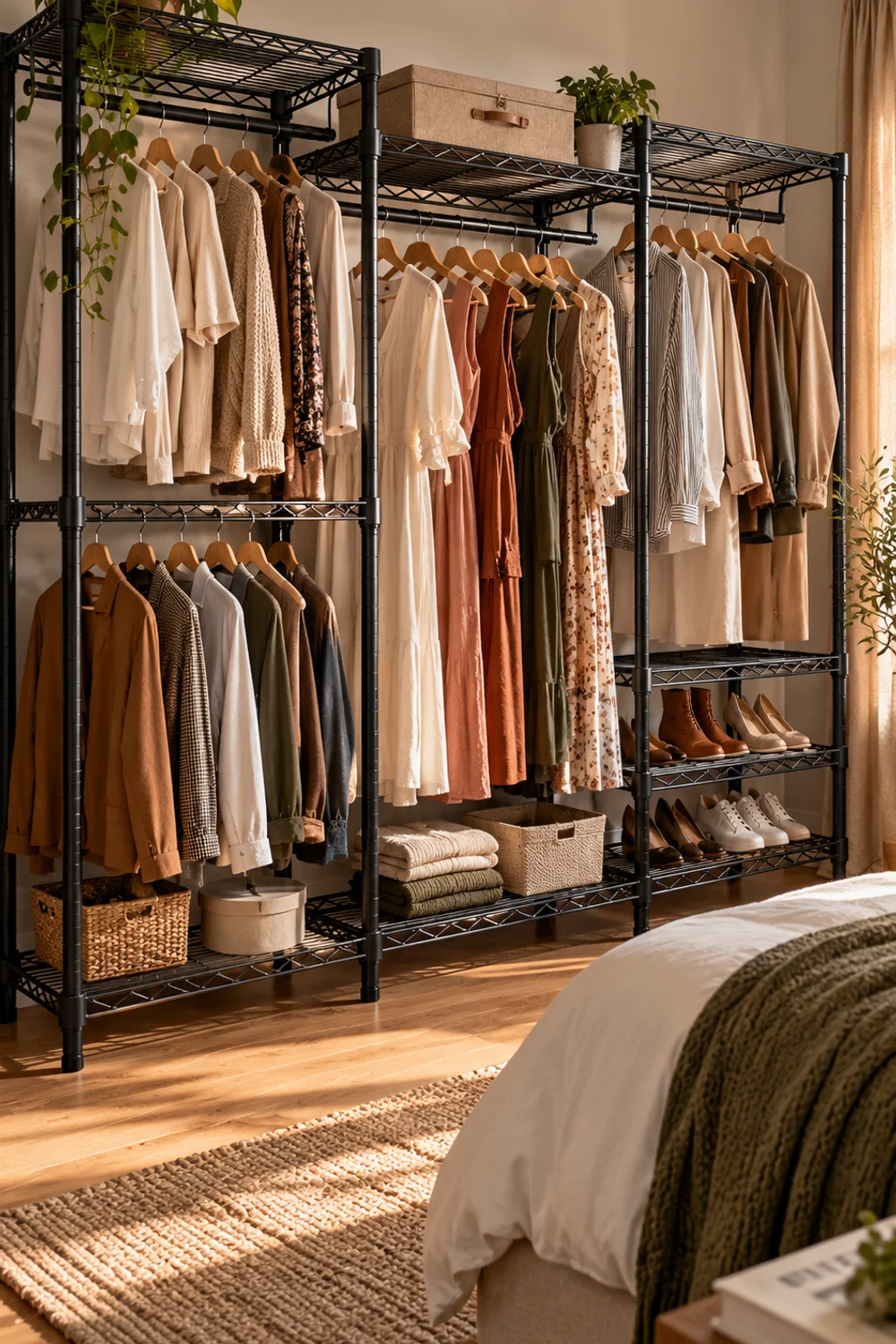
Some people simply own a lot, and for them a freestanding system is the honest answer. It needs no wall fixing in the way a wall-mounted frame does, it moves with you, and it offers the most hanging length and shelf area in the least time. If the bedroom has to hold a whole wardrobe immediately, this is the fastest route to a functioning closet.
This Clothes Rack is a black metal modular frame with four hanging rods and eight wire shelves, two of them adjustable, and the listing gives its size as 68.9 inches long, 15.7 inches wide and 76.4 inches tall. It states a total load of 890 pounds with 60 pounds per rod, and says the system can be expanded with accessories.
Look closely at the depth. At 15.7 inches, it is narrower than the reach-in closets most homes have, which are typically around two feet deep, and a standard adult hanger is roughly seventeen inches across. Expect clothes to sit close to the front and back edges and plan for slim hangers rather than bulky ones. It is a practical compromise, and it is why a freestanding frame suits a bedroom corner better than a heavy winter coat collection.
Once the frame is up, the interior decides whether it looks like a closet or a clothes rack. Group by length so the shelves at the bottom are not blocked, put bins on the wire shelves for small things, and use the lowest level for shoes. The thinking behind zoning a closet like this is covered in Small Bedroom Organization Ideas That Instantly Free Up Space, which works through hangers, shelf bins and off-season storage.
Wire shelves are open on purpose, so line the ones that hold small items with a mat or place them inside baskets. Keep one rod emptier than the others, because a full closet is a stressed closet.
Choose this when capacity is the priority. It is less elegant than an armoire and more movable than a wall system, which suits renters and anyone who expects to move.
6. Hang a Ceiling-Mounted Rod Above a Dresser
 Save it
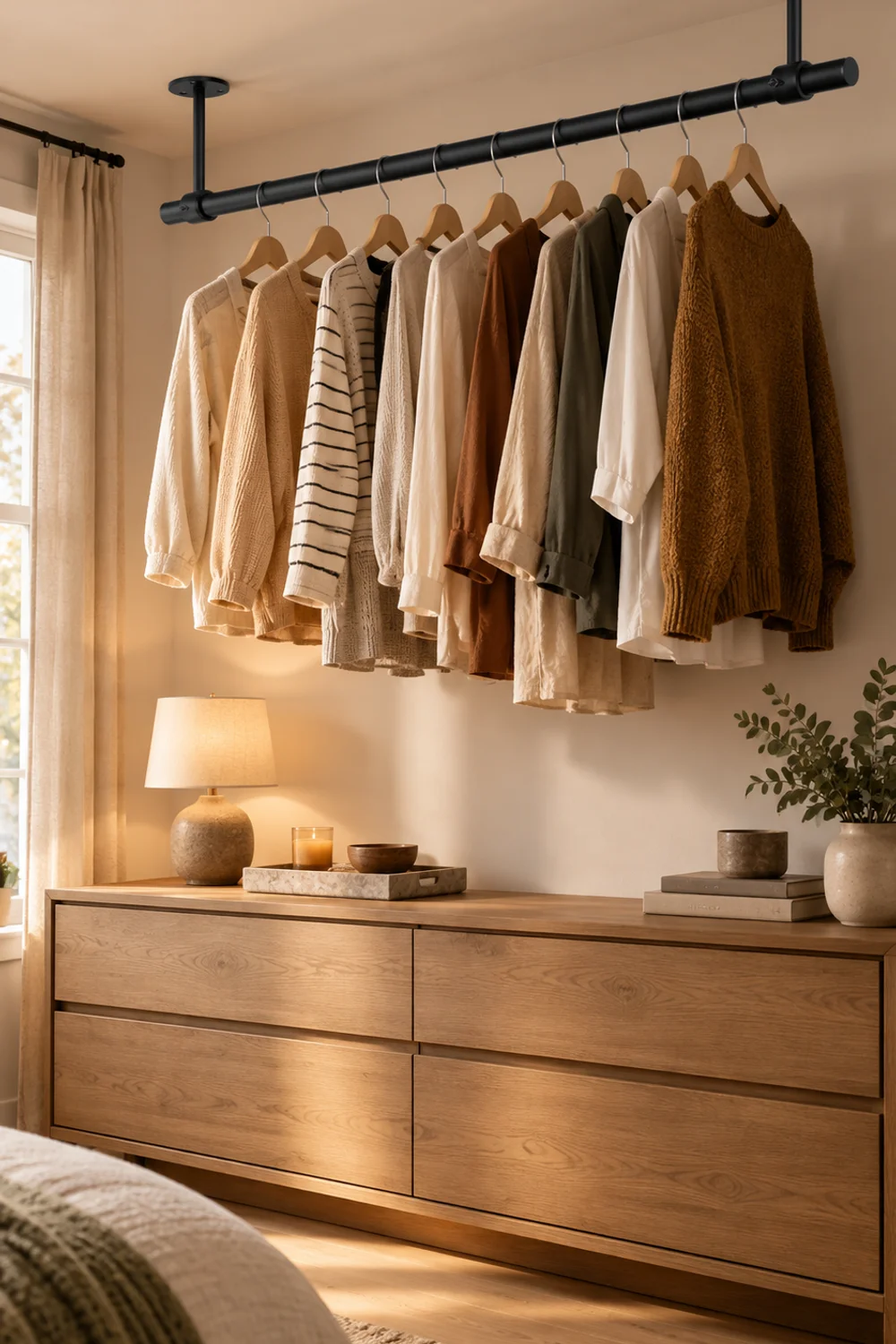
A rod is the simplest piece of closet there is, and where you have a dresser and a free stretch of wall above it, a single rail turns the combination into a closet in miniature. Hanging clothes above and drawers below is the arrangement of a dressing room, and it asks for very little hardware.
This ceiling-mounted rod is a black steel tube with a diameter of 1.3 inches, adjustable from 17 to 54 inches, that mounts to the ceiling or to a wall with plate brackets. The listing’s title states it supports up to 66 pounds. The adjustable length is useful, because it lets you match the rail to the exact width of the dresser beneath it instead of settling for a stock size.
Because it is screwed into a ceiling or wall, find a joist or stud before you commit, and follow the manufacturer’s instructions about anchors, since drywall alone is not a place to hang a rail of coats. Hang it high enough that clothes clear the dresser top with room to spare, and test the height with the longest garment you own, so a dress is not left folded over the lamp.
Keep the arrangement visually light. A slim black rail above a wide wood dresser reads like an intentional dressing nook, especially if you keep only a small edit of everyday clothes on it and use the drawers for the rest. A short row of matching hangers instantly makes the rail look composed.
Choose this when you have a wall and a dresser but no space for another wardrobe. It is the smallest structural change in this guide that still gives you real hanging space.
7. Try a Covered Portable Closet You Can Take With You
 Save it
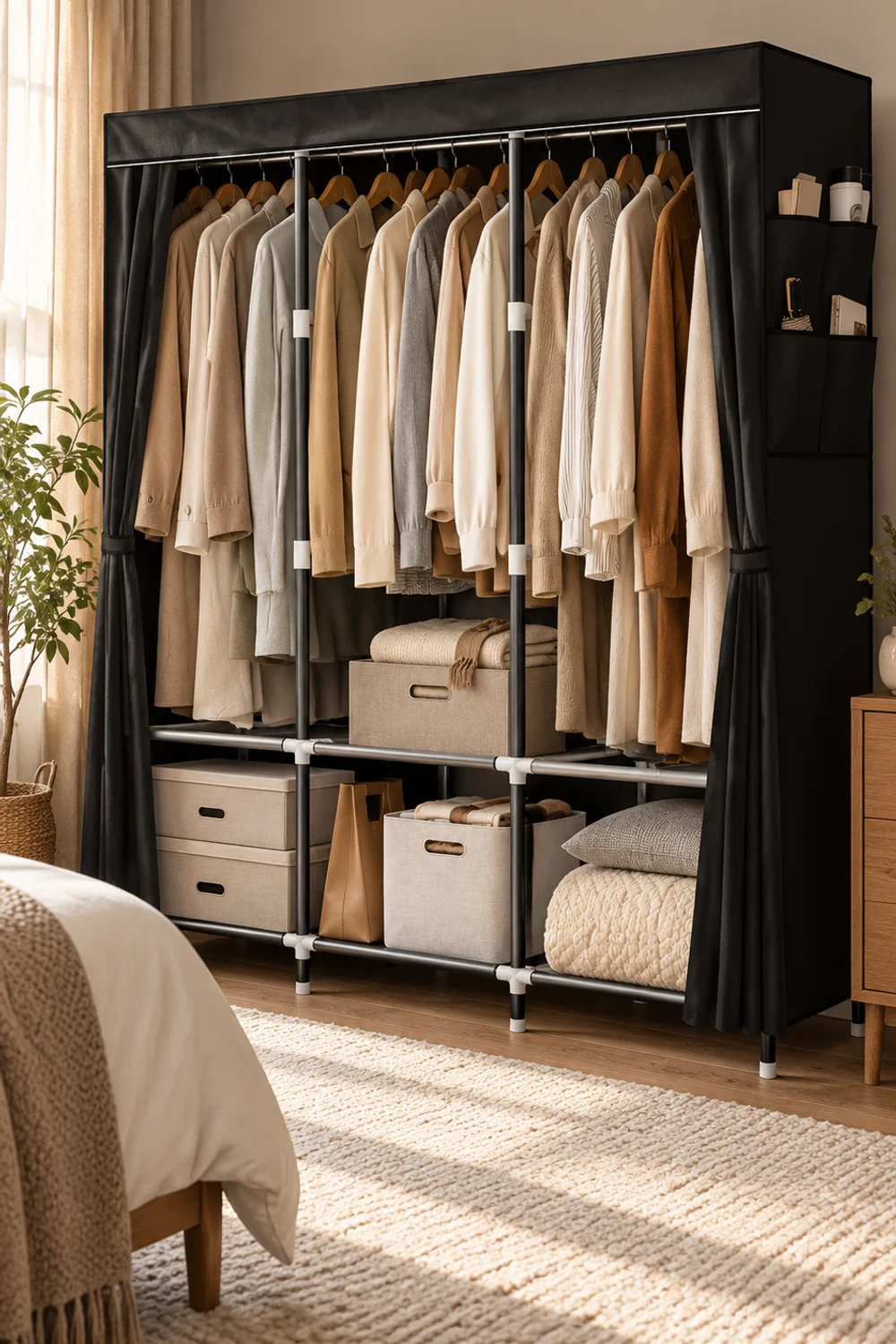
If the thought of drilling into a rented wall is the obstacle, a portable fabric-covered closet removes it. It assembles from poles and connectors, closes with a cover, and comes apart again when your lease ends. It will never feel like a built-in, but it is the quickest way to give clothes a contained, dust-resistant home with no work on the wall at all.
This wardrobe is a black fabric-covered frame, listed at about 51.7 inches wide, 18.2 inches deep and 70.6 inches tall, with three hanging rods and six storage shelves. The frame uses 19 millimetre steel pipe joined with plastic connectors, the cover is non-woven fabric that zips closed, and it has side pockets for small items.
Be realistic about what a light frame can hold. Plastic connectors and thin pipe are fine for everyday clothing and folded knits, but they are not the place for a winter coat collection, and the listing offers no load rating this guide could repeat. Spread weight across the rods rather than loading one, and keep the heaviest items on the lowest shelf.
For renters this is one of several no-drill answers, and Renter-Friendly Bedroom Upgrades That Make a Big Difference gathers more of them, from lighting that sticks on to curtains that hang from a tension rod. A portable closet pairs well with those, because every piece in that kind of bedroom shares the same promise: it comes with you.
Place it where its roll-up sides can open fully, and out of direct sun, which fades fabric. Choose this when flexibility matters more than polish, and consider it a first closet that can be replaced later with something more permanent.
8. Close the Whole Thing Off With a Curtain on a Ceiling Track
 Save it
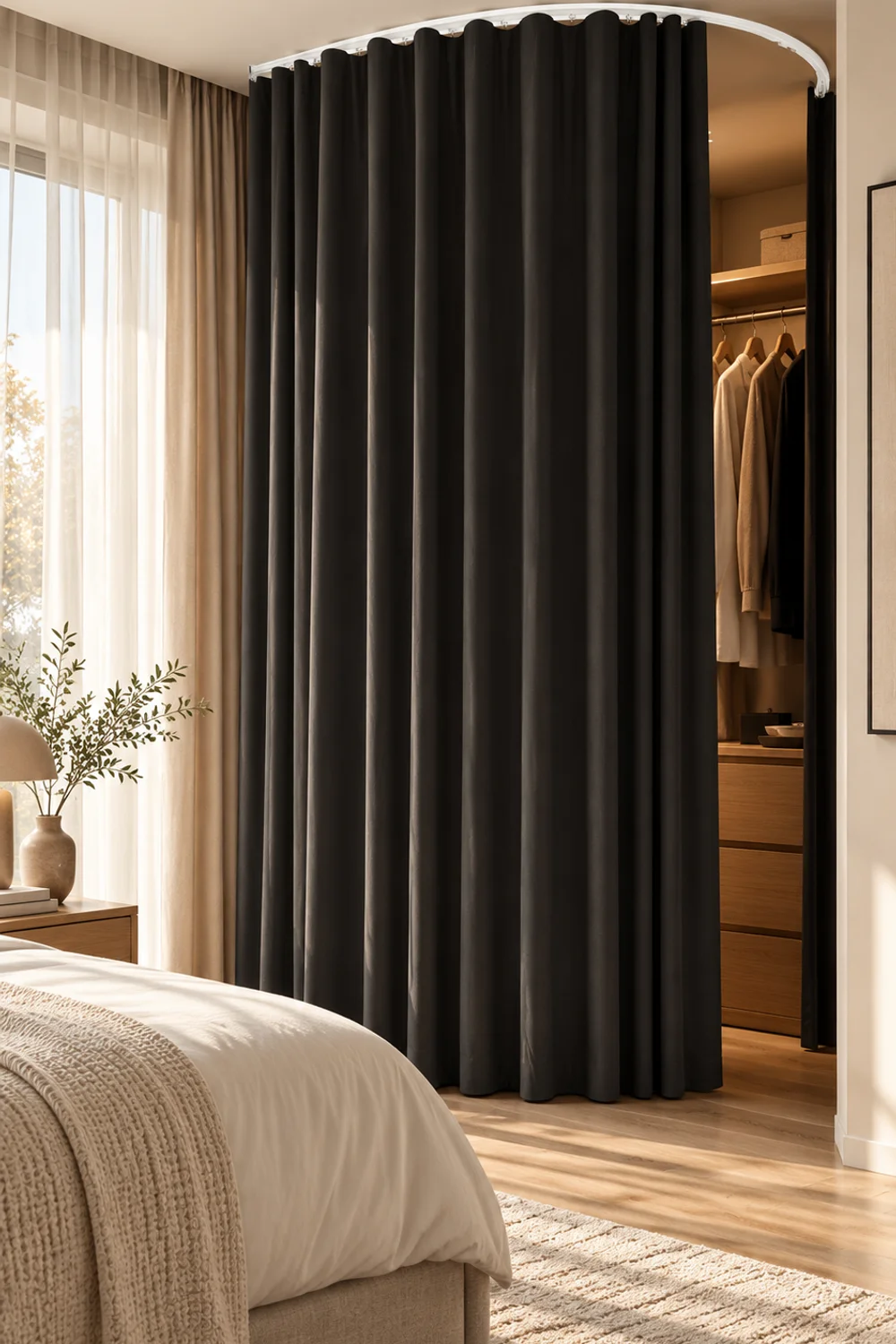
The last piece is the one that turns a collection of furniture into a room within the room. A curtain on a ceiling track hides whatever you have built, open rails, a rack or a portable closet, and it does it softly. Pulled shut, the wardrobe becomes a wall of fabric; pulled open, it is a wardrobe again.
This set pairs one black blackout curtain panel with a white bendable ceiling-mount track, listed at 8.3 feet wide and 7 feet high. The track can be shaped into an arc, a rectangle and other forms, which is what lets you curve it around a corner or enclose an alcove rather than being limited to a straight line, and the listing says the curtain can be machine washed in cold water.
The track screws into the ceiling, so locate a joist or use anchors suited to your ceiling, and follow the manufacturer’s instructions. Measure the opening you want to close, plus a little extra width so the curtain gathers instead of pulling taut, and check the height from ceiling to floor against the seven feet the listing gives.
Colour is the decision that matters most. Black is dramatic and hides what is behind it completely, but in a small room it can feel heavy, so keep it for a corner or an alcove and let the other walls stay light. Leave a gap between the curtain and the clothes, so fabric does not catch on hangers when you slide it open.
Choose this when the storage itself is not beautiful, or when you want one gesture that makes the whole arrangement feel finished. It is also the cheapest way to make a bedroom look as if the closet was planned.
Common Mistakes
1. Buying by width and forgetting depth
A wardrobe, rack or portable frame that fits the wall can still be too shallow for hangers or too deep for the walkway. Measure width, depth and the swing of any doors, and compare the listing’s depth with the width of your own hangers.
2. Overloading light frames
Portable closets and tension-based or plastic-jointed pieces suit everyday clothes, not a winter coat collection. Spread the weight, keep heavy items low, and follow whatever rating the manufacturer gives.
3. Skipping the anchor
Tall furniture needs to be fastened to the wall as its instructions say, and ceiling-mounted rods need a joist or suitable anchors. Neither is a place to guess.
4. Mixing finishes and hangers
Black pipe, white wardrobe, wood dresser and a rack of mismatched hangers read as clutter. Choose two materials, repeat one colour on the rail and let the rest recede.
5. Forgetting the drawers
Hanging space alone does not make a closet. Without somewhere to fold knits and small items, the clothes spill onto the chair again within a week.
Frequently Asked Questions
Can I create a closet without drilling into the wall?
Yes. A freestanding system or a covered portable wardrobe needs no fixings to the wall, though tall pieces should still be anchored if the instructions say so. Wall-mounted rails, ceiling rods and curtain tracks do need screws.
How much space does a closet need?
It depends on how much you hang. A single rail needs the width of your longest run of clothes and enough depth for hangers, which are roughly seventeen inches wide. Leave clear floor in front for doors or for reaching in, and check each listing’s size before you buy.
Is a wardrobe or an open rack better for a small bedroom?
A closed wardrobe keeps the room calmer and keeps dust and light off clothes, while an open rack holds more for less money and is easier to move. If you tend to leave things out, choose the wardrobe.
How do I make an open closet look neat?
Edit it. Use one type of hanger, hang by length and colour, keep a little empty rail, and put small items in bins. A curtain on a ceiling track can close the whole arrangement off when the room needs to look calm.
Final Thoughts
A bedroom without a closet is not a lesser bedroom. It is a room that asks you to decide how your clothes should live, and the answer can be more personal than a standard reach-in box ever allowed. Whether that is a boutique wall, a quiet armoire or a curtain that opens on a rail, the room can feel intentional instead of improvised.
You do not need all eight. Choose one structure for hanging, one place for folding, and one way to finish it, and let the rest wait. The clothes will have somewhere to go, the chair will go back to being a chair, and the room will start to feel finished long before you have bought a single extra piece.
This post contains affiliate links. I may earn a small commission at no extra cost to you. As an Amazon Associate I earn from qualifying purchases.

GET YOUR FREE CHECKLIST
A More Organized Home
Starts Here
Join the community and my free Home Organization Checklist, plus weekly tops and inspiration.
Thank you!
You have successfully joined our subscriber list.