
How to Decorate a Coffee Table for Christmas: A Simple Layered Look That Never Feels Cluttered
By HomeStyledLiving | October 14, 2026
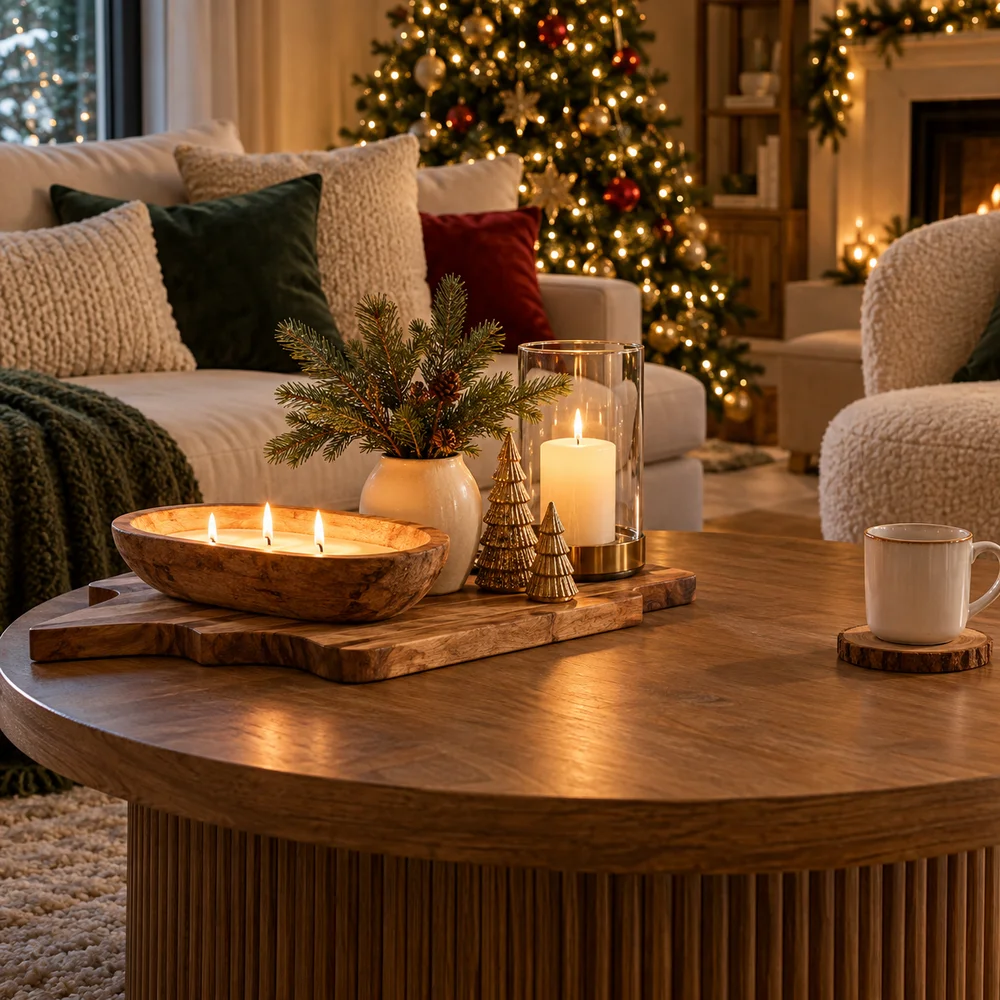
A coffee table is the busiest square meter in a living room. It holds the remote at nine in the morning, a mug at noon, somebody’s book at night, and by the first week of December it is also expected to hold Christmas. That is usually where the trouble starts. A little of everything gets added, one candle here, a ceramic tree there, a bowl of ornaments in the middle, and the table ends up looking like a shelf that lost its wall.
The tables that look best at Christmas are almost never the fullest ones. They are built the way a good photograph is built, with a base, a few layers at different heights, one source of warm light and a calm patch of open surface that lets the eye rest. Decorating a coffee table is really an exercise in proportion: decorate roughly two thirds of the length and leave the rest free, so the table still works as a table.
The eleven ideas below are the layers you can choose from. They are options, not a checklist, and a finished table needs only four or five of them. A tray, a centerpiece, something with height and a little greenery is already a complete look; light, an accent or a hidden basket for the remote can follow if the table has room. Each idea comes with one specific piece that shows how the layer works, so you can see exactly what it looks like before you decide which ones belong on your own table.
1. Clear the Table First and Give Everyday Clutter a Hidden Home
 Save it
Every styled table starts with an empty one. Before a single branch or candle goes down, take everything off the surface and put back only what you use daily. Most people find the list is short: a remote or two, a coaster, perhaps the book they are reading. Everything else, chargers, mail, a pair of reading glasses, the small objects that drift onto a coffee table over months, needs somewhere else to live, because Christmas decor will not hide it. It will only sit next to it and make both look worse.
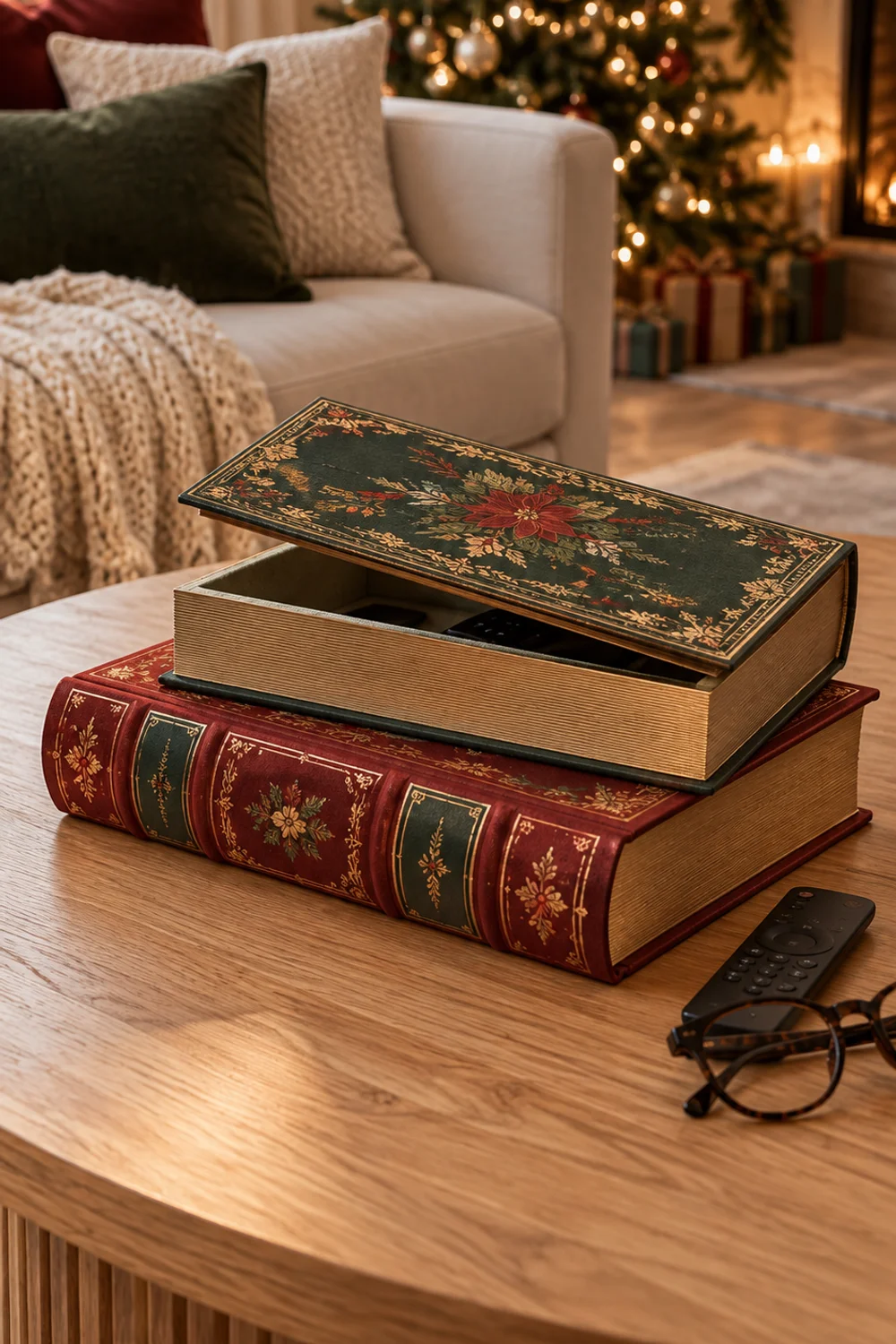
The most useful trick here is a container that looks like decor. A hollow decorative book does that job well, because it reads as part of the styling while quietly swallowing the things you cannot display. This set of two Christmas books comes in two sizes that nest together, about 10.5 by 7.5 inches and 9.3 by 6.8 inches, with linen covers, velvet paper and gold foil detailing, and each one is hollow inside so a remote, a pair of glasses or a few small keepsakes can disappear into it.
Their red and green covers are traditional, so treat them as one of your accents rather than a base. Stack the larger one under the smaller, turn the spines toward the seating and leave the top of the stack free for a single object later. A stack of two is enough. The point of this first step is not to add anything new, it is to decide what the table is for and make the answer visible, so the layers that follow have a clean stage to work on.
Once the surface is clear, stand at the seat where you sit most and look down at it. Notice which edge you see first and which corner you reach for. That quiet corner is where the practical items belong, and the rest of the table is yours to style.
2. Anchor Everything on One Tray So the Table Reads as a Single Picture
 Save it
A group of small objects scattered across a table looks like a collection of separate decisions. The same objects gathered on one base look like one decision. That is the whole case for a tray, and it is why almost every well-styled coffee table starts with one: the edge of the tray draws a frame around the arrangement, tells the eye where the styling begins and ends, and lets you lift the whole composition off the table in one move when you need the surface back.
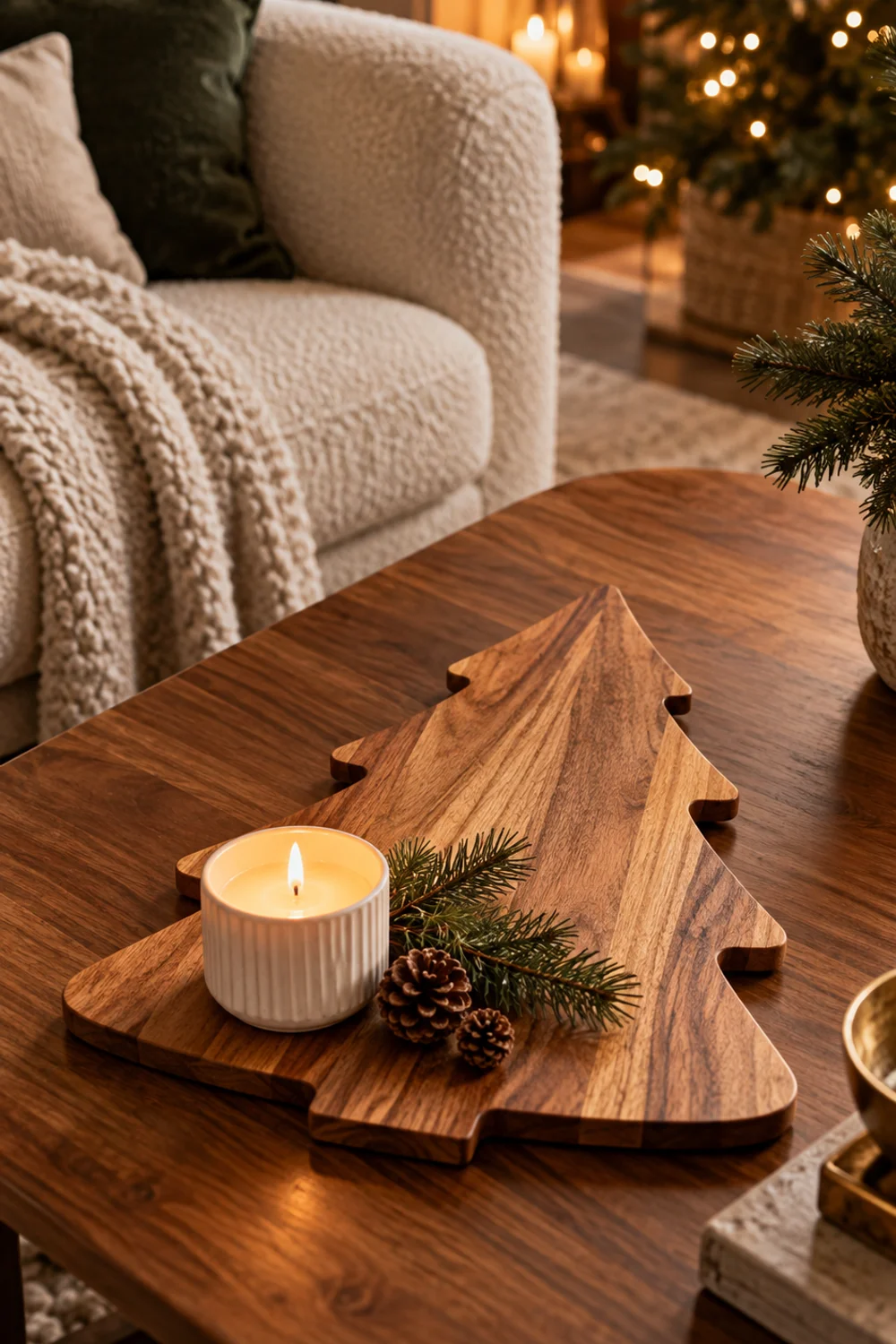
At Christmas a tray can also carry the season on its own. This serving board is cut in the shape of a Christmas tree and measures about 13.8 by 11 inches, with the visible grain and warm tone of natural acacia wood. It is a slim board of roughly half an inch rather than a deep tray with a raised rim, which suits a coffee table well because it adds a base without adding bulk.
Because it is flat, it asks for slightly different handling than a rimmed tray. Keep candles and anything that can roll away from the edges, set the heavier pieces toward the wide base of the tree, and put lighter things toward the narrow point. A thin felt or cork liner underneath keeps it from sliding on a glossy table. Used this way, the board does a second job: its silhouette becomes the first Christmas cue, so the rest of the table can stay quiet and neutral.
Choose the size by eye. The tray should cover about half to two thirds of the table’s length and sit slightly off-center rather than dead in the middle, which looks more relaxed and leaves room for a mug on the other side. On a round table, place it so a free arc of surface remains in front of each seat. If the board is the only layer you add, the table is already styled.
3. Set One Low Wooden Bowl at the Center and Let It Glow
 Save it
Once the base is down, the center of the arrangement needs one thing that holds the eye. A low, wide object does that better than a tall one on a coffee table, because you look across it, not up at it. Nothing blocks the conversation, nothing falls onto a lap, and the table still looks generous from across the room.
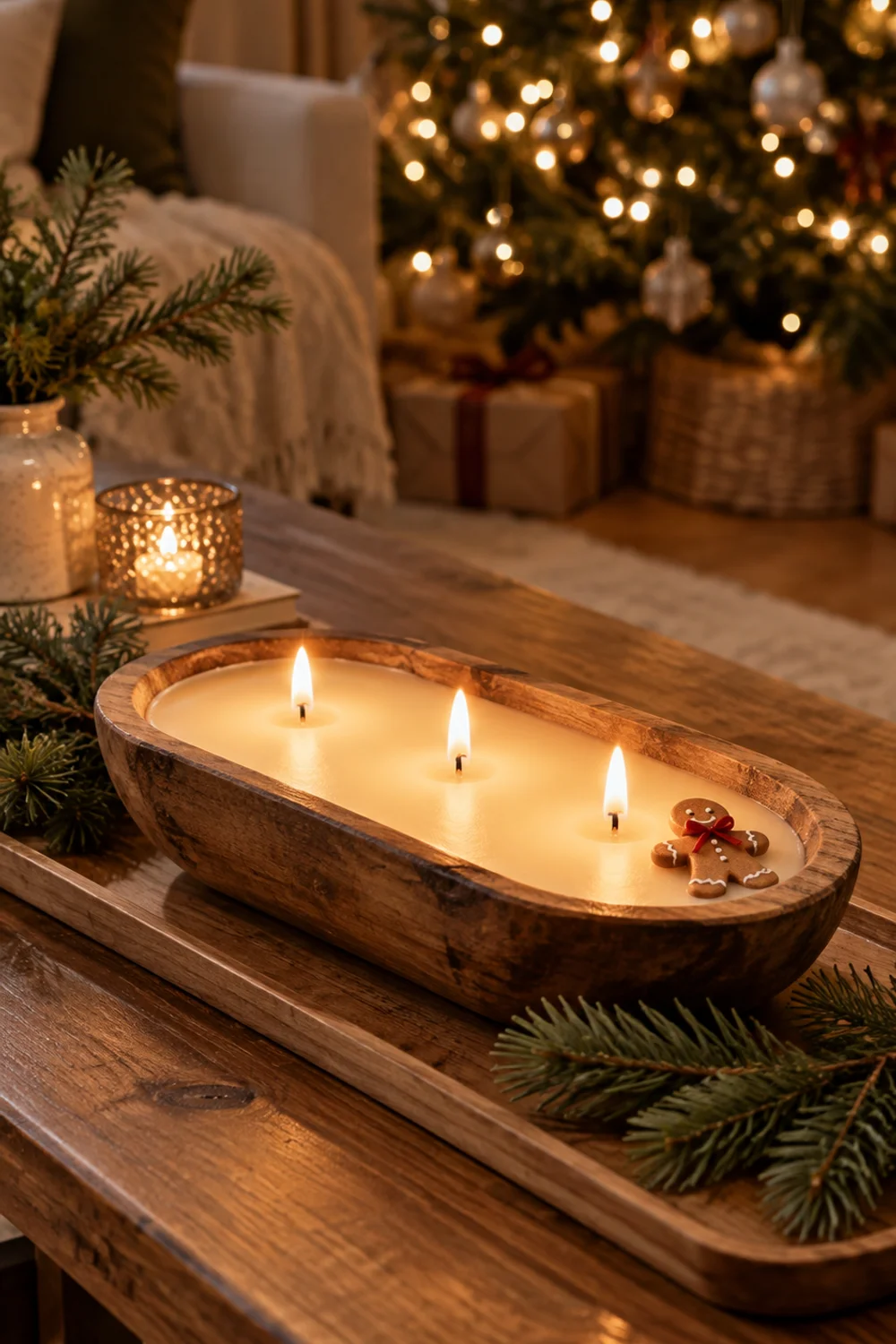
A wooden dough bowl is a natural fit. It is the kind of vessel that looks as if it has always lived on a farmhouse table, and when it holds a candle it adds warm light and a textured, organic shape in a single piece. This Dough Bowl Candle Company candle comes in the Gingerbread scent, a three-wick, 20 ounce soy candle poured into an elongated mango wood bowl of roughly 10 by 6 inches, with a small gingerbread-man tag resting on the wax. It gives the table something distinctly Christmas without a single red ornament.
Place the bowl on the tray, slightly toward one end, so the other end can take height or greenery. Its long oval shape also suits a rectangular table especially well, because it follows the direction of the table instead of fighting it. The scent is a bonus, not the point: gingerbread reads as warm and baked rather than perfumed, so it works in a living room without competing with dinner from the kitchen.
This is a real-flame candle, so a few habits matter. Light it only while you are in the room, keep it away from the edge of the table and from anything dry or hanging, and let it burn long enough for the wax to melt across the surface so it burns evenly. When it is finished, the bowl stays behind as a decorative piece you can reuse for nuts, ornaments or pinecones. If you have young children or a curious pet, skip ahead to section 9 for a flameless version of the same glow.
4. Add Height With a Single Vase of Evergreen Stems
 Save it
A table with nothing taller than a candle looks flat, however beautiful the objects are. One vertical element fixes that immediately. It gives the arrangement a peak the eye can travel up to and makes the lower pieces around it look like they are supporting something. The rule is simple: just one, and not too tall. On a coffee table, anything much above 12 to 14 inches starts to block the view of the person sitting opposite.
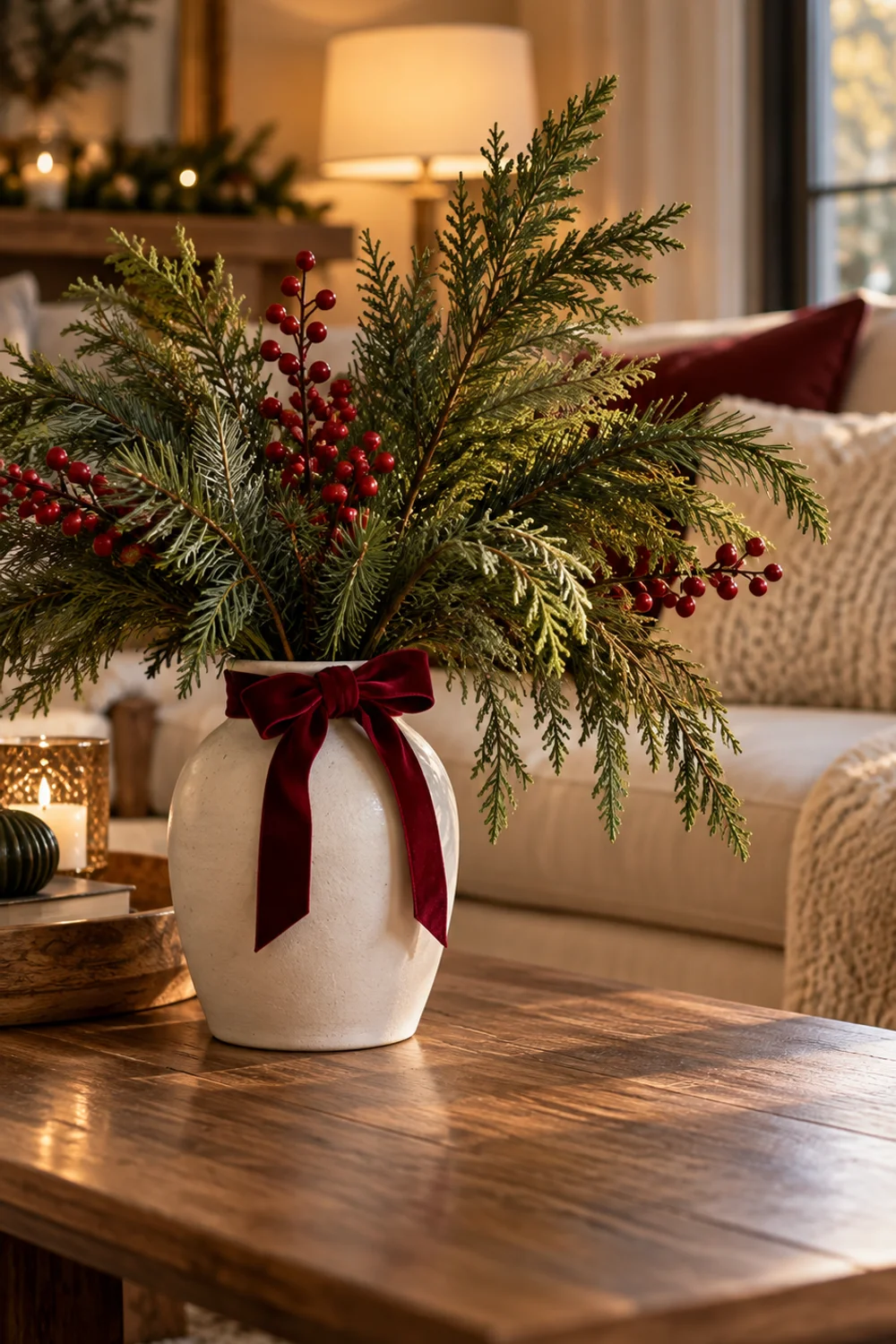
Evergreen stems in a plain vase are the classic solution because they look seasonal without looking busy. This set comes as a single ceramic vase of about 7.5 inches in white, tied with a burgundy bow, plus 35 artificial Norfolk pine and cypress stems of about 10.6 inches and 10 red berry stems. Together that is enough to fill the vase generously and still have branches left over for the other layers on the table.
Resist the urge to fill every inch. Start with the pine stems, cut a few to different lengths and let them fan out slightly, then add only three or four berry stems so the red reads as an accent rather than a theme. Keep the vase at one end of the tray, ideally the end farthest from where people reach for things, so it stays a quiet vertical and never a hazard.
Because the vase is ceramic and white, it also serves as a light visual counterweight to the darker wood of the bowl and tray. If the burgundy bow feels too traditional for your room, simply untie it. The vase works just as well plain, and the stems carry plenty of Christmas on their own. The pleasing thing about a single vertical element is how much it simplifies everything else: with height taken care of, nothing else on the table needs to reach upward.
5. Tuck Greenery and Texture Around the Candles, Not Across the Table
 Save it
Greenery is the layer that makes a styled table feel like Christmas rather than a room with a few candles in it, and it is also the layer most likely to get out of hand. A long garland running the length of the table, or branches scattered everywhere, reads as clutter within minutes. A better approach is to keep greenery close to something, so it looks planted instead of dropped.
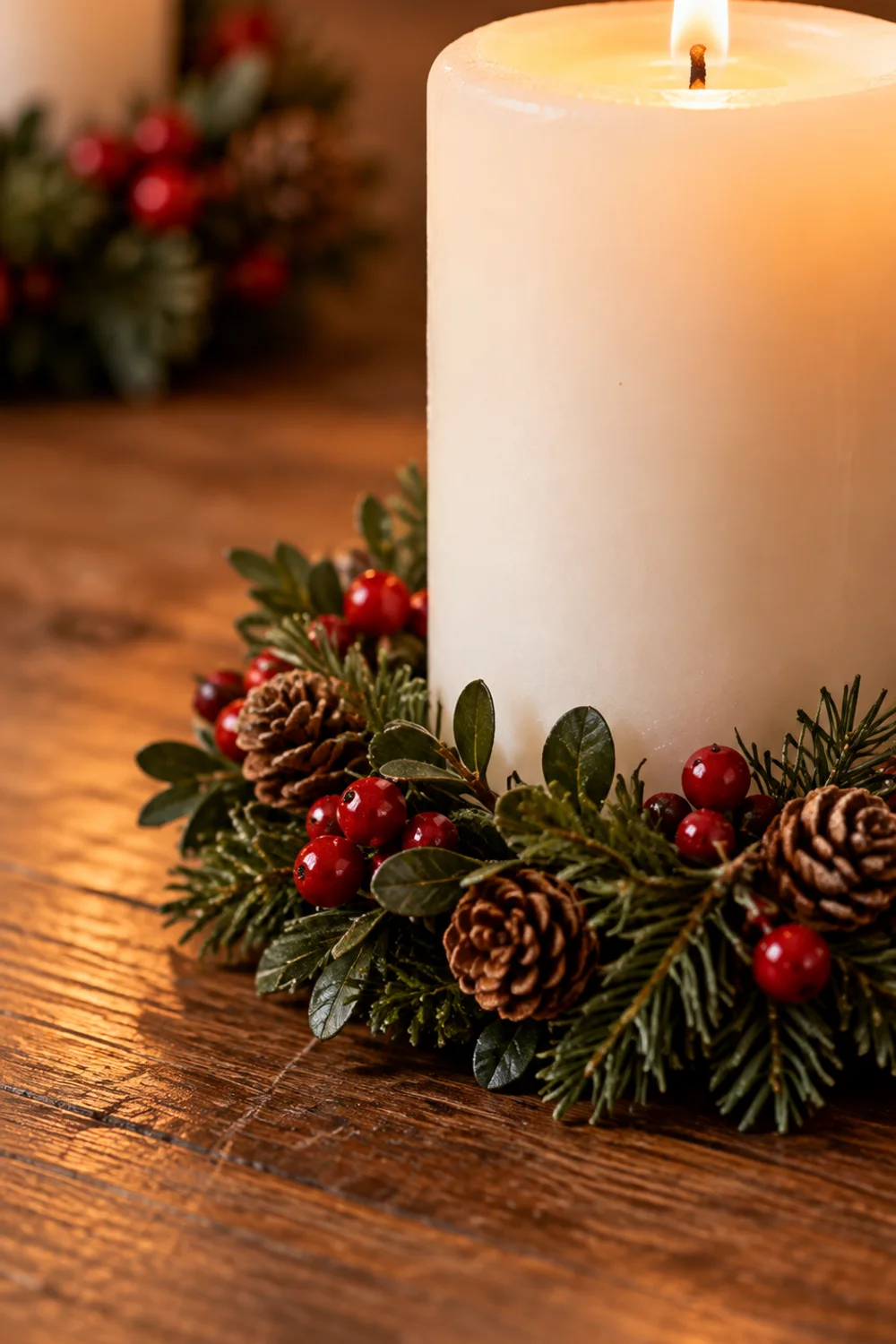
Candle rings do this in the neatest possible way. They are small wreaths designed to sit around the base of a candle, which hides the bottom edge, adds a ring of texture and ties the candle to the seasonal palette in a single move. This set includes eight small rings of about 4.3 inches in diameter, each made from faux berries, pinecones and green leaves on a plastic base.
You will not need all eight. Two or three rings are enough for a coffee table, and the others can go on a mantel, a side table or a dining table later in the season. Use one around the base of the candle bowl or a pillar, one near the vase, and let the tray stay otherwise bare. That restraint is what makes the rings read as a deliberate texture rather than decoration for its own sake.
Mix surface qualities rather than adding more of the same. Smooth white ceramic, rough pine, matte wood and glossy gold look rich together because each one reflects light differently, and that variation is what gives a layered table its depth. If you already have a few pinecones in a bowl or a leftover sprig of greenery from the tree, tuck them in beside the rings and skip buying anything new. Greenery works best as a fringe around the edge of your focal pieces, never as a carpet laid over the whole table.
6. Give Candlelight a Glass Shield With a Pair of Hurricane Holders

 Save it
Candlelight is the most flattering light a living room can have, and glass makes it feel even better. A hurricane holder wraps the flame in a clear dome, which softens the glow, protects it from drafts and gives a candle the height and presence of an object in its own right. Instead of a small flickering point at the bottom of the arrangement, you get a clear column of warm light that sits comfortably at eye level when you are seated.
A pair is more effective than a single holder because two pieces of different sizes create rhythm. This set of two has glass domes on iron bases in a vintage brass finish. The smaller one stands about 4.3 inches wide by 6.8 inches tall and fits pillar candles up to 3.5 inches in diameter, which makes it a practical match for common pillar sizes.
Place the two holders at different points on the tray rather than side by side, so the light is spread across the arrangement and the table does not look like a matching set. Put a simple ivory pillar inside each one and the brass base will catch the glow and echo the gold elsewhere on the table. The glass also adds something other layers cannot: it reflects the lights of the room, which gives the table sparkle in the evening without a single ornament.
Glass layers are also kinder to clutter. Because the domes are see-through, they take up very little visual weight for their height, and you can see the tray and the greenery through them. That means you can add height without crowding the table, which is exactly the balance this look depends on. If real flames are not right for your household, a flameless pillar inside the same holder gives exactly the same silhouette with none of the risk.
7. Choose One Small Seasonal Accent and Let It Be the Punctuation

 Save it
After the base, the center, the height and the light, the table needs one small flourish, a single object that says Christmas out loud. Think of it as punctuation. It should be small, have some character and appear only once. A table with one well-chosen accent looks collected. A table with six looks like a gift shop.
Gold resin trees are an easy way to do it. This set of two comes in different heights, about 8.7 inches and 5.6 inches tall, with a glossy gold finish, a rough textured surface and tiers shaped like six-pointed stars. The shine picks up candlelight beautifully and brings a bit of metallic warmth that sits well next to wood and white ceramic.
Use them as a pair of unequal siblings, the taller one slightly behind and the smaller one just in front, and keep the pair together as one accent. Position them near the end of the tray opposite the vase so the heights do not stack up in one spot, and leave a little space around them so their silhouettes remain visible. Because they are resin, they are lighter than ceramic and less likely to chip, though you still want them away from the table’s edge.
The choice of accent matters less than the discipline of choosing only one. If gold trees do not suit your style, the same role could be played by a single ceramic figure, a small brass bell or a bundle of cinnamon sticks tied with twine. What counts is that the accent is clearly smaller than the centerpiece and clearly different from everything near it. When you step back and your eye lands on it last, after taking in the whole arrangement, you have placed it correctly. If it grabs attention first, it is either too large for the table or too close to the center, and moving it a few inches toward the edge of the tray usually settles it.
8. Limit the Palette to Three Tones So Everything Belongs

 Save it
The fastest way to make a collection of unrelated objects look like a designed set is to hold them to a few colors. Three is a comfortable number: one soft light tone, one dark green and one warm metallic or wood tone. Anything beyond that begins to compete, and a coffee table is too small a stage for competition. A single accent in red is welcome, because it works like a spark, but it should stay a spark.
A frosted white layer is the easiest one to add and the one that makes the greens and golds around it look richer. These three snow-covered mason jars come in graduated sizes, 26, 18 and 9 ounces, and each one carries a different arrangement of pine sprigs, pinecones and glass berries. The white snow finish ties in the white ceramic vase, and the green sprigs repeat the pine stems.
Do not put all three jars out. One or two, placed off to one side so their sizes step down toward the edge of the tray, give you the frosted note without turning the table into a winter village. The remaining jar can move to a shelf or a window sill, where it extends the palette into the room without crowding the table.
Check the palette the same way each time. Squint at the table. If you see white, green and warm wood or gold, with perhaps one small touch of red, the table has a clear voice. If you see five different colors and finishes, remove the piece that is least like the others. It is usually the one you bought on impulse. Letting the palette repeat across the tray, the vase, the jars and the accent is what makes a table look as if it was planned all at once. It also makes the table easier to live with, because a calm palette lets one bright detail, a berry stem or the red cover of a book, stand out without any effort.
9. Swap Flames for Flameless Light Where Kids and Pets Live
 Save it
A coffee table sits at exactly the height of a toddler’s reach and a cat’s curiosity. That is the reason many homes with children or pets skip real candles in December, and it does not mean giving up the glow. Modern LED candles look convincing, offer the same warm flicker and can be set on a timer, so they are on when you want them and off when you forget.
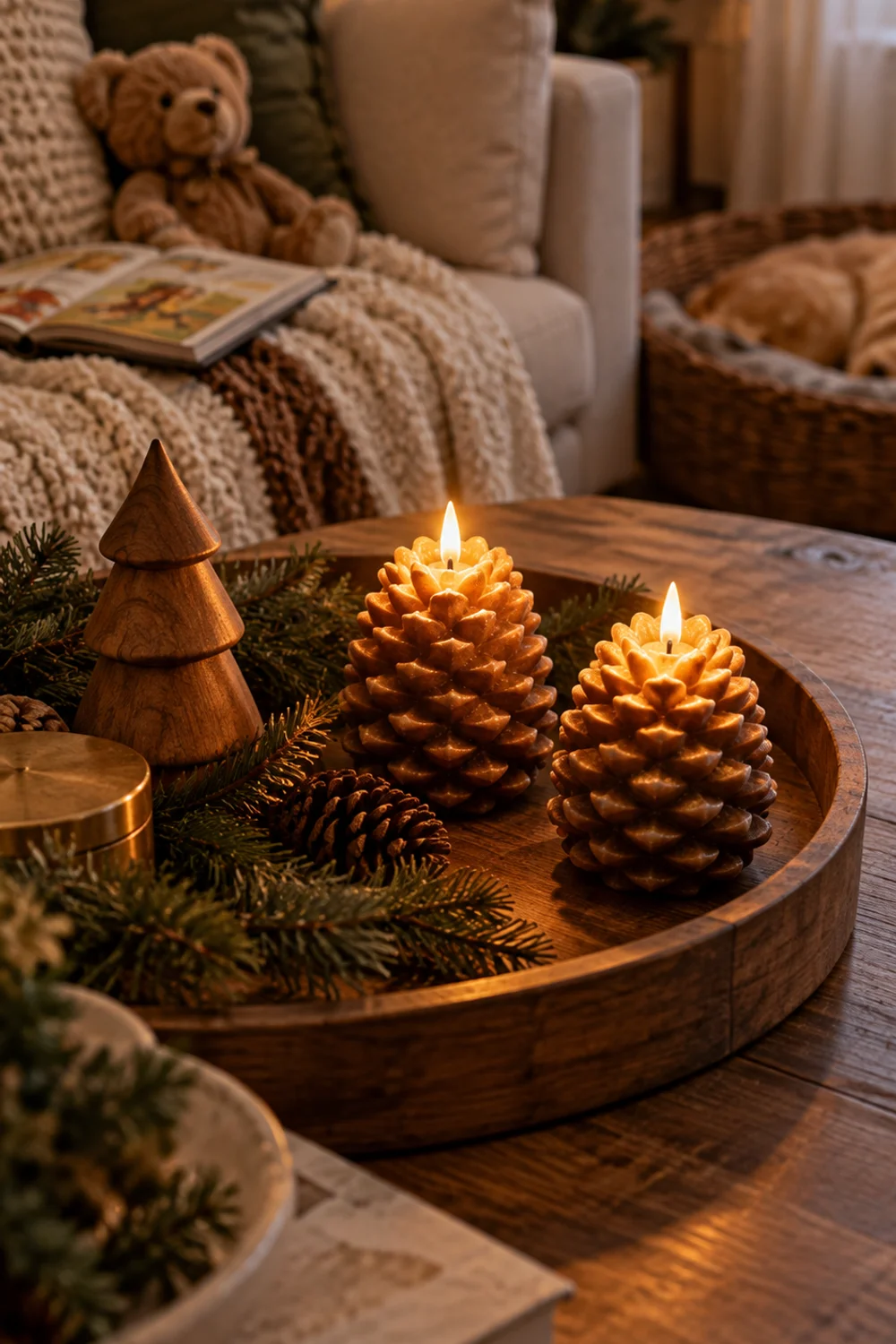
These two brown candles are shaped like pine cones and made with a real wax shell around a flickering LED. Each is about 3.5 inches wide and 4.7 inches tall. They run on two AA batteries each, which are not included, and have a six-hour timer, so they turn themselves on at the same time every evening without a switch to find.
Their brown pine cone shape brings in a natural texture that fits with the wood and the greenery. They are also the right width for the hurricane holders in section 6, so you can set one inside each dome and have the glass shield without any open flame. A flameless candle in a glass holder is hard to tip, hard to burn and still looks like the real thing at a glance.
Think about the rest of the table too. Place breakable objects toward the middle of the tray and away from the edges, and keep lightweight items off the front edge where hands reach first. Choose bases with some weight, such as wood, ceramic and resin, rather than anything that wobbles. Felt, wood and resin pieces handle bumps better than glass, and a tray with a few well-chosen things on it is easier to move out of reach than a dozen loose ones. A child-friendly table is not a different style of table, it is the same layered look with fewer ways to go wrong.
10. Keep One Clear Spot for Cups, Plates and Real Life
 Save it
A coffee table that cannot hold a coffee is a failure however good it looks. The most common mistake in seasonal styling is covering the whole surface and then watching it fill with mugs and plates anyway, which ruins the arrangement within an evening. The answer is to plan the working zone in advance: a deliberate patch of bare table near each seat, protected by a coaster, where cups and snacks can land without disturbing anything.
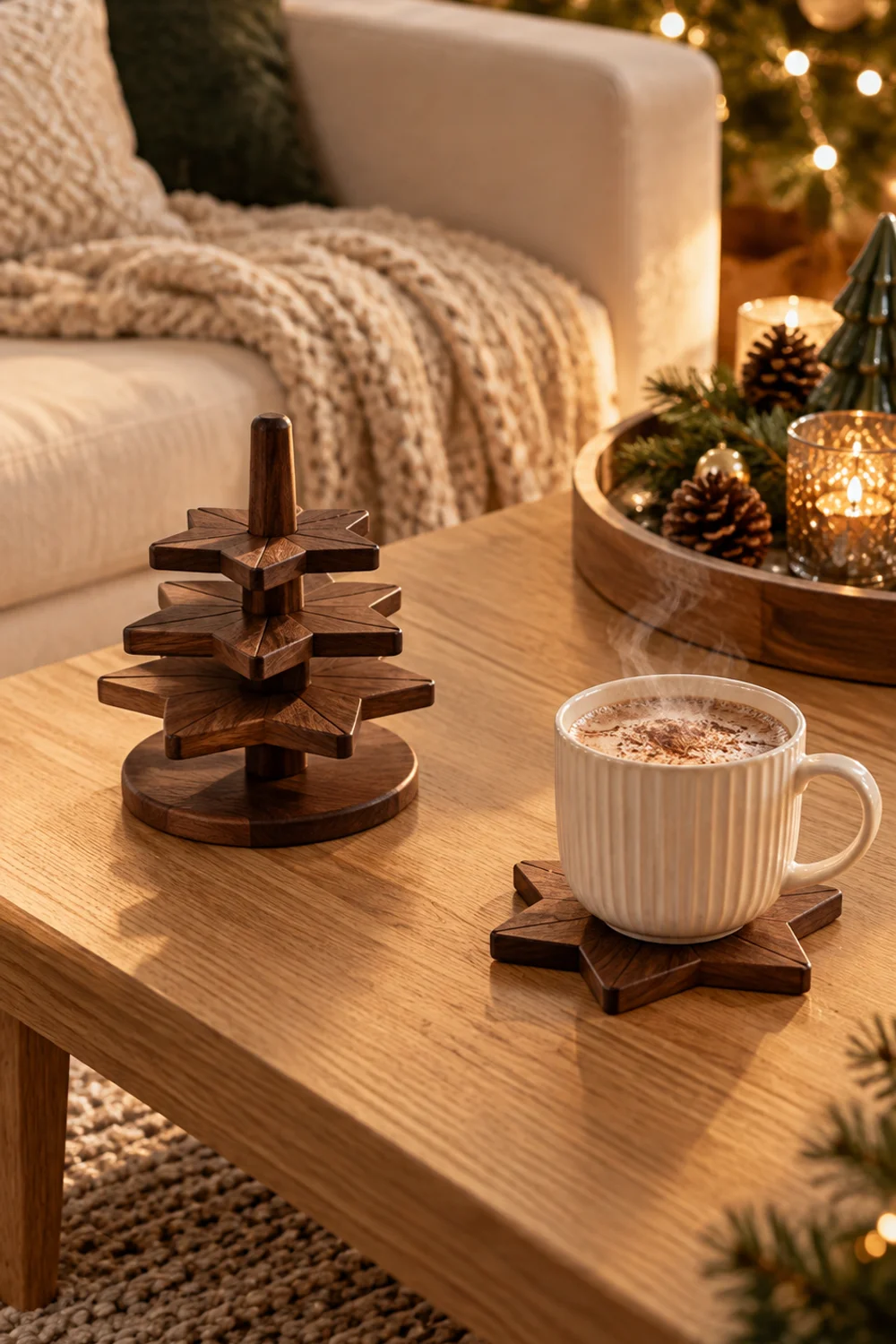
Wooden coasters in a tree shape handle this and add a seasonal note on top. This set holds four wooden trivets on a small stand shaped like a Christmas tree, and the listing describes them as usable both as coasters for cups and as trivets for hot dishes. The stand can sit on the table as a small piece of decor when the trivets are hanging on it, and the trivets come off one by one when you need them.
Put the stand at the edge of the table, near the sofa, where it is easy to reach and tucked outside the styled area. When guests come, they will find the coasters without being told, and you will avoid the usual scene of rings on the wood. The tree shape ties in with the tray and the accents, but since it is all wood, it also blends quietly into the background.
Keep the open zone honest. If the table is rectangular, leave one long side free and move the styled tray toward the other. If it is round, keep a quarter of the circle open. Anything you decide to keep on the working side should earn its place by being used daily. This is the same two-thirds idea from the introduction in practice: the styling occupies most of the table, and the free third is what makes the table feel generous instead of cramped.
11. Edit, Then Reset: Let Painted Wood Trees Carry the Table After the Holidays
 Save it
The last step in any styling job is subtraction. Once everything is in place, step back, look at the table from the sofa and take away one thing. It is almost always the right call. The eye needs breathing room, and the best-styled tables usually look as though they could hold one more item and chose not to.
Editing is not a one-time job. Over a month, a table drifts: a candle moves, a mug appears, a branch leans. A two-minute reset each evening, putting everything back where the tray and the clear zone intend, keeps it looking as good in the third week of December as it did in the first. For the larger picture, How to Decorate Every Room for Christmas Without Overspending shows how to repeat one palette from room to room, so the coffee table is part of a whole house instead of a one-off.
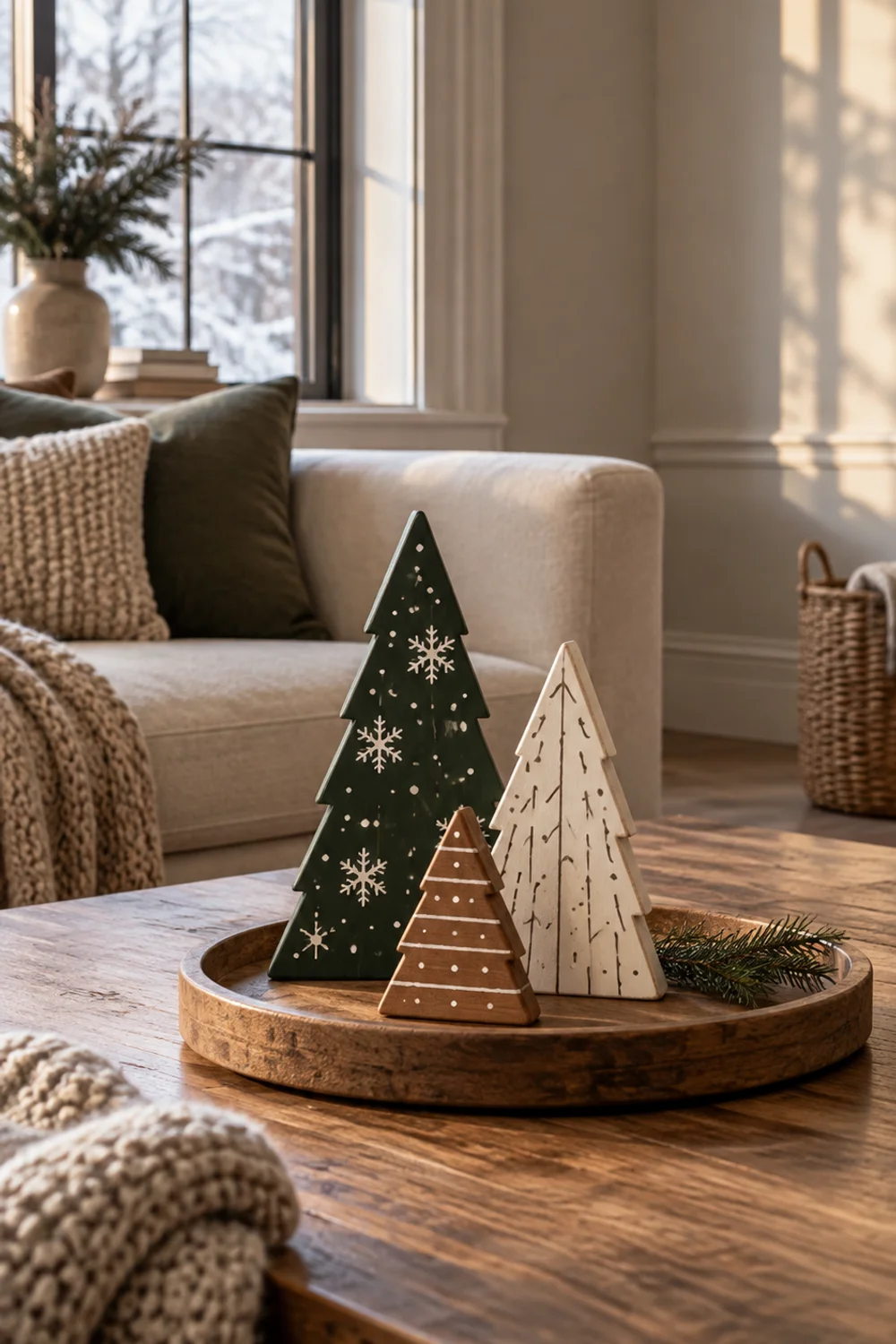
The reset also plans the table’s second life. Christmas-specific pieces like the gold trees and the gingerbread candle can go away once the holiday is over, but a quiet set of painted wooden trees can stay through January as winter decor. This set of three flat wooden trees comes in graduated sizes and is painted in muted forest green, cream and brown, with small snowflakes, dots and fine line patterns. The colors are soft and the shapes are simple, so they read as winter rather than as Christmas once the tree is gone, and they can replace the bolder accents on the tray and keep the table looking intentional.
Stand the three trees from tallest to smallest, with the tallest at the back, and leave the rest of the tray nearly bare. The result is much quieter than the full December table, and that is the point. A table that can shift from festive to calm without being rebuilt is one you will actually keep up.
When you take everything apart in January, put the tray, the bowl and the vase in one box so that next year starts with the same base. The layered method is repeatable, and that repeatability is exactly what keeps the table from becoming cluttered.
Common Mistakes
1. Decorating the entire surface
The most common problem is covering every inch because there is empty space. A coffee table has to work every day, and a fully decorated surface forces you to move things whenever you need to put down a cup. Style about two thirds of the length and leave the rest open, and the table will look more expensive as well as being more useful.
2. Making everything the same height
A row of objects at the same level looks like a shelf display. The eye needs a low centerpiece, a mid-height accent and one taller piece, so it can move across the table instead of stopping. Think in a triangle of heights rather than a line.
3. Using too many small things
A dozen small objects read as clutter even when each one is beautiful. Replace several small items with one or two larger ones, and group what remains on a tray so the table reads as a single arrangement.
4. Leaving real flames within reach of children and pets
A coffee table is the first surface a child or a pet reaches. Light real candles only when you are in the room, keep them away from the edge and away from dry greenery, and switch to flameless candles when the household changes or you leave the room for long.
5. Letting every piece compete for attention
When three objects are all trying to be the focal point, none of them wins. Decide which piece is the star, usually the centerpiece, and let the others play supporting roles in the same colors and materials.
6. Forgetting where the mug goes
Styling that ignores everyday use falls apart by the second evening. Keep a clear spot with a coaster near each seat and put the practical things, remotes and chargers, in a hollow book or a basket rather than leaving them in the middle of the arrangement.
7. Keeping every layer on at once
It is tempting to use every idea you like, but a finished table needs only four or five layers. If you find yourself adding the sixth, take the least necessary one away.
Frequently Asked Questions
How do I decorate a coffee table for Christmas without it looking cluttered?
Start with a clear table, add one tray as a base and build only four or five layers on it: a low centerpiece, something with height, a little greenery, a source of light and perhaps one small accent. Hold the colors to three tones, keep a clear working area near the seats and take away one item at the end.
What should I put in the middle of a coffee table at Christmas?
A low, wide centerpiece works best, because you can see over it. A wooden bowl with a candle, a tray with a small group of objects or a cluster of candles in glass holders all suit the center, and a single taller element, such as a small vase of evergreen stems, can sit at one end.
What is the two-thirds rule for coffee tables?
It is a rule of thumb for proportion. The decor should cover about two thirds of the table’s length, which leaves about a third bare, so the arrangement looks balanced and the table can still be used for cups, books and snacks.
How can I style a coffee table for Christmas if I have kids?
Use flameless candles, choose pieces made from wood, resin or other sturdy materials, keep breakable objects toward the center of the tray and keep the edges clear. Weighted bases are safer than anything that wobbles, and a clear zone near the seats keeps drinks away from the decor.
Is it safe to use real candles on a coffee table with pets?
It is safer to use flameless candles, because pets can knock over or brush against a real flame. If you do use a real candle, light it only while you are in the room and keep it away from the edge and from anything flammable.
Should a coffee table tray be round or rectangular?
Choose the shape that echoes the table. A rectangular table usually looks best with an oblong or rectangular base, and a round table suits a round one, but a shaped tray, such as one cut like a Christmas tree, can work on either as long as it leaves some table visible around it.
When should I take the Christmas decor off the coffee table?
Most people take it down in the first week of January. A simple option is to keep a few neutral pieces, such as simple painted wooden trees, on the tray through the winter and pack the rest away.
Final Thoughts
A Christmas coffee table does not need more decorations to look finished. It needs a base, a few layers at different heights, one warm light and a patch of open space that lets the whole thing breathe. Choose four or five of the ideas above, keep the palette to three tones and edit the table once more before you step away.
Do that, and the table does two jobs at once. It looks like part of a considered room, and it still holds a mug, a remote and a plate of something warm. The same tray and the same method will carry you through next December, and the one after that, with only the details changing.
This post contains affiliate links. I may earn a small commission at no extra cost to you. As an Amazon Associate I earn from qualifying purchases.

GET YOUR FREE CHECKLIST
A More Organized Home
Starts Here
Join the community and my free Home Organization Checklist, plus weekly tops and inspiration.
Thank you!
You have successfully joined our subscriber list.