

Simple Bedroom Organization Ideas That Create a Clutter-Free Space
By HomeStyledLiving | October 12, 2026
Most bedrooms are tidy on Sunday and cluttered again by Wednesday. Nothing dramatic happens in between. A phone charger stays plugged in on the nightstand, a necklace gets dropped next to the lamp, a pair of shoes is kicked off by the closet door, a sweater is draped over the chair because the shelf looked too full to fold it onto. Each one is a tiny decision made at the end of a long day, and by midweek the room has quietly filled up again.
It is tempting to read that as a storage problem and go looking for more cabinets, but most bedrooms do not need more space. They need better landing spots. Clutter collects on flat surfaces, the nightstand, the dresser top, the bed, the chair and the closet floor, because those surfaces are the easiest place to put something down. The moment a specific home is easier to use than the nearest surface, the pile stops forming.
That is the idea behind every section of this guide. Each one looks at a single hotspot, explains why things keep landing there, and gives those things one simple, contained place that takes less effort than the surface itself. There are no renovations here and no complicated systems, just ten changes you can make in an afternoon, several of them in a few minutes.
The ideas move from the inside of the dresser to the closet, the bedside, the dresser top and finally the corners of the room where laundry and blankets tend to gather. Each one is paired with one specific product that shows the idea in practice, and each explains why it works, so you can adapt it to the bedroom you actually have.
1. Sort Small Clothes Into Fabric Drawer Bins So the Dresser Top Stays Clear
 Save it
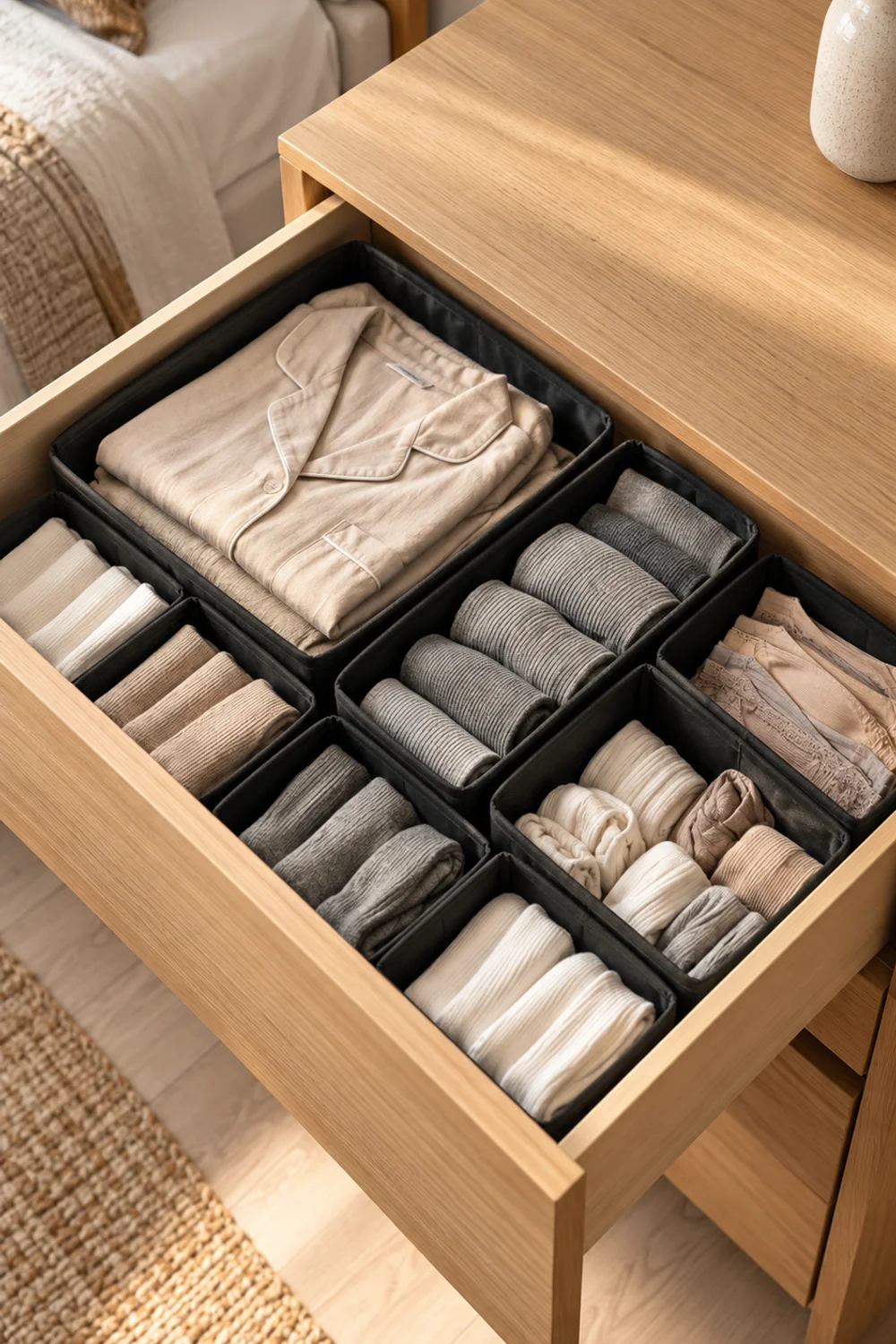
It sounds backwards to start a clutter-free bedroom inside a drawer, but the dresser top usually fills up because the drawer below it no longer works. When socks, underwear, tights and sleep shorts are tossed loosely into the top drawer, it reaches a point where it barely closes. From then on, clean laundry waits on the dresser “until there is time,” and the surface becomes a second drawer that everyone can see.
Small clothes are the hardest category to keep in order because they are soft, light and shapeless. They slide into each other, and every search for a matching pair stirs up the rest. Open fabric bins give them walls. Instead of one big drawer holding everything, you get a set of smaller compartments, each holding one type of item, and nothing can drift into its neighbor.
The fabric drawer organizer set comes as twelve black bins in three sizes: four large 11-inch squares, four medium rectangles and four small 5.5-inch squares. That mix is what makes it useful in a bedroom dresser. Larger bins hold sleepwear or leggings, medium bins hold rolled T-shirts or tights, and the small squares are right for socks, underwear and the little things that otherwise float around the drawer. The bins zip into shape with no tools, have stiffening boards in the sides, and fold flat if you rearrange later.
Before you place a single bin, empty the drawer completely and decide which categories genuinely belong there. A drawer organized around clothes you no longer wear is still a crowded drawer. Then arrange the bins like a puzzle, with the categories you reach for every morning at the front.
If your dresser also has deep lower drawers, they need a different approach than this small-item drawer. The method of standing larger folded clothes in narrow lanes is covered in Small Bedroom Organization Ideas That Instantly Free Up Space, and the two techniques work well together. Once the top drawer closes easily again, putting laundry away takes seconds, and the dresser top is free for what it was meant to hold.
2. Move Shoes and Bags Into One Rotating Shoe Tower
 Save it
Shoes are one of the quickest things to make a bedroom look untidy. They rarely go back where they belong because where they belong is usually a crowded closet floor, so they end up by the bed, beside the door or half under a chair. Handbags follow the same pattern: dropped on the bed, hung on a doorknob, propped against the dresser. Neither category needs much space. Both need a home you can reach in one motion.
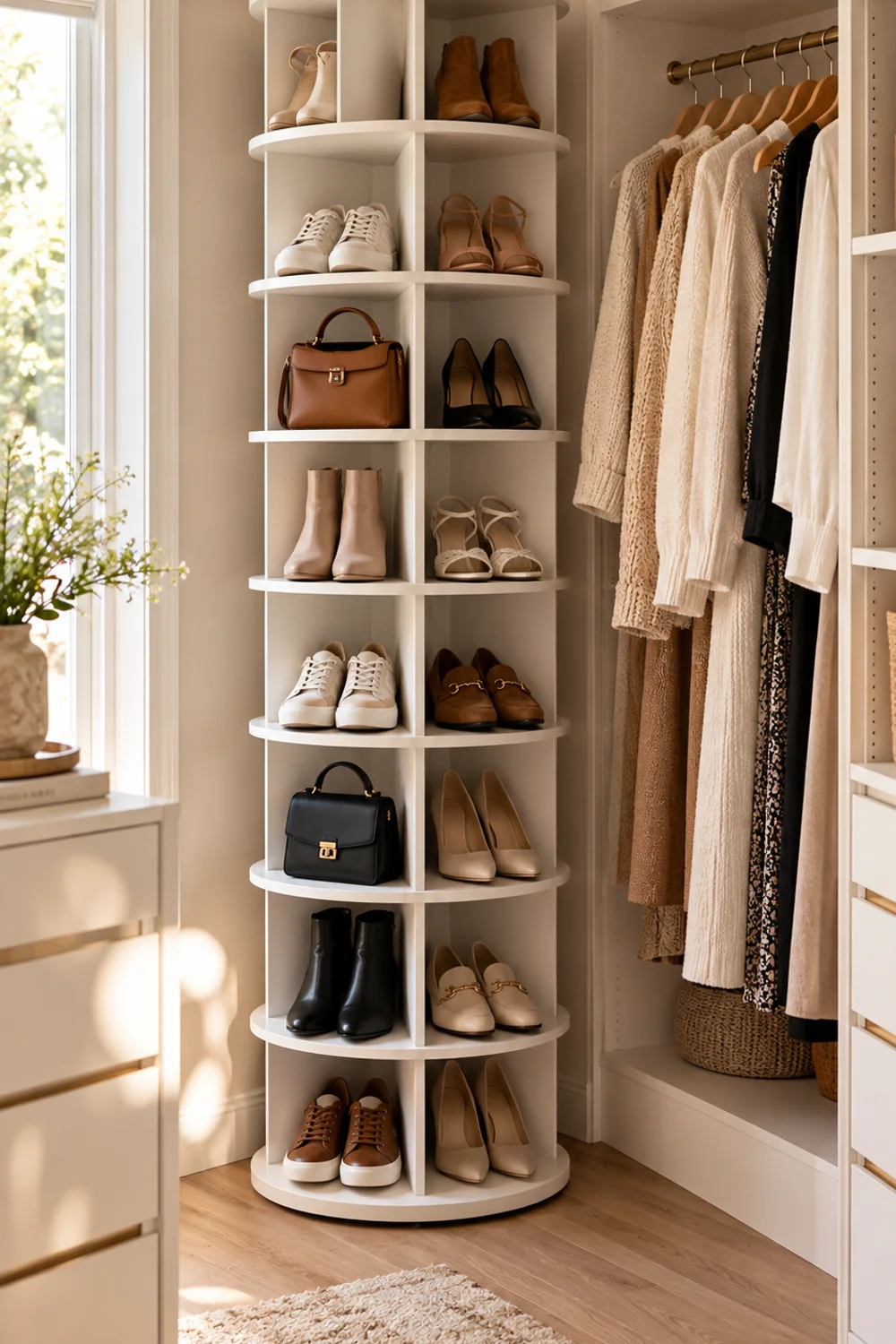
A rotating tower works because it changes the shape of the problem. Most shoe storage spreads sideways across the floor, which is exactly the space a bedroom has the least of. A tower stacks the same number of pairs vertically, and because it spins, every pair is reachable from one spot. You do not need to reach behind the front row, so you are much more likely to put a pair back.
The rotating shoe rack tower is a white seven-tier carousel, about 23 inches wide and deep and 63 inches tall. Each round tier is divided into wedge-shaped compartments by vertical panels, so shoes sit in their own sections rather than sliding into a heap, and the listing notes it can also hold handbags, hats and other accessories. The white finish lets it read as a piece of furniture in a closet corner or a bedroom alcove rather than as a utility rack.
Give the tower a clear job. The pairs you wear most belong on the middle tiers, between waist and eye height, where they are quickest to grab and put back. Occasional shoes can go on the top and bottom tiers, and one or two tiers can hold the bags that currently live on your bed. Measure the corner before you buy, since a tower that needs a 23-inch circle and enough clearance to turn will not fit everywhere.
It also helps to set a limit. If the tower is full, a new pair means an old pair leaves. That simple rule keeps the tower from overflowing onto the floor around it, which would bring you right back to where you started.
3. Free the Nightstand With a Bedside Wall Organizer
 Save it
The nightstand is the most overworked surface in a bedroom. It is the only flat space within reach of the bed, so everything you use in the last and first ten minutes of the day ends up there: phone, remote, glasses, lip balm, a water bottle, headphones, a book. Each item is perfectly reasonable on its own. Together, they make the most visible spot in the room look crowded every single night.
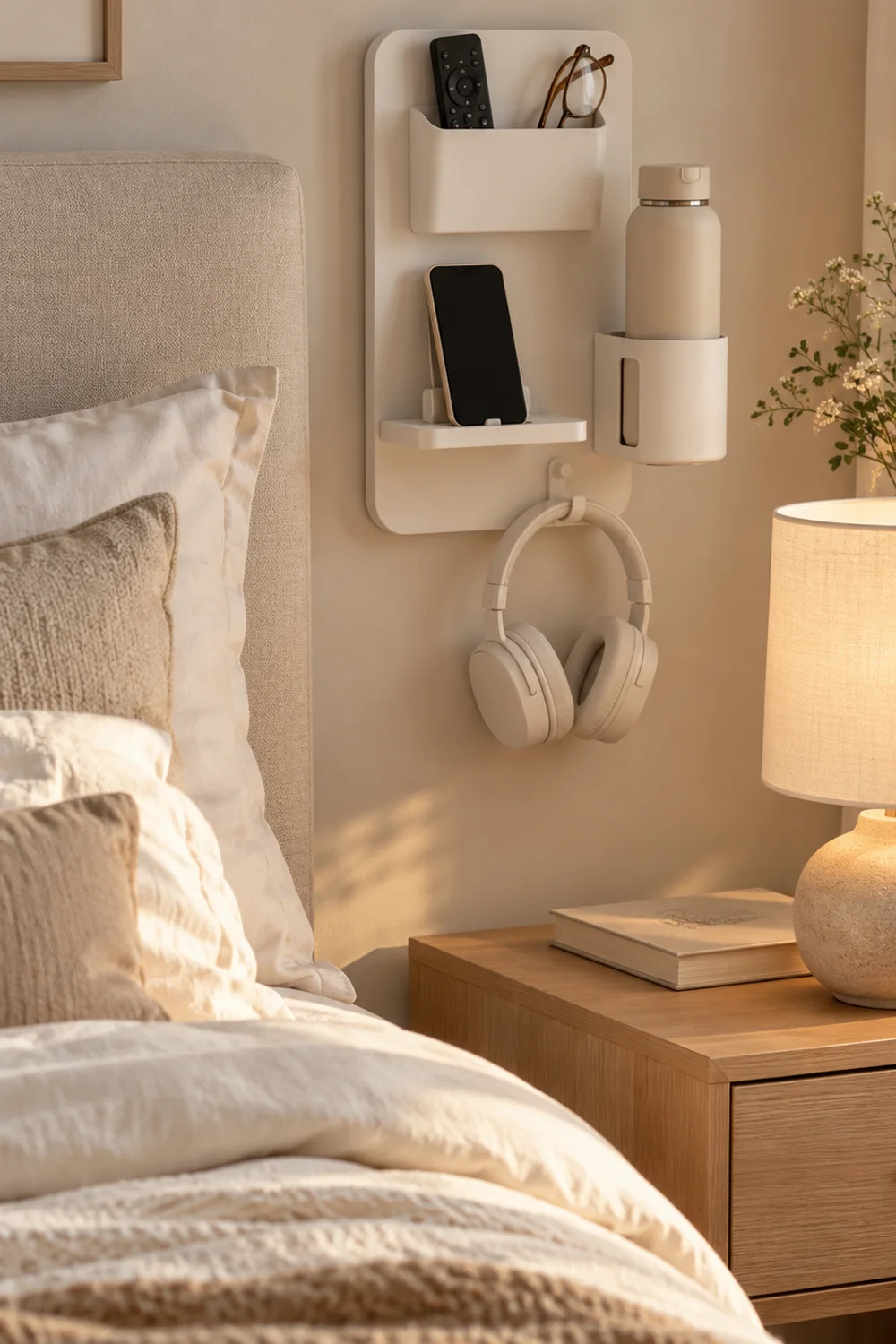
The fix is not a bigger nightstand. It is to take the small things that need to be within reach off the surface and give them a place on the wall right beside the bed. A bedside wall organizer keeps everything at the same arm’s length, but each item now has its own slot instead of competing for space on a tabletop.
The Bedside Wall Organizer 2.0 in white is designed for exactly this. It combines a pocket at the top for things like remotes and glasses with a floating ledge that holds a phone, and it has modular add-ons such as a cup holder and hooks for headphones or keys. It mounts with either adhesive or screws and has a built-in level, so it is a practical option for renters and for anyone who would rather not drill next to the bed.
Mount it at the height your hand naturally reaches when you are lying down, usually a little above mattress level, and keep it to the things you really use at night. If you charge your phone in bed, plan the cable route before you mount it so the cord does not drape across the wall. Keep heavier items, like a full glass of water or a stack of books, on the nightstand itself.
Once the small things move to the wall, the nightstand can hold just a lamp and one object you enjoy looking at. If the nightstand itself is the problem, too big or too heavy for the space, the lighter bedside options in Easy Small Bedroom Ideas That Make Any Room Feel Bigger pair well with a wall organizer. Either way, the side of the bed you see first every morning starts the day clear.
4. Hang Necklaces and Bracelets on a Two-Tier Jewelry Stand
 Save it
Jewelry creates more visual clutter per square inch than almost anything else in a bedroom. A necklace dropped on the dresser is small, but within a week there is a little pile of chains, a bracelet, two single earrings and a ring in a saucer. Necklaces also tangle when they are left in a heap, which makes them annoying to wear and even more likely to be left out.
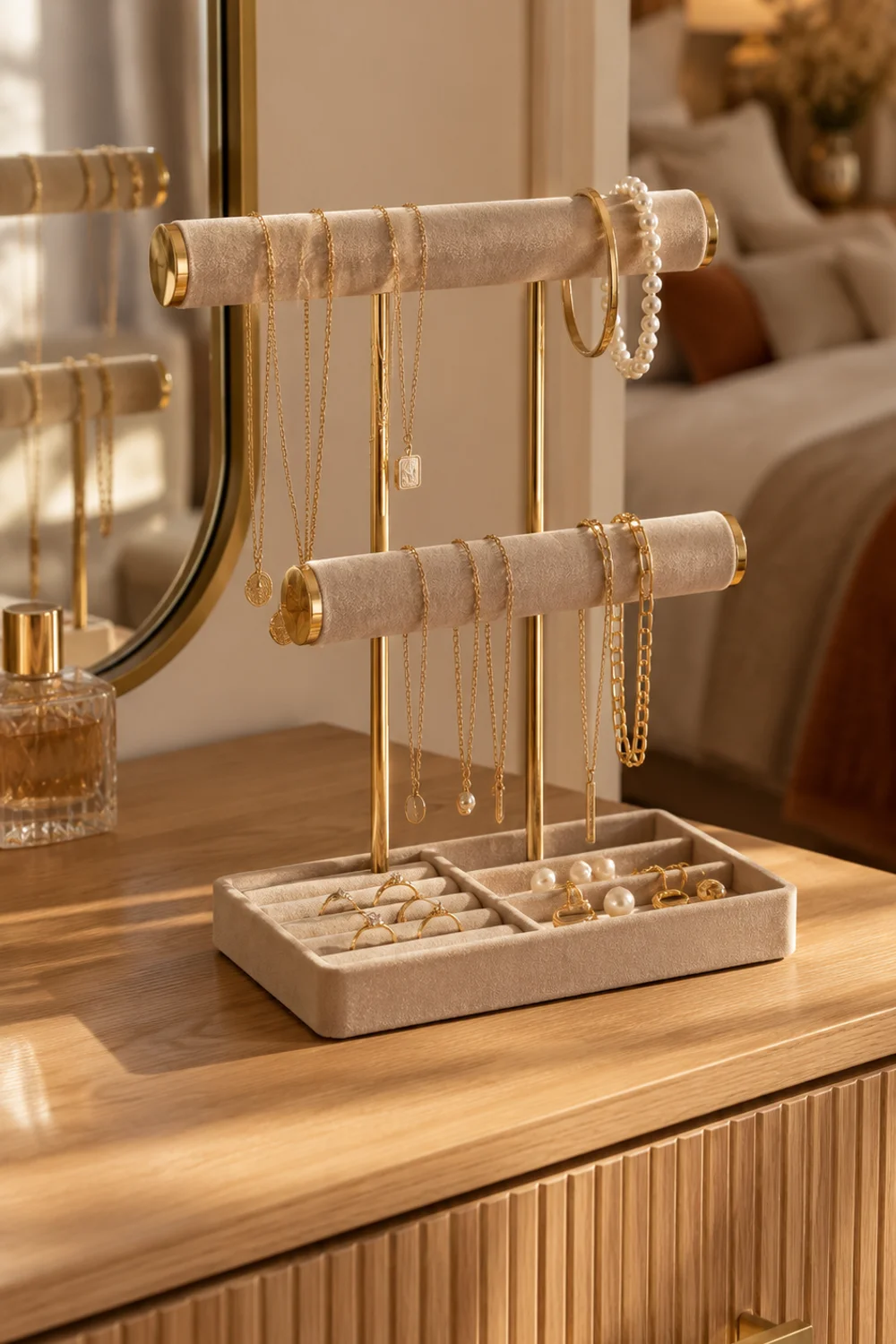
The solution is not to hide every piece away. The jewelry you wear every day needs to be quick to grab, or it will end up back on the dresser. What it needs is a defined footprint: one place that holds everyday pieces vertically, so chains hang straight and nothing has to be untangled before you can leave the house.
This 2-tier jewelry stand is a T-bar design with two beige velvet rods on gold-tone uprights, set on a base that includes a small ring tray and a compartment. Bracelets slide over the rods, necklaces drape across them, and rings and earrings sit in the tray below. The velvet surface helps keep pieces from slipping and from being scratched, and the soft beige with gold reads as a decorative object rather than a storage product, which matters on a surface as visible as a dresser.
Before you set it up, sort your jewelry into what you actually wear in a typical week and everything else. Only the first group goes on the stand. Occasional pieces, special-occasion jewelry and anything you are keeping for sentimental reasons are better stored in a drawer or a lidded box, where they are protected and out of sight.
Place the stand at the back corner of the dresser or beside a mirror, not in the middle of the surface, so it frames the space rather than taking it over. The rule from here on is simple: a piece of jewelry is either on you, on the stand or put away. It is never loose on the dresser. That single habit removes one of the most common sources of small, scattered clutter in the room.
5. Charge Phone, Watch and Earbuds on One 3-in-1 Charging Stand
 Save it
Cables are a type of clutter people stop noticing after a while, but they are one of the main reasons a bedside looks messy even when everything else is tidy. A phone charger, a separate watch charger and an earbud cable each need their own plug and their own spot, and the result is three cords trailing across the nightstand and down the back of the furniture.
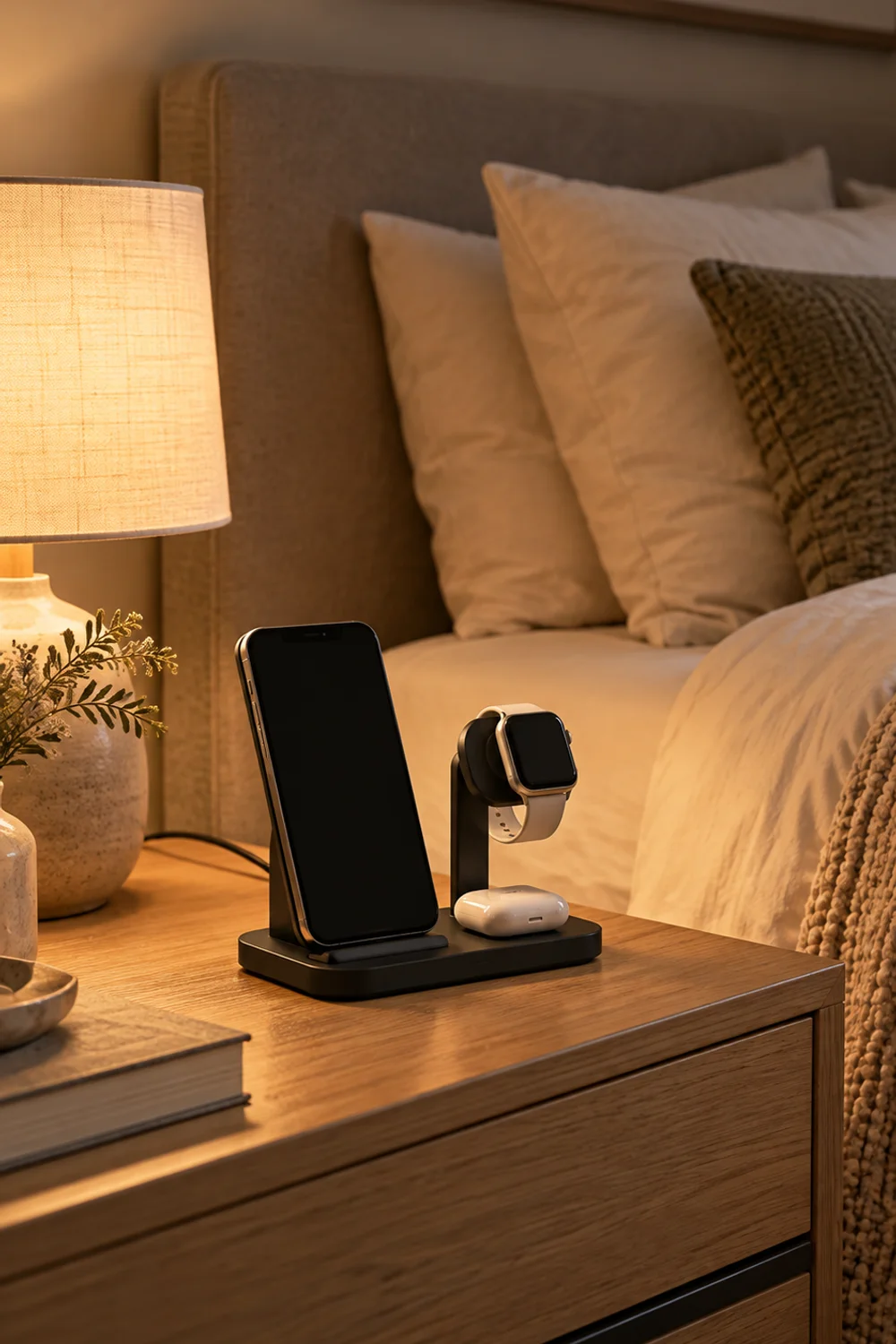
A single charging stand reduces all of that to one footprint and one cable. Instead of three devices lying flat wherever there was room, they sit upright in a designated place, which also makes it obvious when something is missing from its spot. It works the same way as a key hook by the front door: the habit forms because the place is easy and always the same.
This 3-in-1 wireless charging station in black has an upright pad for an iPhone, a raised puck for an Apple Watch and a pad on the base for AirPods. According to the listing, it works with recent iPhone, Apple Watch and AirPods models, including AirPods that are in a wireless-capable charging case, and it supports phone cases up to about 4 millimeters thick, without metal rings or magnets. It has LED indicators and folds flat, so it can also travel with you.
It is worth being clear about what a wireless stand does and does not do. It still needs one cable to the outlet, so plan where that single cord runs, ideally straight down behind the nightstand. And it is designed for Apple devices, so check compatibility before buying if your household uses a mix of phones.
Decide whether the stand lives on the nightstand or on the dresser. Putting it across the room is a small trick that many people find helpful: the phone charges overnight where you cannot scroll it from bed, and the alarm makes you get up. Wherever you put it, retire the old individual chargers to a drawer or donate them, so they do not drift back onto the surface.
6. Contain Makeup and Skincare in a Clear Organizer With Drawers
 Save it
When makeup and skincare live on a bedroom dresser, they tend to spread. Bottles are set down wherever there is room, a palette stays open, brushes lie on their sides, and every morning the collection moves a few inches further across the surface. Even a modest routine can take over half a dresser because nothing gives it an edge.
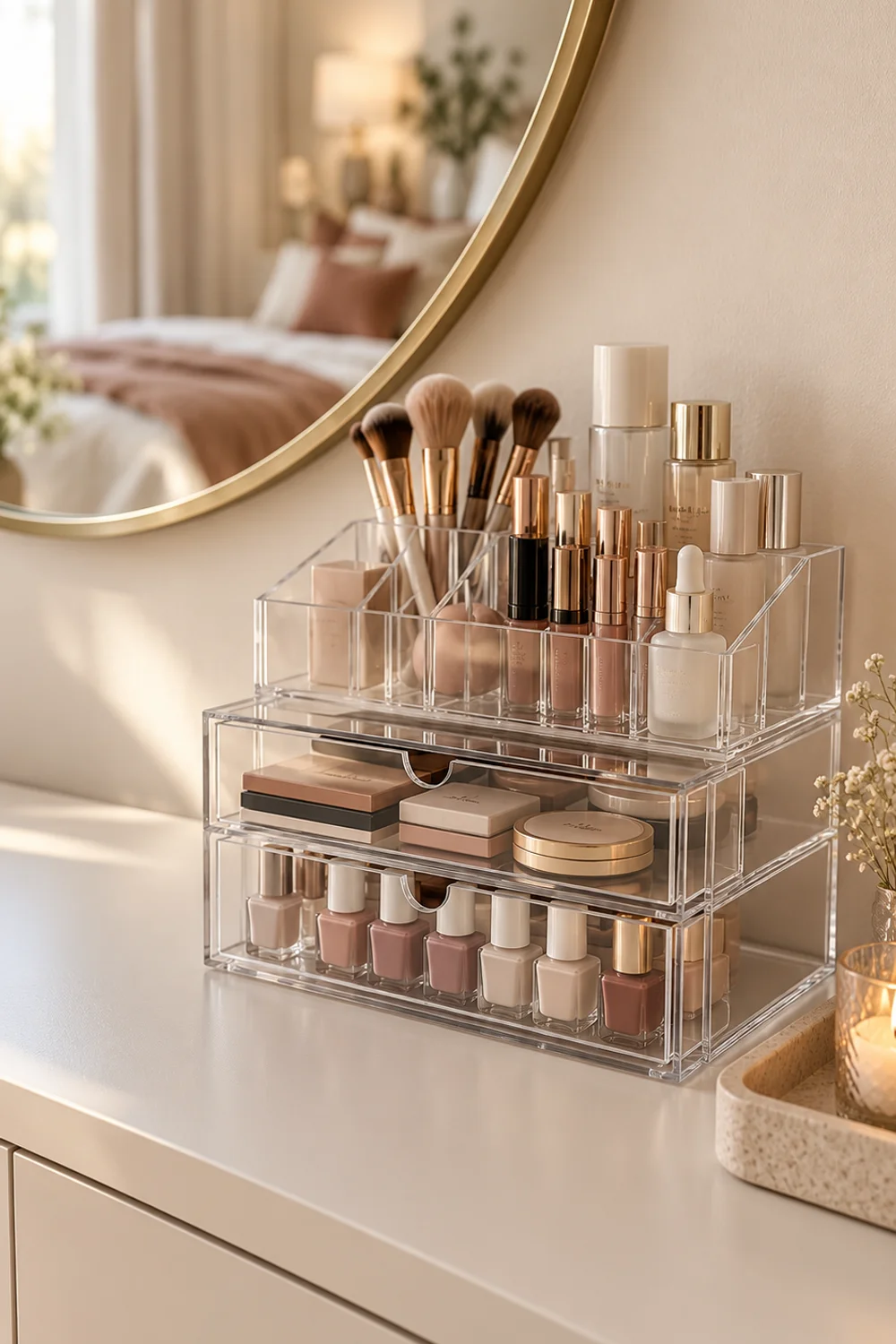
A contained organizer creates that edge. Everything you use daily stays within a fixed footprint, and because a good organizer stacks upward, it holds more while covering less of the dresser. Clear sides matter more than they seem to: you can see what you have at a glance, so you are less likely to rummage, spill or buy a duplicate of something you already own.
This 3-tier clear makeup organizer combines an open top section with multiple compartments for brushes, lipsticks and upright bottles and two clear pull-out drawers below for flatter items like palettes, compacts and nail polish. The drawers have slide rails and stoppers so they do not pull all the way out and spill, and the base has anti-slip pads so the unit stays put on a polished dresser top.
Start with an edit. Gather every product, discard anything expired, dried out or no longer used, and set aside special-occasion items. Only what you use most days goes into the organizer. Tall items go in the top compartments, at the back, so nothing hides behind them, and the drawers hold one category each, for example face products in one and eye products in the other.
Place the organizer beside a mirror or at one end of the dresser rather than in the center, which leaves part of the surface open. Then keep one rule: when you finish using something, it goes back into its compartment, not on the dresser beside it. Because the organizer is right there and every item has a visible slot, that takes no more than a second, and the rest of the dresser stays clear.
7. Keep a Woven Reset Basket for Things That Belong in Other Rooms
 Save it
Some bedroom clutter has nothing to do with the bedroom. A mug from the kitchen, a charger that belongs in the office, a child’s toy, a delivery package, a borrowed book, a jacket that should be in the entryway. These items land in the bedroom because you carried them in, and they stay because walking each one back to its proper room at the end of the day feels like too much effort.
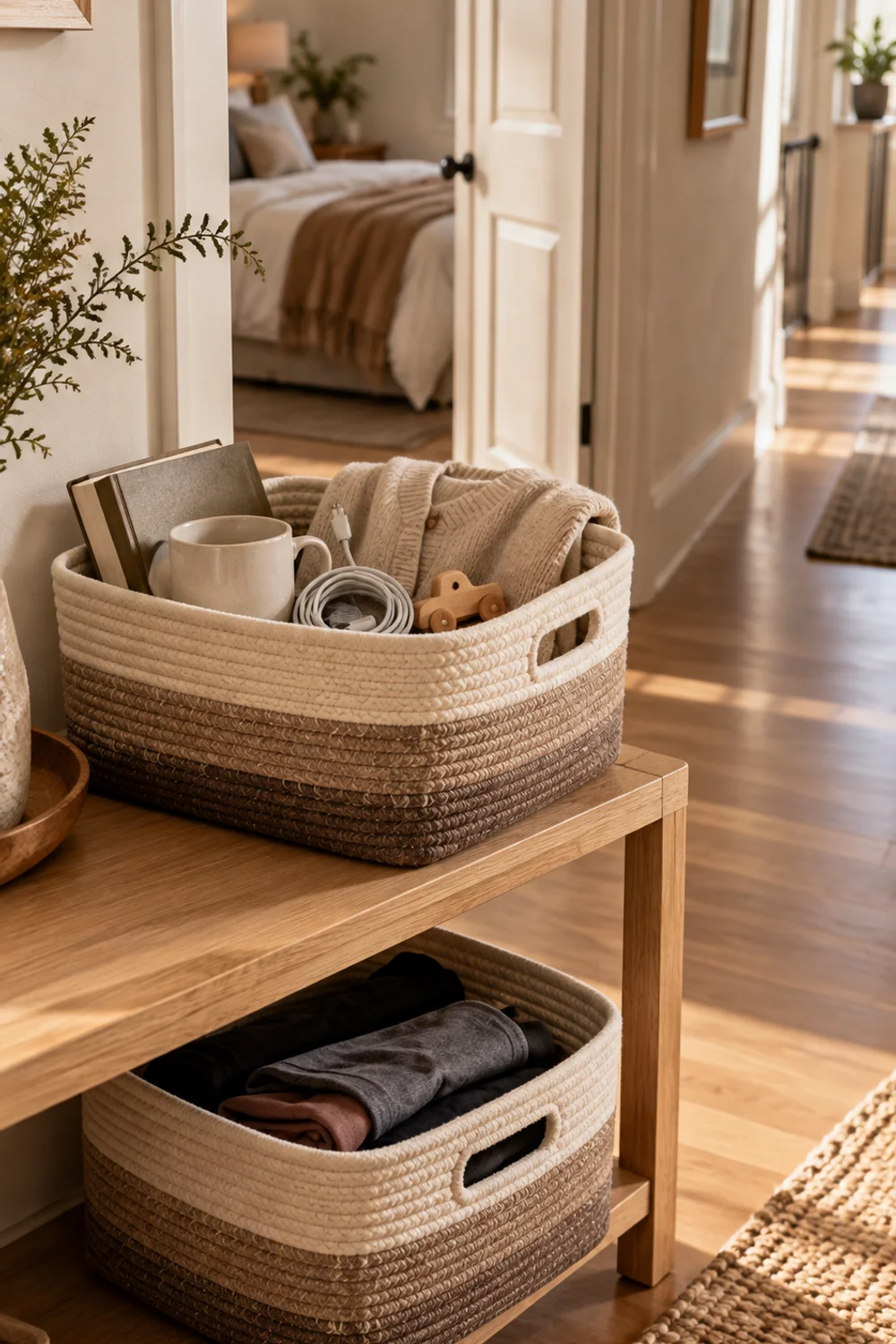
A reset basket turns that problem into one trip. Anything that does not belong in the bedroom goes into the basket rather than onto a surface. Once a day, often in the morning on the way out, you carry the whole basket through the house and empty it room by room. The bedroom stays clear, and the other rooms get their things back without a dozen separate trips.
The woven cotton rope baskets come as a set of four, each about 13 by 11 by 8 inches, with cut-out handles on the sides. The handles are what make the reset habit work: you pick up the basket and go, without thinking about it. The woven cotton rope, with a white top band fading into taupe and darker brown, looks calm enough to sit out in the open on a shelf or a bench without adding visual noise, and the baskets fold flat when they are not needed.
Use one basket as the reset basket and keep it in a fixed spot near the bedroom door, where things naturally get set down. The other three can each have one clear job elsewhere in the room, for example holding chargers and cables in the closet, or the current book stack on a low shelf, or folded workout clothes.
The key is that the reset basket is emptied every day. If it fills up and stays full, it just becomes a new pile with handles. Paired with a simple morning routine, though, it is one of the easiest ways to keep a bedroom feeling like a bedroom rather than a storage room for the rest of the house.
8. Hide Dirty Laundry in a Tall Lidded Hamper
 Save it
A laundry basket can be perfectly organized and still make a bedroom look messy. Open hampers show everything inside them, so the most private corner of the room becomes a display of yesterday’s clothes. And when a hamper is too small or awkward to use, clothes go onto the chair or the floor next to it, which is often how the familiar chair pile starts.
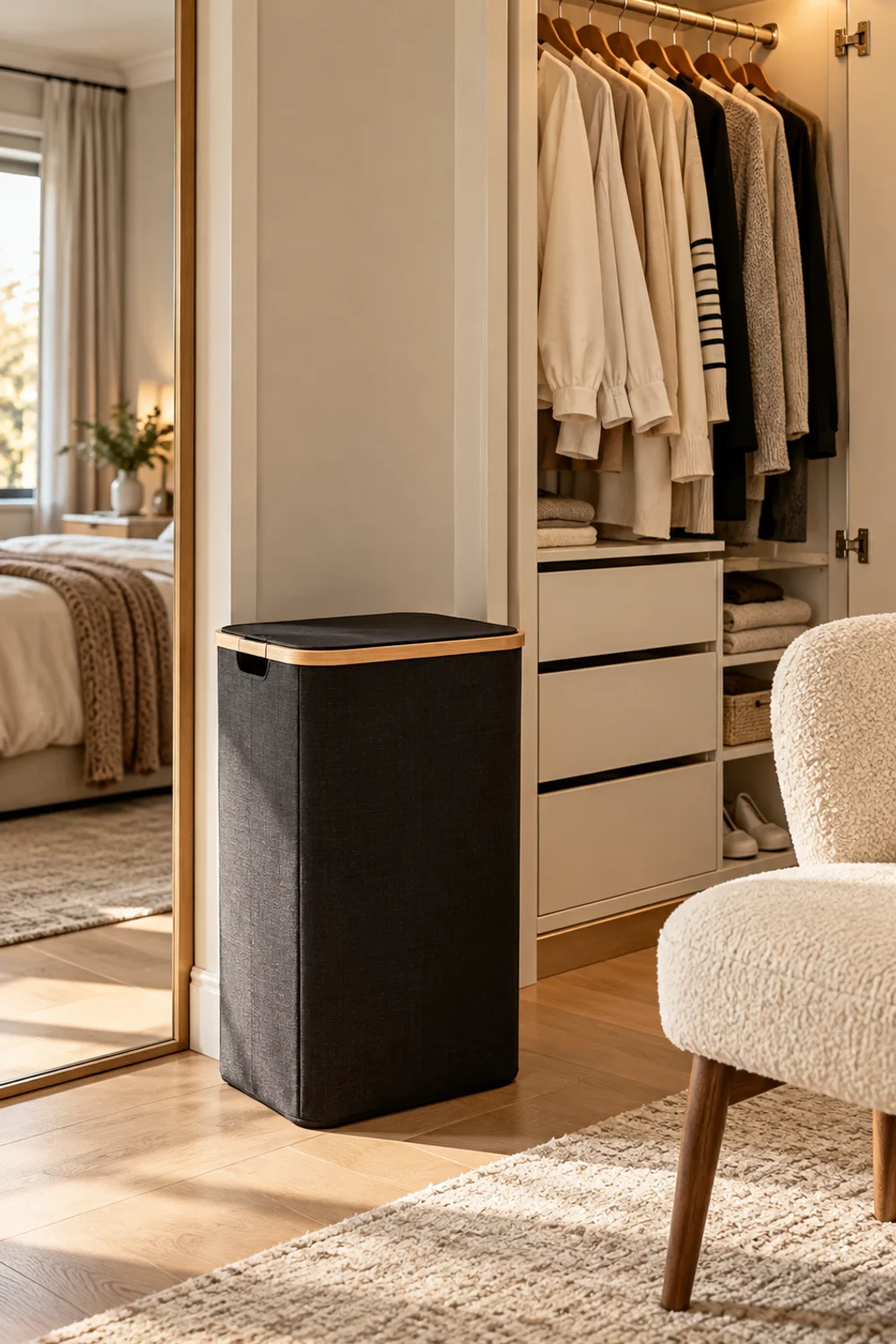
A tall hamper with a lid solves the visual part of the problem. Once the lid closes, the hamper reads as a simple, quiet object rather than a pile of laundry. A tall, narrow shape uses height rather than floor space, so it can hold a lot without taking over the corner. And a removable inner bag solves the practical part: you lift out the bag and carry it to the machine without hauling the whole hamper.
This laundry hamper is a tall black fabric hamper with a lid and a bamboo-trimmed rim, measuring about 17 by 13 inches at the base and 29 inches high, with a listed capacity of 110 liters. It comes with a removable, machine-washable inner bag, the lid helps contain odors, and the frame collapses with detachable rods when you need to store it. The black fabric and natural bamboo look clean and modern next to wood or white furniture.
Put the hamper where clothes actually come off, which is usually inside or right beside the closet, not across the room. A hamper that is three steps away from where you change is a hamper that gets skipped. If two people share the room, a second hamper or a separate bag for darks and lights saves sorting later.
Finally, decide on a laundry day, or a simple rule like “when the bag is full, it goes.” The lid makes it easy to forget about the hamper for a while, which is the point visually, but a hamper that overflows defeats the purpose. With a fixed rhythm, dirty clothes always have a home, and the chair goes back to being a chair.
9. Keep Folded Stacks Upright With Clear Acrylic Shelf Dividers
 Save it
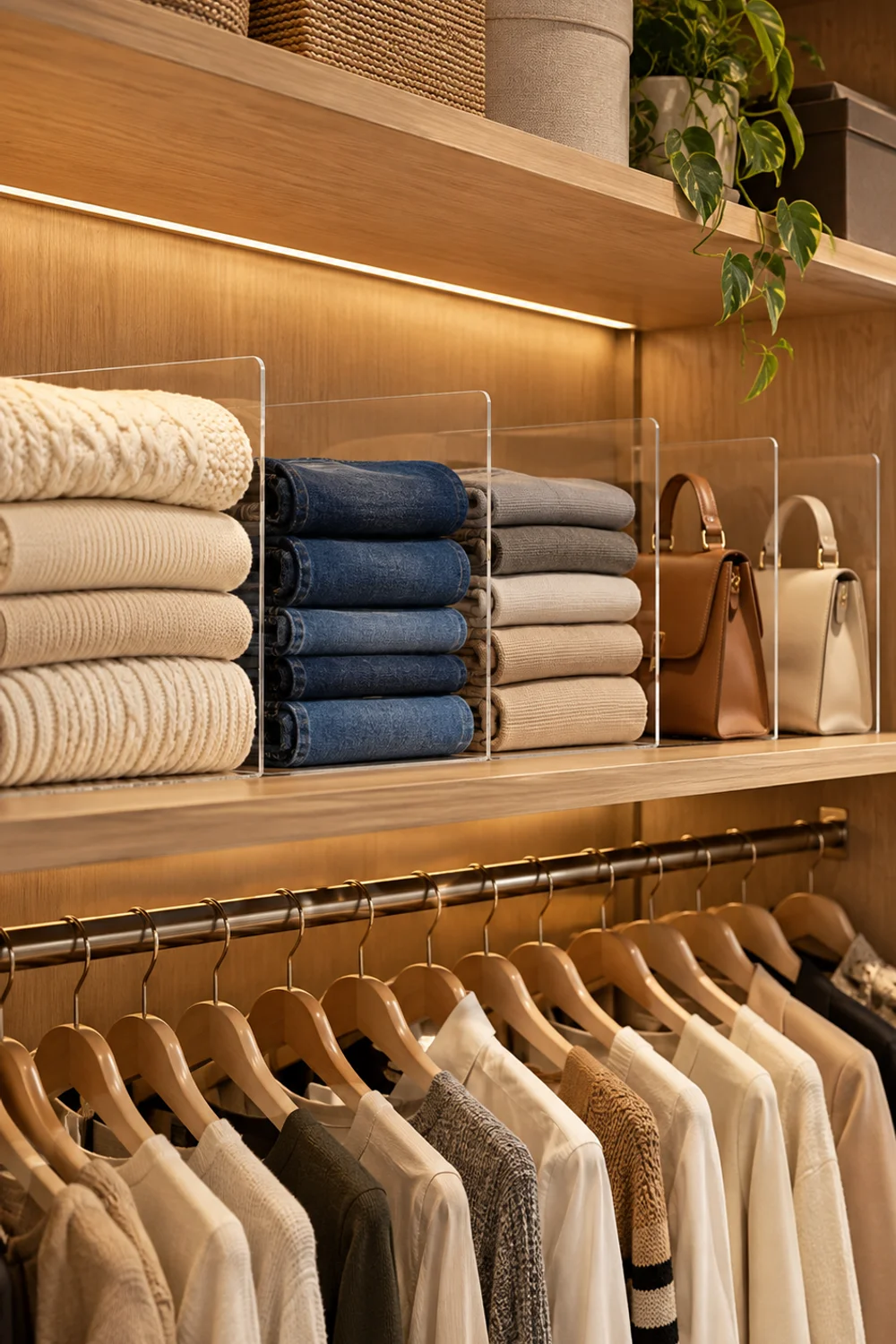
Closet shelves are where clutter hides in plain sight. Sweaters, jeans and folded tops start as neat stacks, but every time you pull something from the middle, the stack leans. A few days later the leaning stacks have merged into one soft heap, and the shelf looks cluttered even though nothing has been added to it. Often, rather than refolding the whole pile, it becomes easier to drape the next sweater over the chair.
Shelf dividers give each stack a wall on both sides. Clothes can no longer slide sideways into the next category, so a stack keeps its shape even when you pull a sweater from the middle. The same principle works for handbags, which stand upright between two dividers instead of slumping into each other, and for spare towels or bedding if your bedroom closet holds them.
These acrylic shelf dividers come as a set of six clear dividers, each about 9.3 inches high and 11 inches deep. They slide onto the edge of a shelf with no tools or hardware, fit shelves up to about 0.8 inches thick, and have a non-slip base and rounded corners. Because they are transparent, they organize the shelf without adding visual weight, and the folded clothes remain what you see.
Measure your shelf thickness before you buy, because that determines whether a slide-on divider will grip properly. Then plan the shelf by category before you clip anything on: sweaters in one section, jeans in another, a row of handbags at the end. Keep each stack to a height you can easily lift from, usually no higher than the dividers themselves, so you are not pulling from the bottom of a towering pile.
Leave a little space in each section. A slot packed to the edges is just as hard to use as a leaning stack. With some breathing room, putting a folded sweater back takes a second, which is exactly what stops it from ending up over the chair.
10. Fold Extra Blankets Into a Tall Woven Basket Instead of Over the Chair
 Save it
Blankets and throws are among the most common bedroom clutter, and the reason is simple: they are bulky, they are used often, and there is rarely an obvious place to put them. A throw gets left at the end of the bed, a spare blanket is draped over the reading chair, another one is half folded on the bench. None of them is out of place, exactly, but together they make the room look unfinished.
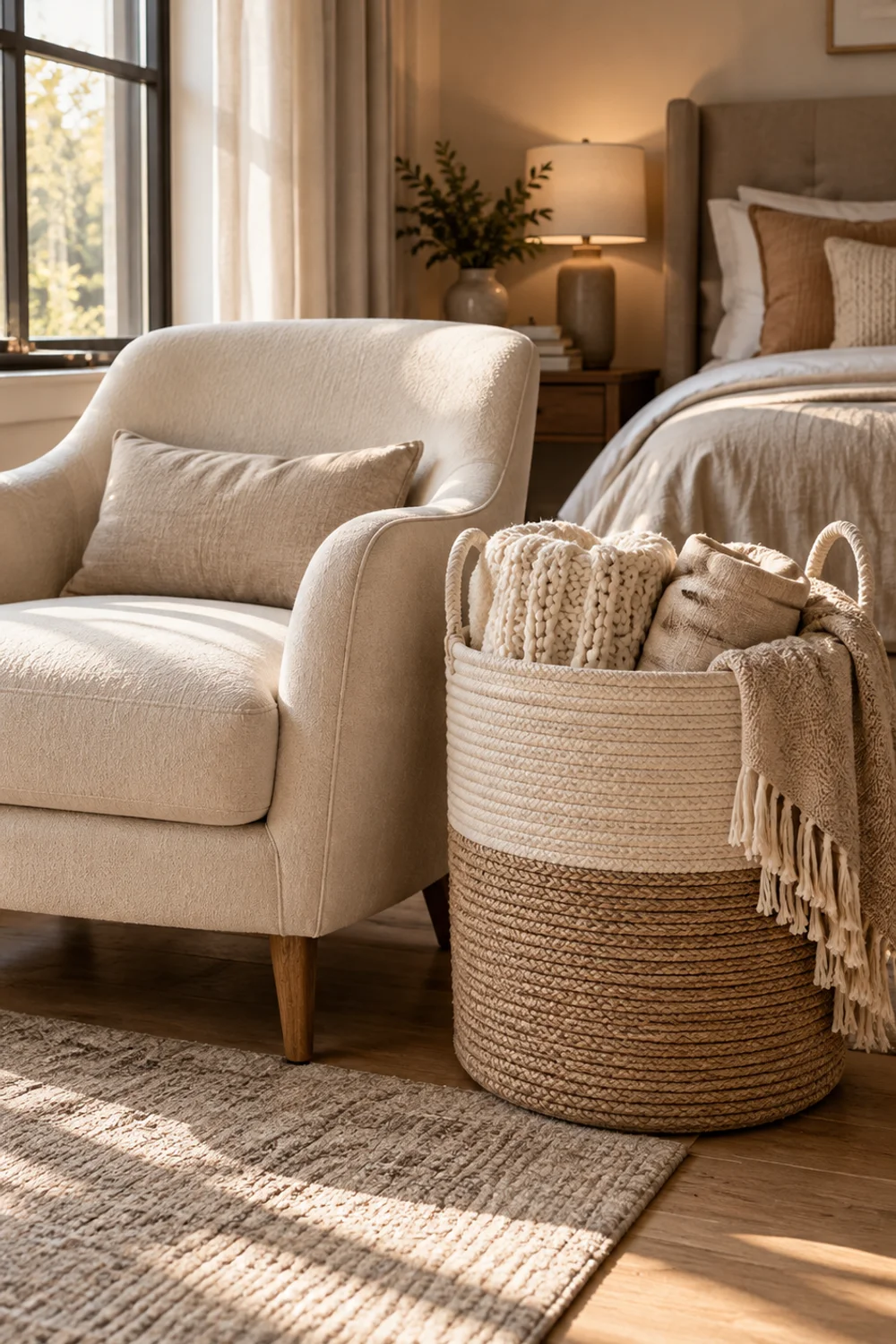
A tall basket gives soft things a home that still feels soft. Instead of trying to fit bulky blankets into a drawer or a closet shelf, you roll or loosely fold them and stand them upright in one container, so they are visible, easy to grab on a cold night and just as easy to put back. A tall shape matters here, because it holds several blankets in a small floor footprint, about the size of a lamp base, instead of spreading across a bench or chair.
A tall woven rope basket is about 15 inches across and 20 inches high, with a listed capacity of 58 liters. It is hand woven from cotton rope, with a white upper band over a light brown lower half, and has two long rope handles for moving it. The listing describes it as suitable for blankets, throws and pillows as well as laundry, and it folds down when you need to store it.
Place the basket next to the place where blankets are actually used: beside the reading chair, at the foot of the bed on the side you get in, or next to a window seat. If it sits across the room, the blanket will still end up over the chair. Roll the heaviest blanket and stand it in first, then add lighter throws, so the basket keeps its shape.
Keep the number of blankets in it honest. One or two for warmth and one decorative throw are usually enough. Spare bedding for guests belongs in a closet, not in the basket. With a set limit, the basket stays neat enough to be part of the room’s styling, and the chair, the bench and the end of the bed stay clear.
Common Mistakes
1. Buying organizers before deciding what stays out
Organizers only help when they have a clear job. Buying trays, stands and baskets first and filling them later usually adds more objects to surfaces that were already full. Start by deciding which few things really need to live on each surface, then choose the organizer that holds exactly those.
2. Putting several containers on one surface
One container on a dresser looks intentional. Three trays, a jar, a box and a basket on the same dresser look like clutter with better packaging. Give each surface one main organizer, and let everything else live in drawers, closets or the reset basket.
3. Keeping everything visible instead of everyday items only
Clear organizers and open stands work because they show what is inside, but that means they should only hold what you use every day. Special-occasion jewelry, backup skincare and rarely worn shoes belong behind a door or in a drawer, where they do not compete for attention.
4. Letting the chair become storage
A bedroom chair is the easiest surface in the room to pile on, and once a few clothes land there, the rest follow. Give worn clothes a hamper, clean clothes a shelf and blankets a basket, and the chair loses its role as a holding area.
5. Skipping the daily reset
Even the best landing spots decay without a small routine. If the reset basket stays full and the hamper overflows, the surfaces fill up again within days. A few minutes each evening or morning, putting things back in their places, keeps every other idea in this guide working.
Frequently Asked Questions
How do I keep my bedroom clutter-free every day?
Give the things that usually end up on surfaces a specific home that is easier to use than the surface itself, then spend a few minutes each day putting things back. A reset basket for items from other rooms, a lidded hamper for dirty clothes and a fixed spot for chargers cover the most common daily clutter.
What should be on a nightstand?
Ideally only a lamp and one or two things you use every night, such as a book or a glass of water. Small items like remotes, glasses and your phone can go into a bedside wall organizer, which keeps them within reach without crowding the surface.
How do I organize jewelry without cluttering the dresser?
Keep only the pieces you wear every week on a single stand, with necklaces hanging and rings in a tray, and put everything else away in a drawer or lidded box. One defined spot for jewelry stops small pieces from spreading across the dresser.
How do I stop clothes from piling up on the bedroom chair?
Make sure every type of clothing has an easier destination than the chair. Dirty clothes go into a hamper placed where you change, folded clothes go onto shelves with dividers that keep stacks upright, and blankets go into a basket beside where you use them.
Where should I store shoes in a small bedroom?
Use vertical storage that keeps shoes off the floor and lets you reach every pair easily. A rotating shoe tower in a closet corner or alcove holds many pairs in a small footprint, and setting a limit on how many pairs it holds keeps it from overflowing.
Final Thoughts
A clutter-free bedroom is less about owning fewer things and more about giving the things you use a better place to land. When small clothes have bins, shoes have a tower, chargers have one stand, jewelry has one display and laundry and blankets have their own containers, the surfaces of the room are no longer the default destination for everything.
If you are not sure where to begin, start with the surface you see first when you wake up. For most people that is the nightstand, for others it is the chair or the dresser. Clear that one surface, give its usual clutter a home and live with the change for a week. Then move on to the next hotspot. You will quickly notice which homes get used without thinking and which ones need a small adjustment, such as a basket moved closer to the door or a stand moved closer to the mirror. One landing spot at a time, the bedroom becomes a room that stays calm on its own.
This post contains affiliate links. I may earn a small commission at no extra cost to you. As an Amazon Associate I earn from qualifying purchases.

GET YOUR FREE CHECKLIST
A More Organized Home
Starts Here
Join the community and my free Home Organization Checklist, plus weekly tops and inspiration.
Thank you!
You have successfully joined our subscriber list.