
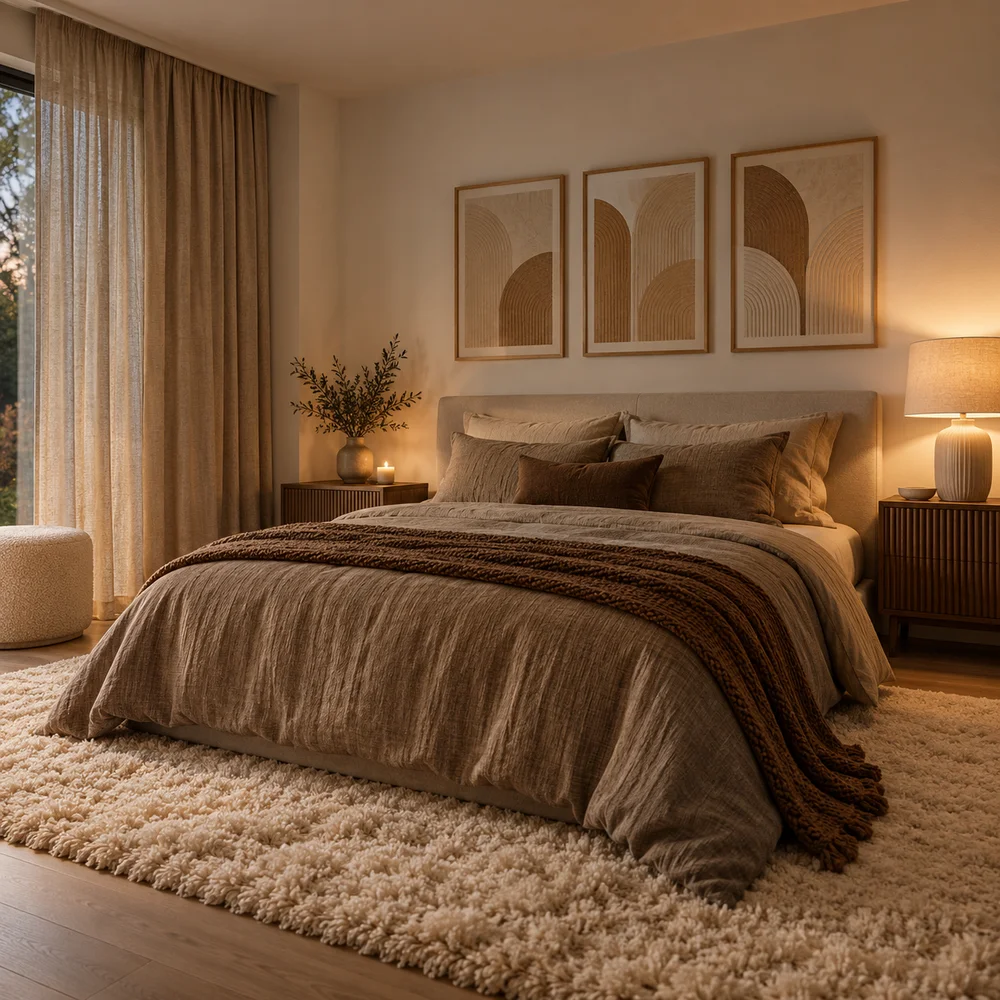
How to Make a Neutral Bedroom Feel Warm
By HomeStyledLiving | October 28, 2026
A neutral bedroom can have everything right on paper. The walls are soft white, the bedding is beige, the furniture is pale and nothing clashes, and still the room feels a little cold when you walk in. It looks calm in photographs and slightly flat in person, as if someone removed the part that makes a room feel lived in.
The cause is rarely the colors themselves. Neutral rooms go flat for a handful of reasons: the light is harsh or too white, the undertones disagree with each other, every surface has the same smooth finish, and nothing in the room has weight, wood, stone or shadow. Each of those has a small, specific fix, and none of them needs a can of paint.
Before you buy anything, do one quick check. Hold a white sheet of paper next to your walls, your bedding and your curtains, in daylight and again at night. Some of them will lean yellow or cream, and some will lean grey or blue. Warm neutrals, the creams, oatmeal shades, sand and light taupes, feel inviting. Cool neutrals feel crisp, which is lovely until everything in the room is crisp at once. The goal is not to remove every cool tone, only to make sure the warm ones are leading.
This guide moves outward from the bed through thirteen changes: fabric, light, texture, shape, wood, stone and art. Each one targets a different reason a neutral room can feel flat. Some are cheap and take a minute, others change the room more noticeably. Treat it as a menu rather than a project plan, because two or three well-chosen pieces will do more than all thirteen at once.
Every product here is described the way its listing describes it, and where a detail is not stated, such as a weight rating or a bulb, the advice is to check the listing before you buy.
1. Start With a Washed-Cotton Duvet Cover in a Warm Greige

 Save it
The bed is the largest soft surface in the room, so its color sets the temperature of everything around it. A crisp white or cool grey cover can pull a whole neutral room toward cold, while a warm tan-grey tone makes the same walls look softer. Heathered, slightly tannish tones sit in the middle: grey enough to feel calm, warm enough not to feel clinical.
A duvet cover set is listed in Heathered Tannish Linen Grey, a mottled tone that reads as a light warm taupe rather than a flat beige. It is made of washed cotton that is described as looking like linen but feeling like cotton, with a deliberately lived-in, slightly wrinkled surface. That wrinkled finish is part of the point. A perfectly smooth, sateen-bright cover reflects light and looks formal, while a relaxed washed one absorbs it and looks soft.
Check the size before you order, because this listing is the King set. It is a three-piece set with a duvet cover and two pillowcases, with a hidden zip and eight interior corner ties that hold the insert in place. The comforter or insert itself is not included, so you will need your own. Colors also look different on every screen, so hold the swatch idea from the start of this guide against your own walls in daylight when the cover arrives.
If you want to take bed styling further, with layered quilts, shams and full looks in different palettes, Bed Styling Ideas That Make Your Bedroom Look Expensive covers the bed in detail. Here the cover has one job, which is to set the warm base tone.
Keep the rest of the bed simple at first. A warm, textured cover with white or cream pillows already looks finished. Add contrast through the objects around the bed, and the sections that follow show where.
2. Warm the Light With a Ribbed Ceramic Lamp and a Linen Shade

 Save it
Light is the quickest way to change how a neutral room feels, because the same beige looks different under different light. A bare cool-white bulb turns cream walls grey. A soft, warm bulb turns the same walls golden. Look for bulbs labelled soft white or around 2700K, and use the same color temperature in every lamp so the room does not split into warm and cool patches.
A fabric shade does a second job. It diffuses the bulb into a glow and tints the light slightly, which is why a linen shade feels warmer than a clear glass one. This table lamp pairs an off-white, hand-textured ceramic base with a beige linen shade. The listing image shows a ribbed base, which adds a fine vertical texture even when the lamp is off.
At 17.75 inches tall, it is a compact bedside lamp, built for small tables and narrow nightstands. The shade attaches to the bulb socket instead of a traditional frame, which keeps the silhouette simple. The listing does not say whether a bulb is included, so check that and choose a warm one.
Place it where its glow lands on something. A lamp that lights a pale wall or a wooden surface looks warmer than one that shines into empty space. Put the bulb at roughly eye level when you are seated in bed, so the light falls on the pillow and the wall rather than into your eyes.
If there is no outlet near the bed, or no space for a lamp, plug-in alternatives exist. Renter-Friendly Bedroom Upgrades That Make a Big Difference includes battery-powered peel-and-stick sconces for exactly that situation.
A single warm lamp already changes the evening mood of a bedroom, and a matching second one on the other side makes the arrangement feel deliberate. Keep the two shades the same color and the two bulbs the same temperature, and the room will read as warm from the doorway.
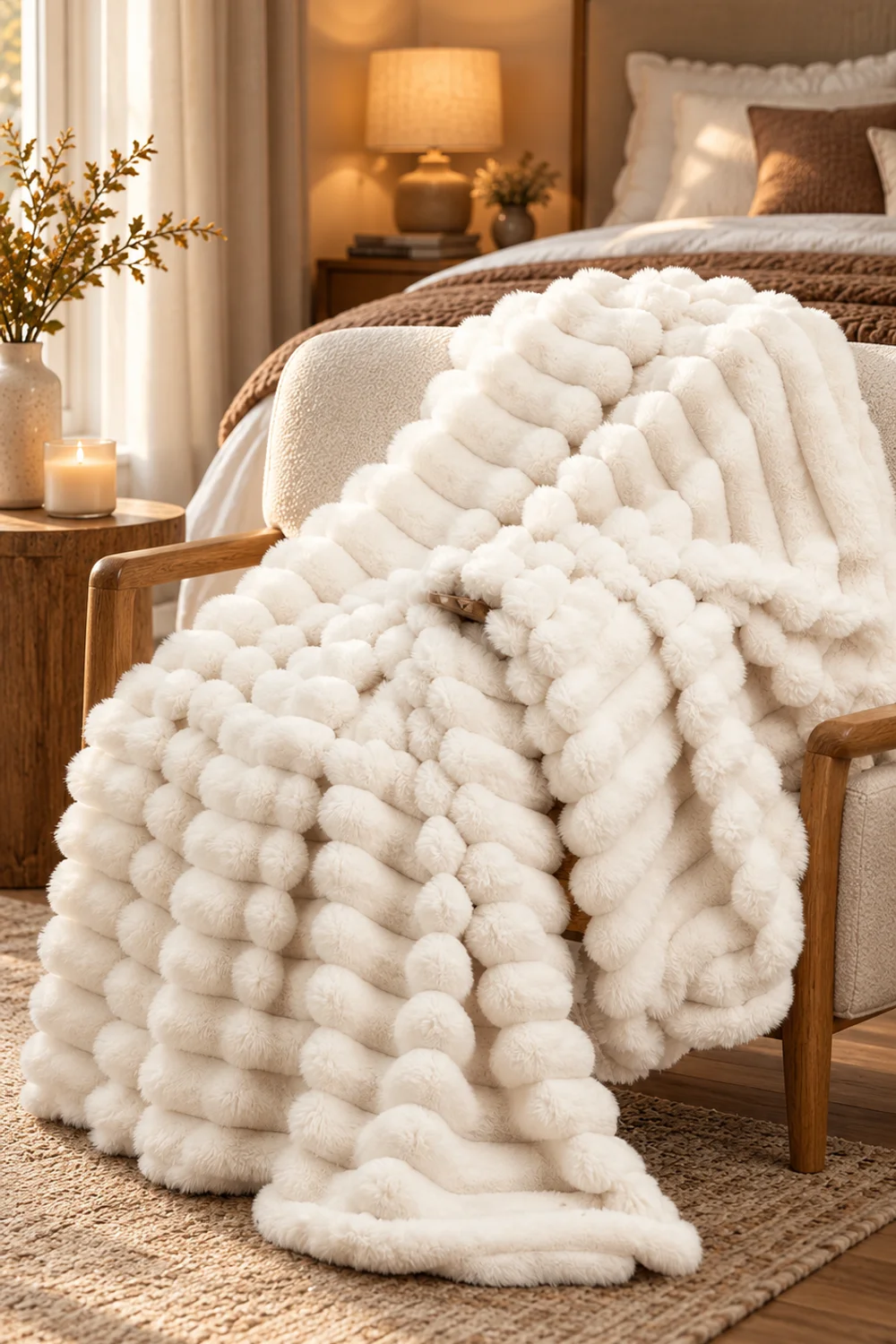
3. Add a Cream Faux Fur Throw for Soft Contrast
 Save it
A neutral room needs variety in surface more than variety in color. When everything is smooth, the eye has nowhere to rest and the room feels flat, however pretty the palette. A throw with real pile introduces a different kind of surface, and the contrast between a flat washed cotton cover and a plush one is what the eye reads as depth.
This cream-white faux fur blanket in a 50 by 60 inch size, with a tonal striped surface. Stripes in the same color are the right choice for this job, because they add dimension without adding a pattern that competes with anything else. The listing describes a dense, plush pile, and the fabric is polyester.
Try it somewhere other than the center of the bed. Draped over the arm of a chair, across a bench or folded over one corner at the foot of the bed, a throw reads as styling rather than as a blanket someone left behind. Let it hang loosely, with a fold or two, because a smooth, tightly squared throw looks stiff.
Placement also matters for balance. If the bed cover is a heathered tan, a cream throw lifts the palette a shade lighter, which brightens the room without adding anything cool. If your walls are already warm white, a throw one tone deeper creates the contrast.
Care is straightforward according to the listing: machine wash in cold water on a gentle cycle, and tumble dry with no heat. Faux fur can look flat after washing, so shake it out and brush it gently with your fingers before putting it back.
Keep it to one throw. A plush surface works because it is a single point of contrast, and three of them blur the effect into clutter.
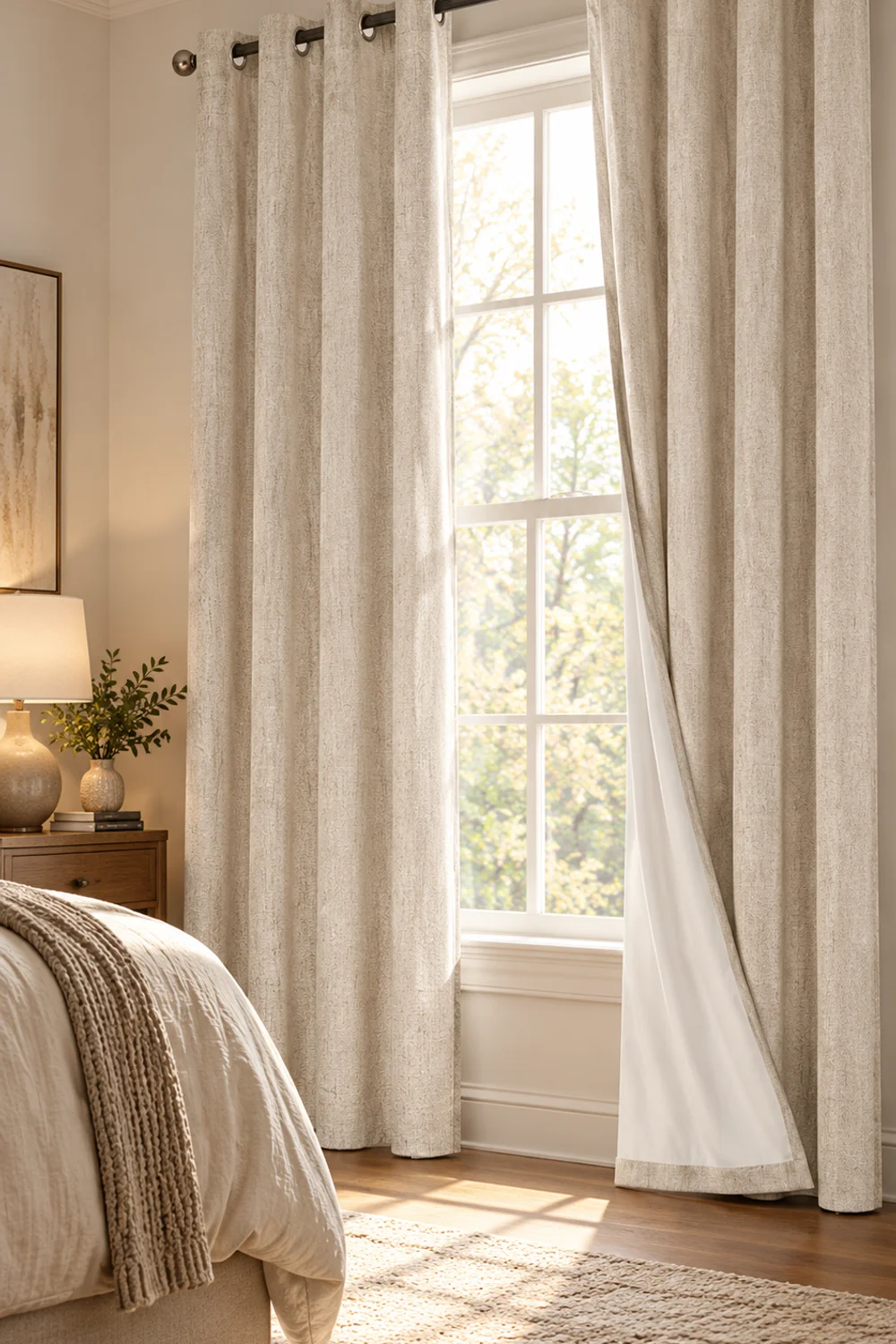
4. Hang Natural Linen-Look Curtains to Soften the Window
 Save it
A window is a large, flat, bright shape, and the curtains beside it determine how the daylight enters the room. White curtains reflect cool daylight straight back into the room. A natural, slightly warm tone filters it and lets the room hold onto a warmer feel through the day.
These curtains come in the shade called Natural, a warm oatmeal-linen tone. They are linen-look rather than linen, made of polyester with a white blackout lining, which matters if you sleep late or work nights. The listing gives each panel as 52 inches wide and 84 inches long, with eight grommets that fit rods up to one and a half inches, and the pair is sold together.
Hang them high and wide. Mounting the rod closer to the ceiling than to the window frame stretches the wall and makes the room feel taller, and letting the curtains stack beyond the glass keeps the full width of the window clear. Measure from the rod to the floor before you buy, because 84 inches suits a standard ceiling height but not every window.
Grommet curtains hang in even, wide folds, which suits a room that already has plenty of straight lines. Pull the curtains slightly open during the day so the fabric catches some light, because the color changes completely between a drawn and an open panel.
For more on curtain height and how the curtain line changes the room, including a ceiling-mounted track, Easy Small Bedroom Ideas That Make Any Room Feel Bigger goes through it.
Blackout fabric is heavier than a sheer, so it suits bedrooms where light control matters. If your window gets strong morning sun, the lining does the work, and the warm fabric color keeps the room from looking like a dark box when the curtains are closed.
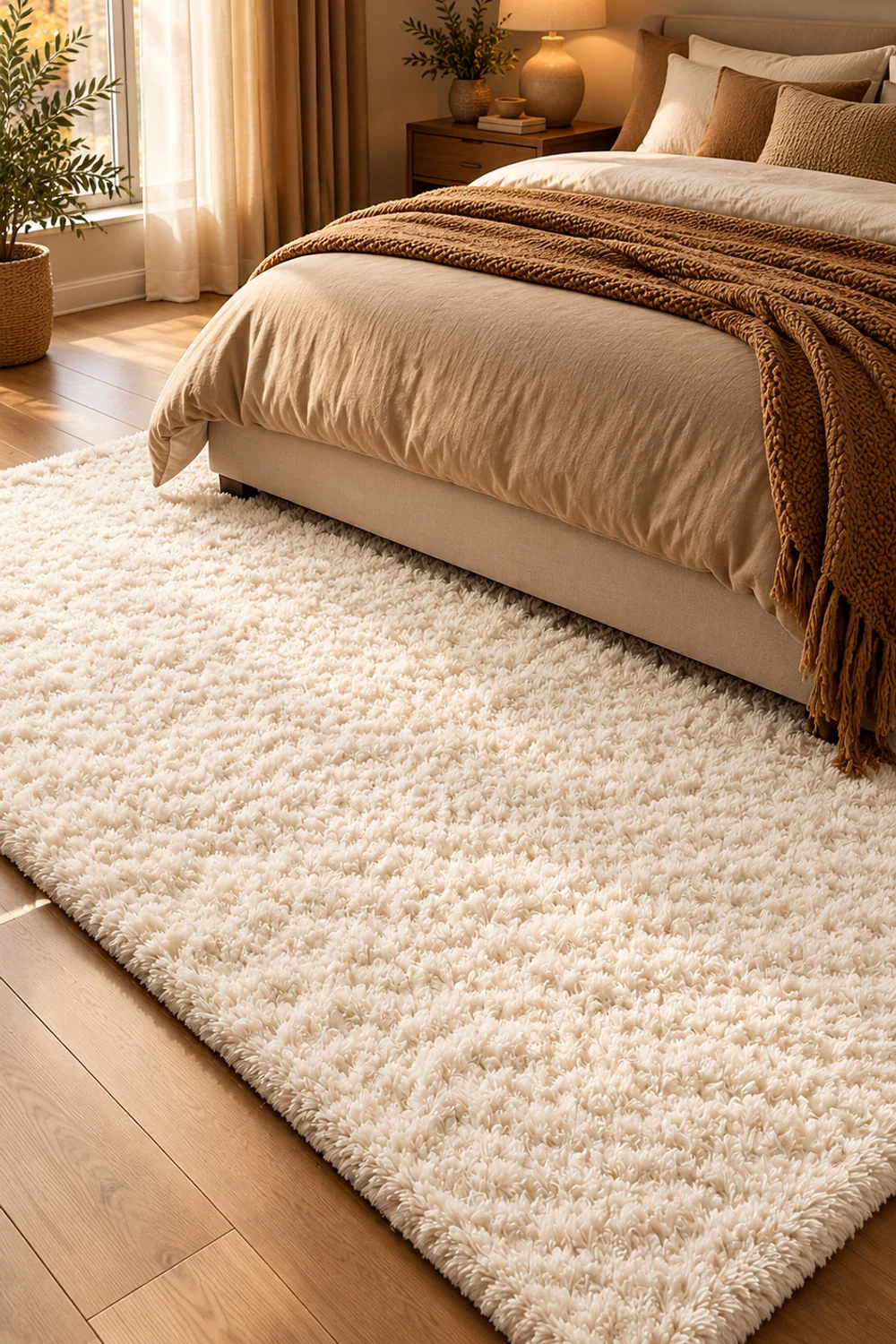
5. Ground the Bed With an Ivory Shag Rug
 Save it
Floors are often the coldest surface in a neutral room: pale wood, grey laminate or beige carpet, all flat and all hard. A thick rug changes the first thing your feet touch and changes how the bed looks from across the room, because it adds a soft, textured layer beneath it.
This rug is an ivory, high-pile shag in a 5 by 7 foot size. Ivory is warmer than stark white, and the long pile catches light and shadow, which gives the floor depth that a flat-weave rug does not have. The listing describes a polyester pile with a sponge interlayer and a non-slip bottom.
Be realistic about size. A 5 by 7 rug will not fill the floor under a large bed. It works best where you can see it: placed across the foot of the bed, along one side so the first step out of bed is soft, or sitting partly under the bed so only the front third shows. If you want a rug that extends well beyond a King bed on all sides, that calls for a larger size than this one.
Keep the rug off the walkway if it creates a trip hazard. A high pile can catch a foot or a door, so check clearance before you settle on a spot.
Pile also changes the way a rug looks in daylight and lamplight. In soft light the surface looks creamy and uneven in a pleasant way, and under a bright ceiling light it can look flat. That is another reason to sort out the lighting first.
If your floor is very pale, choose the rug in a shade just a little deeper than the floor. When both are the same color, the rug disappears, and the bed seems to float on a single flat plane.
Vacuuming a shag rug takes a little care, so check the listing’s care note before you use a beater bar, and consider it before putting it somewhere that gets heavy use.
6. Layer One Long Oatmeal Boucle Lumbar Pillow

 Save it
One accent in a slightly deeper tone does more for a neutral bed than a pile of cushions. A long pillow lying across the bed, between the sleeping pillows and the foot of the bed, introduces a new shape and a new texture at once, and the deeper tone gives the cream tones something to contrast with.
This cover is a long lumbar style in oatmeal, 36 inches by 14 inches, made of boucle, the looped, textured fabric that looks like tiny curls. Oatmeal is a warm, slightly yellow-beige, so it pulls the room toward warm without introducing a new color. It is a plain, tone-on-tone textured piece, not a pattern.
This listing is for a single cover, so you will need an insert of a matching size, and it is worth checking the dimensions first. A cover that is too big for its insert looks limp, and a firm, full insert is what gives the pillow a defined, deliberate shape.
Place it in front of the sleeping pillows, lengthwise across the bed, so its texture is the first thing that you see. Use it with a smooth cover and a plush throw, and the bed has three different surfaces without any pattern. If the bed already has two or three decorative pillows, remove one first, because adding a new piece to a crowded bed makes it look busy rather than warm.
Boucle also looks different at different distances. Close up it is a looped surface, and from across the room it reads as soft and slightly irregular, which is exactly what a smooth bedroom lacks.
If you prefer a different shade, hold the swatch idea from the start of this guide up against your bedding. Oatmeal suits a heathered tan cover, but a very yellow cover can make it look dull, and a cooler cover can make it look yellow. Match the undertone, not just the color name.
One long pillow is enough. The goal is a single deliberate layer, and anything more starts to look like a display in a shop.
7. Add a Boucle Ottoman for a Soft, Rounded Shape
 Save it
Bedrooms are full of straight edges: the bed frame, nightstands, dresser, window frame and door. All that geometry makes a room feel hard even when its colors are soft. A rounded, textured piece breaks it up and gives the eye a curve to follow.
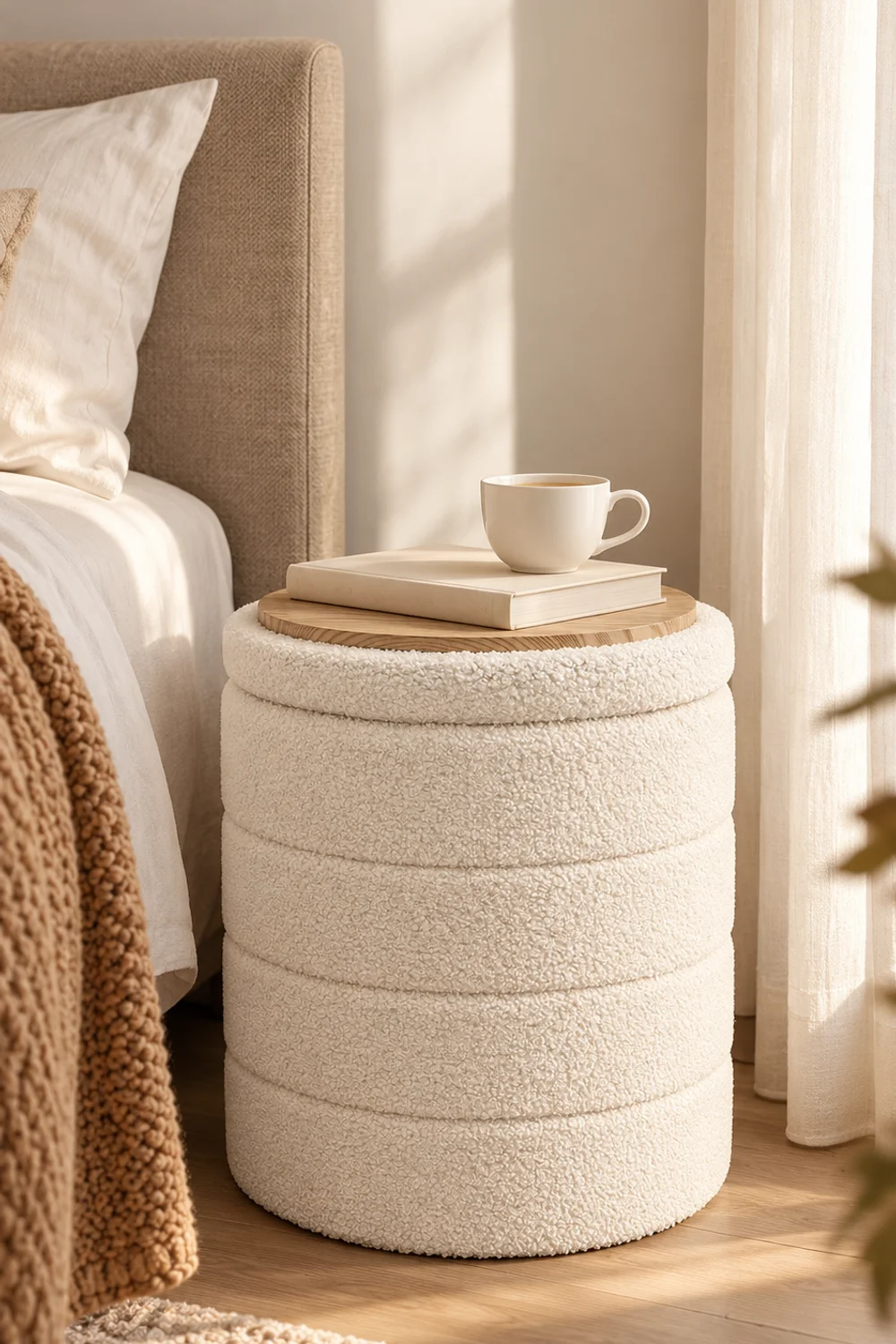
This ottoman is a compact round cylinder in cream boucle, 14.6 inches across and 17.7 inches tall, with horizontal channel lines running around it. The cushion lid flips over to show a wooden tray top, and the ottoman opens to hidden storage and folds flat. The frame is engineered wood under the fabric.
It is a small piece, so think of it as a seat, a bedside perch or a spot to drop a robe, not as a bench for two people. Next to the bed or beside a window, it works as an extra seat or a low side table, and with the lid flipped, the wooden tray gives it a flat surface for a book or a cup.
Placement affects how warm it looks. In a corner, it fades into the room. Beside a nightstand or at the end of the bed, it becomes part of the arrangement, and the cream boucle picks up the same softness as the cover and throw.
Leave a little space around it. A round shape needs breathing room to read as a shape, and pushing it flush against a straight wall wastes the effect.
Storage is a bonus rather than the point. The listing mentions hidden storage, but it does not state a capacity or a weight limit, so check the product page before you rely on it as a seat for an adult or a place for heavy items.
Keep the fabric clean, because cream boucle shows marks. If it lives next to a bed with a drink or a pet, use the wooden tray side up and the surface stays easy to wipe.
8. Replace a Harsh Ceiling Light With a Linen Drum Fixture

 Save it
The ceiling fixture is the light people forget to change. Many bedrooms have a flat white disk, a glass bowl or a bare bulb that floods the room with a single, even, slightly cold light. That kind of light flattens texture, removes shadow and turns cream into grey.
This fixture is a 13 inch semi flush mount with a natural linen drum shade, a black metal frame and three E26 sockets. The listing gives it as about 12.6 inches wide and 6.3 inches high, and the image shows a linen shade with a frosted diffuser underneath. The fabric softens the light and spreads it across the ceiling and walls as a warm wash, instead of a hard pool.
With three sockets, you can choose the bulbs yourself, which is the real opportunity here. Choose soft white bulbs of the same type and the same color temperature, and make sure they match the bulbs in your lamps. If your wall switch has a dimmer, check that the bulbs are dimmable, because mixing the two can cause flicker.
Replacing a ceiling fixture involves electrical work. If you are not comfortable turning off the power at the breaker, disconnecting a fixture and wiring a new one, it is worth paying an electrician for an hour. The listing’s instructions will cover what comes in the box, but not your wiring.
Use the ceiling light less once you have lamps. In the evening, a warm lamp on each side of the bed and the ceiling light turned off does more for the mood than any decorative change, and the ceiling fixture is there for when you need to see everything, such as when you are cleaning or looking for something.
Look at the shade from below, too. A drum shade is a visible object, and the weave of the fabric adds a small amount of texture overhead, a place most neutral rooms leave blank.
9. Bring In Warm Wood With Fluted Walnut Nightstands
 Save it
Wood is the oldest way to warm a neutral room, and a neutral room without any can feel like a showroom. Pale walls, pale bedding and pale floors need something with a visible grain and a deeper tone to anchor them, and nightstands are the right place, because they sit at the side of the bed in your eyeline.
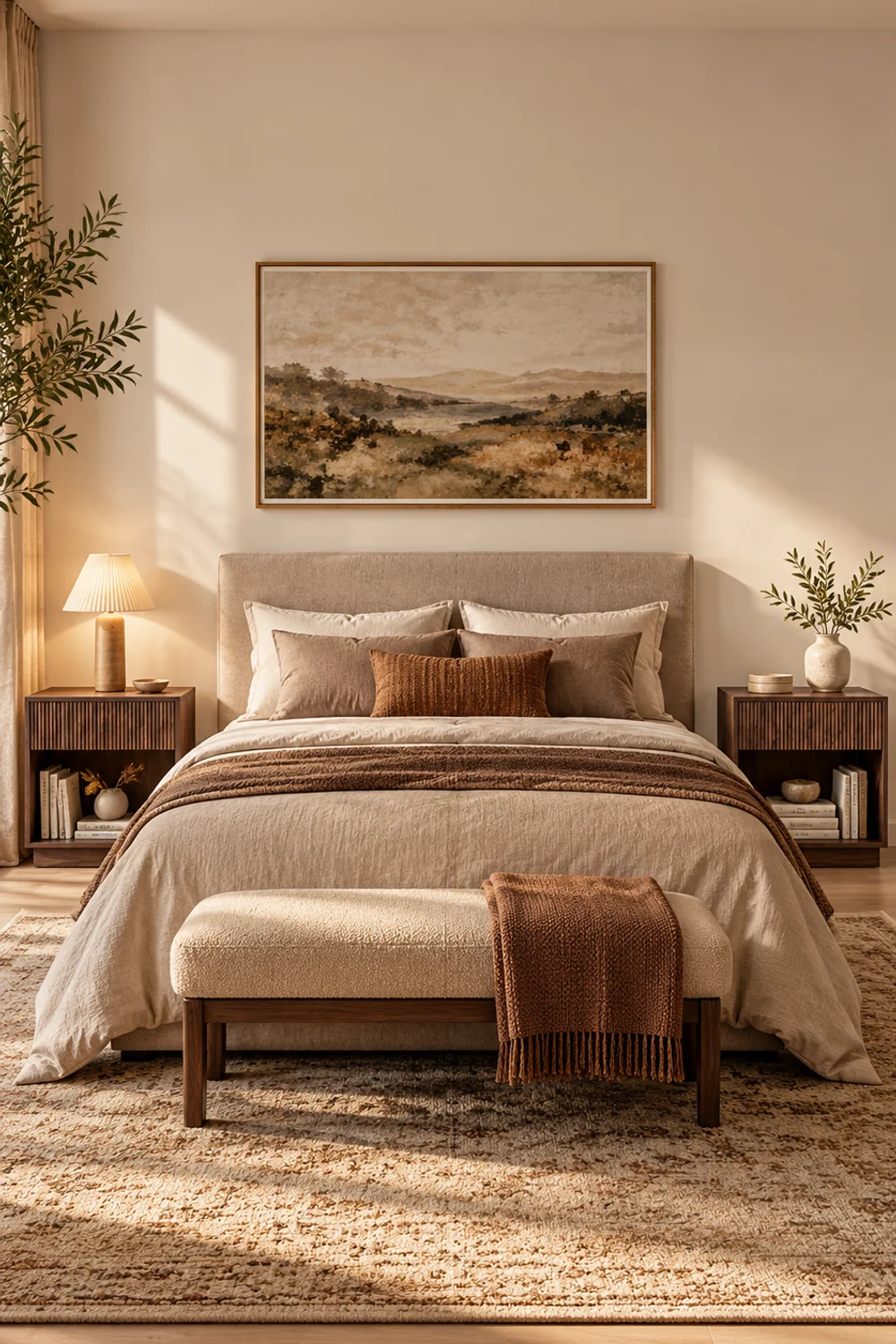
This set is two nightstands in a walnut finish. Each one has a drawer with a fluted front and an open shelf below, and the listing describes engineered wood construction with a wood-grain finish. The fluting is a vertical texture that catches light and throws small shadows, so the front looks carved even though it is a simple shape.
The listing’s measurements are inconsistent, so check the dimensions on the product page against the space beside your bed before you buy. A nightstand should sit at about the height of the top of the mattress, give or take a few inches, and leave enough room to walk around the bed.
Walnut is a deep, warm brown. In a room of cream and oatmeal, it works as the single dark note, and it can be enough on its own. Try not to add a second wood tone in the same room unless the two have the same undertone, because two woods that disagree make the room look less warm, not more.
Style them with restraint. The open shelf suits a few books or a basket, and the top suits the lamp from earlier and one other object. A nightstand with a stack of unrelated items looks cluttered however good the wood is, and Simple Bedroom Organization Ideas That Create a Clutter-Free Space gives every bedside surface a simple landing spot.
The two nightstands make a matched pair, which gives the bed symmetry. Symmetry feels calm, and calm plus warm color is exactly what a neutral bedroom is aiming for.
10. Place a Sculptural Cream Vase on a Quiet Surface
 Save it
Neutral rooms often lack an object with a strong shape. Everything is soft, rectangular and quiet, and one sculptural piece gives the eye a place to land. A vase does the job without needing to hold flowers, because the silhouette is the point.
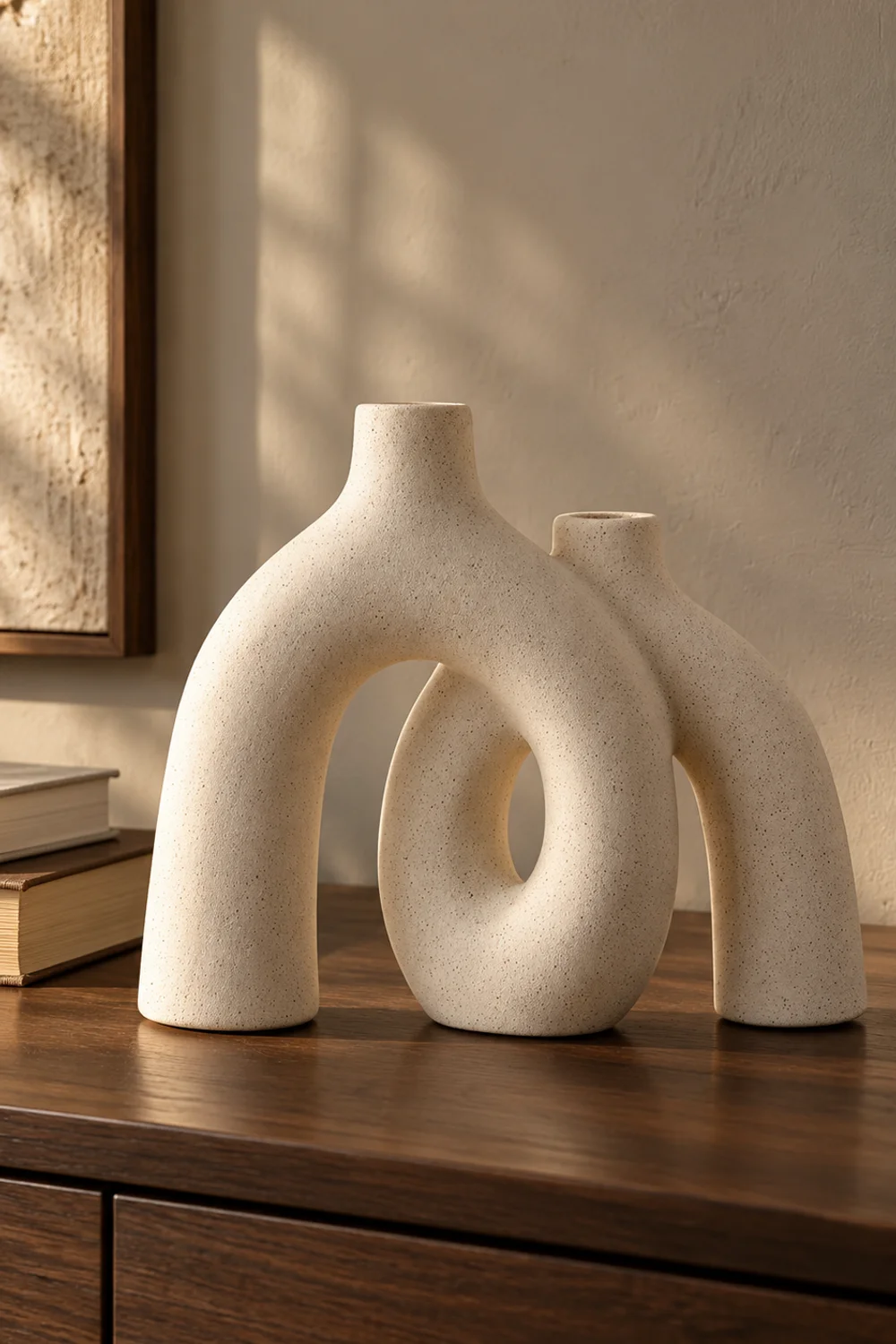
This vase is a matte cream ceramic piece made of two interlocking loops, each with a narrow neck. The listing describes a speckled, sand-like surface, and gives the pair sizes as about 7.3 and 8.3 inches high, with a neck of 1.5 inches. The speckles and the matte finish matter, because a glossy white vase reflects light and looks cold, while a matte speckled one looks hand-made and warm.
Because the necks are narrow, it holds only a few thin stems, and it looks good empty. Treat it as a sculpture first. Place it on a dresser, a console or a shelf where it has empty space around it, and let the shape be the decoration.
Give it a backdrop. A cream vase against a cream wall disappears, and against a darker surface, such as a wooden dresser top, it stands out. Put it next to something with contrast, perhaps a stack of books or the tray in the next section, and you create a small, deliberate arrangement.
Stand back and check the height. Objects work best in uneven groups, so pair a taller item with a shorter one, and keep a gap between them. The vase is eight inches tall, so it suits a surface with a lamp or a framed piece behind it.
Keep the surface edited. One strong object and a couple of small ones look styled. Five medium-sized objects look like a shelf, and the vase stops being a focal point once it competes with its neighbors.
If you move it around the house, handle it carefully. The shape has two narrow necks and several thin points, so it is more fragile than a plain cylinder.
11. Anchor a Dresser or Bedside With a Travertine Tray
 Save it
Stone brings a different kind of warmth to a neutral room, a quiet, natural one. Travertine has soft cream and beige tones, small natural pits and subtle veining, and none of those details can be reproduced convincingly by a printed pattern. In a room of fabric and wood, a piece of stone adds a cool, heavy, tactile contrast that makes the warm materials look warmer.
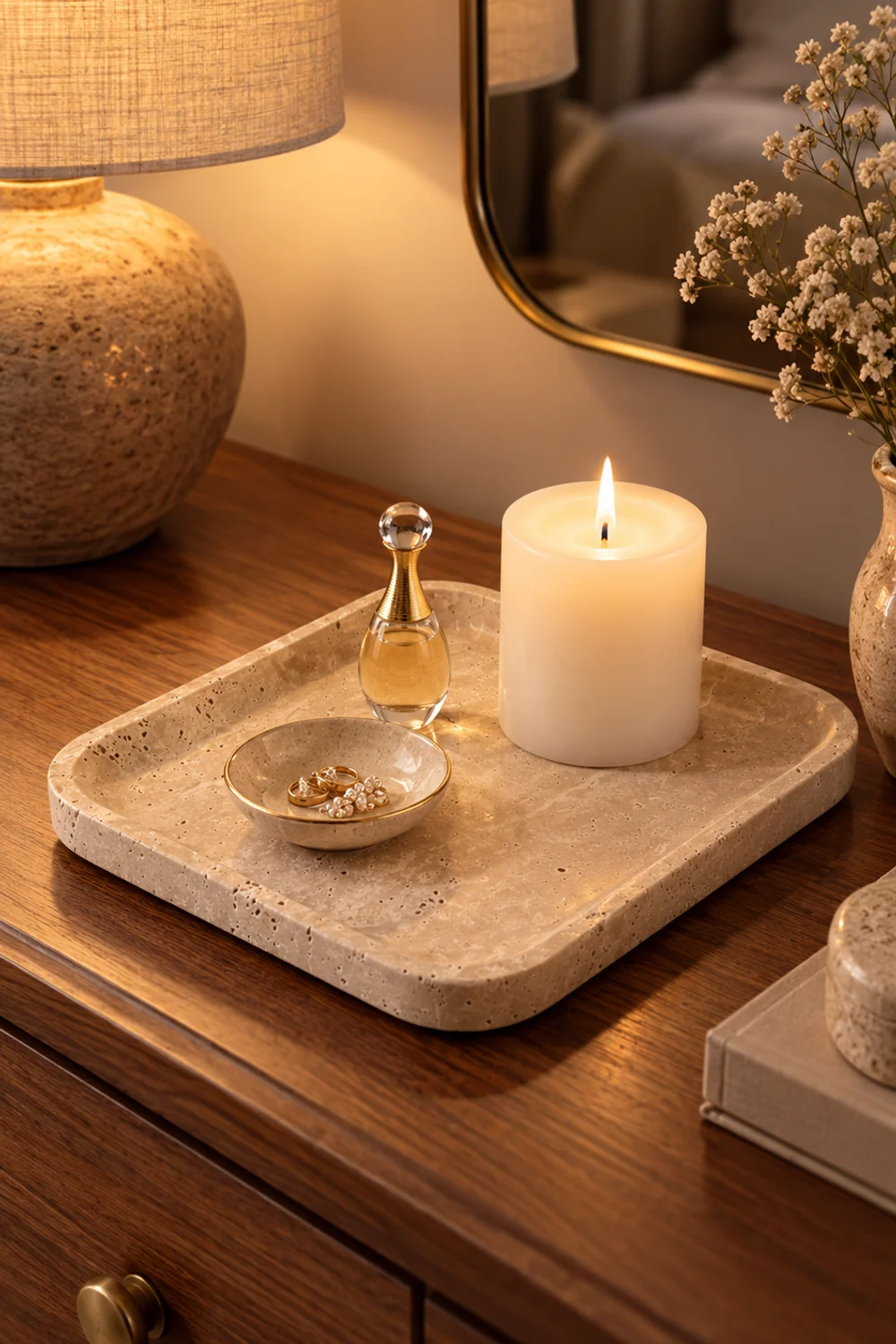
This tray is a rectangular travertine tray in the Travertino Romano color, 11.8 inches long and 7.8 inches wide, with softly rounded corners and a low rim. The listing describes it as made of travertine, and the image shows natural pits across the surface, so each tray will look slightly different.
A tray has a job as well as a look: it groups small things so they read as a collection instead of clutter. A candle, a perfume bottle and a small dish of jewellery on a tray look intentional, and the same three items scattered across a dresser look untidy. Use it on a dresser top, beside the bed or on a console.
Choose what goes on it with care. One taller item, one shorter item and one small dish is plenty, and the edges should stay visible.
Natural stone is porous, so wipe up spills promptly and avoid leaving anything wet or oily on the surface for long. The listing says it is easy to clean, but it does not give a sealing or care guide, so follow whatever instructions come with it. Stone is also heavy, which is useful, because it stays put, but it can scratch a polished wooden surface, so a small felt pad underneath is a sensible precaution.
Place it near the lamp, because the light brings out the warm cream in the stone. In daylight the tray looks pale and neutral, and under a warm bulb it takes on a golden glow.
12. Add Soft Pampas for Height and Movement
 Save it
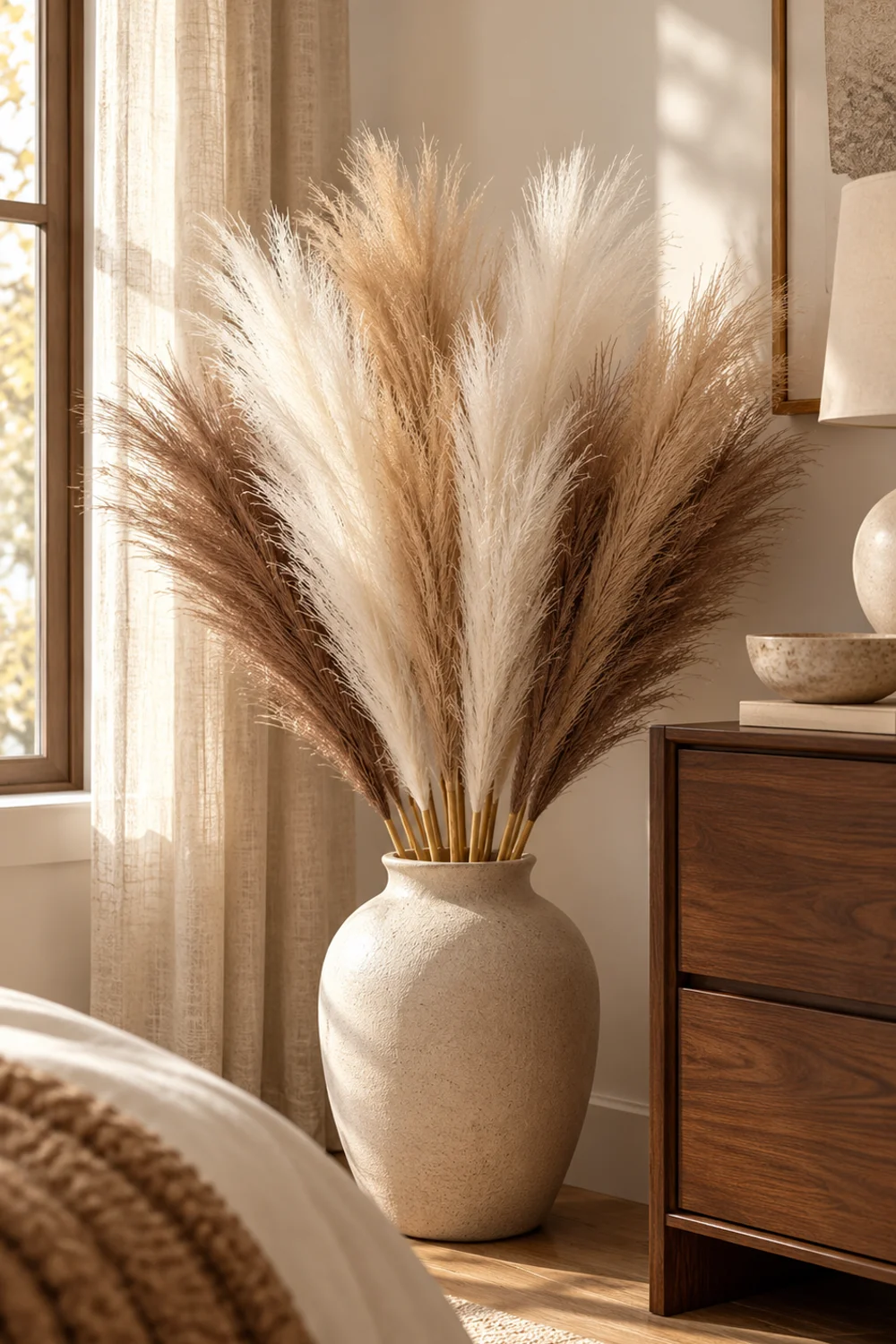
Straight lines and soft cushions leave one thing missing in many bedrooms: something that reaches upward and moves. A few tall, feathery stems add vertical height and a light, airy texture, and they bring warm earthy tones, from cream to brown, without needing paint or fabric.
This set contains 30 artificial pampas stems, each about 21.7 inches tall, in a mix of white, beige and brown. The listing describes silk and wire construction, and the wire means the stems bend and can be trimmed to suit the height of your container. They are artificial, so they need no water or care and do not shed in the way real dried plumes do.
Thirty stems is a lot, so use a small number at a time. Five to seven stems in a tall vessel look elegant, and a crowded bunch looks like a wedding. A heavier container works better than a lightweight one, because the plumes are top-heavy, and the narrow necks of the vase in the previous section suit only two or three thin stems, so use a separate pot for a fuller bunch.
Mix the three tones. The beige and cream stems blend with the rest of your room, and a few brown ones give a deeper accent that ties in with the walnut nightstands. A group of only white stems can look sterile in a neutral room, and the brown adds depth.
Position matters, too. Put the stems where air will not constantly blow through them, and keep them out of direct sunlight, because the color can fade over time. A corner beside a window works well, or a dresser against the wall under the art.
Fluff the stems occasionally and re-shape them, because they flatten when they are crowded in a container. Because they are artificial, the arrangement can stay the same all year, which is a useful quality in a bedroom where you want a calm, unchanging look.
13. Finish With Framed Earth-Tone Arch Art
 Save it
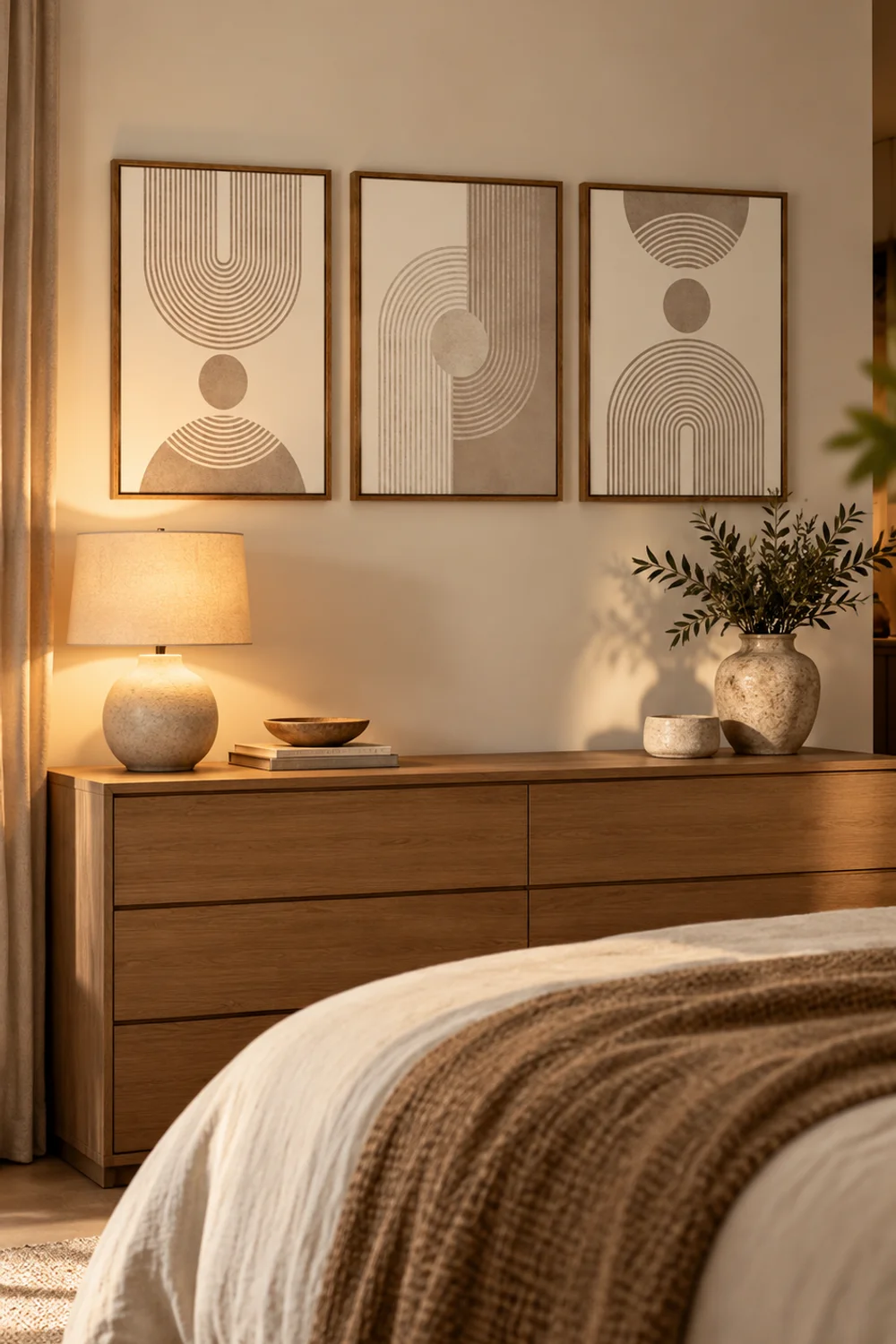
Art is where a neutral room can state its palette. Walls with nothing on them feel unfinished, and a wall with the wrong art, in cool greys or stark black and white, can undo everything you have done with textiles and wood. Art in warm beige, tan and cream tones, framed in light wood, carries the room’s warmth up onto the wall.
This set is three portrait pieces, each 12 inches by 16 inches, printed with arches, circles and fine line patterns in beige, brown and cream. The image shows them in natural wood-tone frames, and the listing describes artist-grade canvas with archival inks. Arches and circles are soft, curved shapes, which suit a bedroom much better than sharp angular geometry.
Hang the three together, in a row, with equal gaps of two to three inches between them, and treat them as a single piece. Hang the group above a dresser or a nightstand, where it has furniture beneath it to anchor it, and place its center at about eye level, around 57 inches from the floor.
The listing says trace-free pegs are included for hanging, but it does not give a weight rating or say which wall types they suit. Check the packaging before you use them, and if you are unsure, hang art beside or across from the bed rather than directly above your head.
The light wood frames also help with the wood in the rest of the room. If your nightstands are a deep walnut, a lighter frame adds a second, related wood tone, and two similar tones look intentional. Check that the frames and the nightstands share the same warm undertone, and not one yellow and one red.
Finally, stand back and look at the whole room. If a corner still feels flat, work out which of the reasons applies: light, texture, shape, wood or stone. Then add one thing. A neutral room warms up in layers, and the last layer is usually the art.
Common Mistakes
1. Mixing warm and cool whites
A cream duvet beside a cool white wall looks dirty rather than warm, because the eye reads the difference as a stain. Compare your whites against each other in daylight, and keep them in the same family.
2. Using cool-white bulbs
The best textiles and finishes lose their warmth under a cold bulb. Use soft white bulbs of the same temperature in every lamp and fixture, and be consistent.
3. Adding one texture everywhere
A room full of plush pieces is as flat as a room full of smooth ones. Mix a few surfaces, such as washed cotton, boucle, stone and wood, and let each one stand alone.
4. Matching everything exactly
Pieces in the exact same color look like a catalogue set. A slightly deeper or lighter tone in each piece adds depth, so aim for a family of tones.
5. Judging colors only in daylight
A color that looks warm at noon can look grey under a lamp at night. Check your fabrics and finishes in the light you actually use in the evening.
Frequently Asked Questions
Is beige or grey warmer?
Beige and cream usually lean warm because they contain yellow or red, and grey leans cool because it contains blue. Some greys, called greige, carry enough warm undertone to sit between the two, so compare each one against a white sheet of paper before you decide.
What bulb color is best for a warm bedroom?
Look for bulbs labelled soft white or around 2700K, and use the same color temperature in every light. Mixing warm and cool bulbs in one room makes the walls look patchy.
Can I make a neutral room warm without repainting?
Yes. Light, textiles, wood, stone and art all change how a room feels, and none of them involves paint. Start with the bulbs and one textured piece, then add the rest gradually.
How many textures should one bedroom have?
Three or four is plenty: one soft, such as boucle or faux fur, one smooth, such as washed cotton or ceramic, one natural, such as wood or stone, and one airy, such as pampas. More than that and the room starts to look busy.
Will warm tones make a small room feel smaller?
Not if you keep the tones light. Cream, oatmeal and sand reflect light, so a small room stays bright, and the warmth comes from the undertone and the textures, not from darker colors.
Final Thoughts
A neutral bedroom does not need more color to feel warm. It needs the right light, a consistent undertone and a few different surfaces to give the eye something to hold. Most of what makes a room feel cold is fixable with small changes, and most of those changes can be made one at a time.
You do not need all thirteen. Start with the bulbs and one textured piece, live with the room for a few evenings, and then decide what is still missing. A warm room is built in layers, and the last few layers, a lamp glow, a wooden edge and a quiet piece of art, are the ones you will notice every night.
This post contains affiliate links. I may earn a small commission at no extra cost to you. As an Amazon Associate I earn from qualifying purchases.

GET YOUR FREE CHECKLIST
A More Organized Home
Starts Here
Join the community and my free Home Organization Checklist, plus weekly tops and inspiration.
Thank you!
You have successfully joined our subscriber list.